
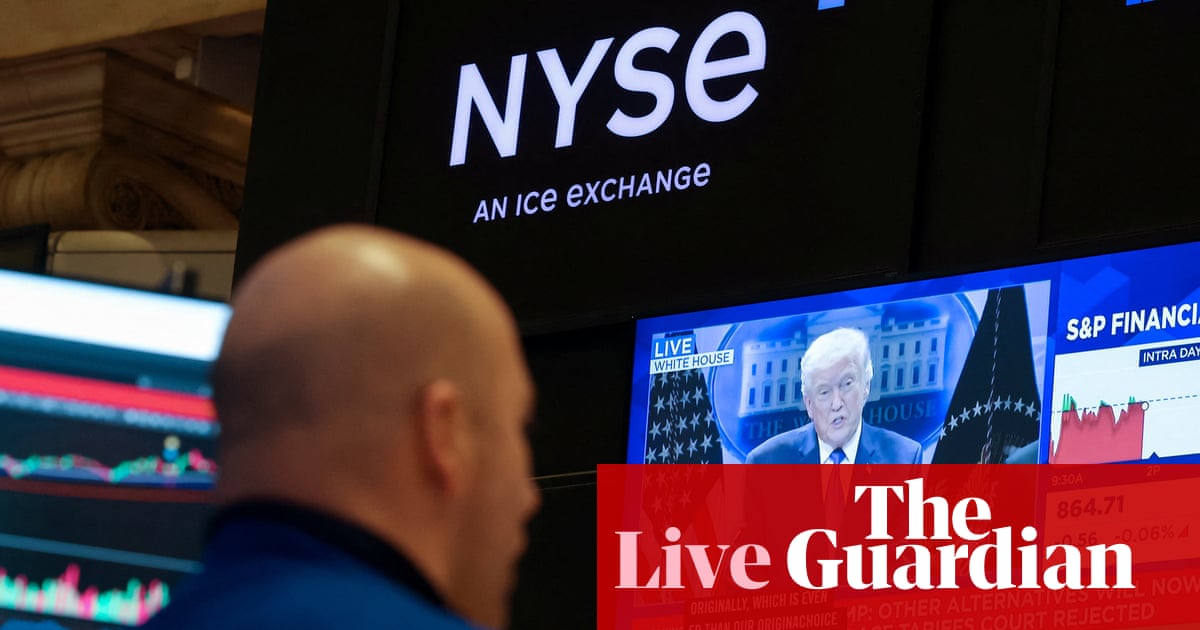
Confusion reigns in UK and EU over 15% tariff Lisa O’Carroll
Confusion continues as to whether Donald Trump’s new 15% tariffs kick in tomorrow in the UK or the European Union, despite the US trade representative Jamieson Greer’s assurances that nothing changes for the 20-odd countries the US has already agreed tariff deals with.
The new president of the British Chambers of Commerce, Andy Haldane, told the BBC he believed that the 15% tariffs did apply from tomorrow unless the government hears otherwise.
Haldane told the BBC Today programme:
double quotation mark“We are 10% [tariff rate with the US]. If he [Trump] follows through tomorrow, that will be 15% and that will mean UK sits towards the bottom the league table in terms of who’s been made worst off by the measures of the weekend.”
And the German confederation of businesses, BDI, called on the EU to “quickly approach the US and provide clarity on tariffs and trade rules”.
With European stock markets down today, and analysts warning of an ‘unholy mess’ of tariff confusion, BDI president Peter Leibinger said:
double quotation mark“These decisions create significant new uncertainty for transatlantic trade. Businesses on both sides of the Atlantic urgently need planning certainty and reliable trading conditions.
The EU, with the support of the German government, should quickly approach the United States and provide clarity on tariffs and trade rules. Only through dialogue can transparency be established and trust in transatlantic economic relations be secured.”
On Sunday Greer told CBS that the US will not back out of tariff deals it has already sealed with countries around the world, including the UK, the EU, Japan, Switzerland and others.
“We want them to understand these deals are going to be good deals,” Greer said. “We’re going to stand by them. We expect our partners to stand by them.”
In a strongly worded statement, the EU called on the US not to walk back the July deal.
“A deal is a deal,” it said, adding:
double quotation mark“As the United States’ largest trading partner, the EU expects the US to honour its commitments.”
Updated at 05.34 EST
Key events
Show key events only
Please turn on JavaScript to use this feature
How Trump’s 15% tariff could disrupt UK supply chains
Potential shockwaves from Donald Trump’s global 15% U.S. tariff could disrupt UK supply chains overnight, warns Dr Jonathan Owens, senior lecturer in operations management and global supply chain expert at the University of Salford.
double quotation markIf implemented, a 15% tariff policy under Donald Trump could send immediate shockwaves through UK supply chains, despite the measures being imposed by the United States. The UK is tightly woven into global trade networks, and many British firms either export directly to the U.S. or supply critical components that feed into American markets. A sudden cost barrier of this scale would not be contained within U.S. borders and could ripple quickly across the Atlantic.
In the short term, higher U.S. import costs would likely suppress demand for UK goods, particularly in strategically vital sectors such as automotive manufacturing, aerospace, machinery, and pharmaceuticals. British suppliers embedded in transatlantic production lines could face abrupt order cancellations, forcing production cuts and leaving warehouses with unsold inventory. For smaller firms operating on thin margins, such disruption could quickly escalate into a cash-flow crisis.
The indirect fallout could be equally destabilising, Owens continues:
double quotation markCountries hit by falling U.S. demand may flood European markets with surplus goods, intensifying price competition and squeezing UK manufacturers. At the same time, currency volatility could surge, driving up hedging costs and injecting further unpredictability into procurement and pricing strategies.
Logistics networks would not escape unscathed, as shipping routes could be rapidly reconfigured as firms scramble to avoid tariff exposure. This could lead to port congestion, delivery delays, and rising freight costs.
While the long-term consequences would depend on political negotiations, the immediate impact would be clear: heightened uncertainty, mounting cost pressures, and a period of acute supply chain turbulence as UK businesses fight to remain resilient.
However, this could ultimately prove to be little more than a burst of political theatre, generating headlines rather than lasting economic damage. If the policy were short-lived, disruption to UK supply chains might be sharp but brief.
ShareConfusion reigns in UK and EU over 15% tariffLisa O’Carroll
Confusion continues as to whether Donald Trump’s new 15% tariffs kick in tomorrow in the UK or the European Union, despite the US trade representative Jamieson Greer’s assurances that nothing changes for the 20-odd countries the US has already agreed tariff deals with.
The new president of the British Chambers of Commerce, Andy Haldane, told the BBC he believed that the 15% tariffs did apply from tomorrow unless the government hears otherwise.
Haldane told the BBC Today programme:
double quotation mark“We are 10% [tariff rate with the US]. If he [Trump] follows through tomorrow, that will be 15% and that will mean UK sits towards the bottom the league table in terms of who’s been made worst off by the measures of the weekend.”
And the German confederation of businesses, BDI, called on the EU to “quickly approach the US and provide clarity on tariffs and trade rules”.
With European stock markets down today, and analysts warning of an ‘unholy mess’ of tariff confusion, BDI president Peter Leibinger said:
double quotation mark“These decisions create significant new uncertainty for transatlantic trade. Businesses on both sides of the Atlantic urgently need planning certainty and reliable trading conditions.
The EU, with the support of the German government, should quickly approach the United States and provide clarity on tariffs and trade rules. Only through dialogue can transparency be established and trust in transatlantic economic relations be secured.”
On Sunday Greer told CBS that the US will not back out of tariff deals it has already sealed with countries around the world, including the UK, the EU, Japan, Switzerland and others.
“We want them to understand these deals are going to be good deals,” Greer said. “We’re going to stand by them. We expect our partners to stand by them.”
In a strongly worded statement, the EU called on the US not to walk back the July deal.
“A deal is a deal,” it said, adding:
double quotation mark“As the United States’ largest trading partner, the EU expects the US to honour its commitments.”
Updated at 05.34 EST
Shares in Danish pharmaceutical firm Novo Nordisk are sliding, after it announced disappointing results from a key weight loss trial.
An 84-week trial of its CagriSema weight loss product found that it caused a smaller weight loss than a rival product, Eli Lilly’s tirzepatide (injectable Mounjaro).
People treated with CagriSema achieved a weight loss of 23.0% after 84 weeks compared to 25.5% with tirzepatide, Novo reported. As such, the trial did not achieve its primary endpoint of demonstrating non-inferiority on weight loss for CagriSema compared to tirzepatide.
CagriSema appeared to have a safe and well-tolerated profile; the most common adverse events were gastrointestinal, the company reports.
Novo’s shares are down 8.5%, as investors digest this setback.
But Martin Holst Lange, executive vice president, R&D and chief scientific officer at Novo Nordisk, has a positive take, saying:
double quotation mark“We are pleased with the weight loss of 23% for CagriSema in this open-label trial. CagriSema has the potential to be the first GLP-1/amylin-combination product to reach the market for people living with obesity, documenting that cagrilintide adds to the existing benefits of semaglutide and offers clinically meaningful additive weight loss effects superior to what has been observed with GLP-1 biology alone.
Based on the learnings from completed studies we look forward to the REDEFINE 11 readout, and the initiation of the higher-dose CagriSema trial, which are both designed to assess the full weight-loss potential of CagriSema.
ShareWhy rising trade uncertainty is bad news
Donald Trump has managed another blow to world trade, Professor Costas Milas of the University of Liverpool’s management school.
double quotation markA flat tariff rate of 15% seems, at face value, less confusing than multiple tariff rates. Nevertheless, this will apply for up to five months, after which, no exporter (or even importer) will know what to expect next. The main issue is that in anticipation of the mid-term elections towards the end of the year, and with US inflation (the Fed’s preferred measure) already at 2.9%, Trump might (or might not) be willing to lower tariffs from 15%.
The problem for the UK economy remains a significant one, not least because my recent paper shows that trade uncertainty, again on the rise, is a major driver of future GDP and CPI inflation developments…
The supreme court ruling against Donald Trump’s IEEPA tariffs is creating new cracks in the president’s “electoral-fiscal-trade” trilemma, says Grace Fan of City consultancy TS Lombard.
Fan writes:
double quotation markStill, Trump’s trilemma (electoral-fiscal-trade) – in a midterm election year in which Trump’s approval rating is tanking – means the great tariff reshuffle has just begun.
With the administration’s top priorities shaping up to be voters and jittery bond markets, look for the White House to dial down tariffs further on targeted consumer items this year to address the affordability crisis, while ratcheting up Sec. 232 (national security) and 301 (“unfair” trade) tariffs to plug the IEEPA tariff revenue hole with Sec. 122 set to expire in August.
Likely losers are select industrial sectors, with the burden falling on both US importers and across core trading partners (USMCA, Asia, EU).
Photograph: TS LombardShareDoug Gurr selected as preferred candidate to chair CMA
Former Amazon boss Doug Gurr has been named as the preferred candidate to chair Britain’s competition watchdog, despite criticism of his appointment as interim chair a year ago.
Business secretary Peter Kyle has announced that Gurr is his choice of candidate to continue as chair of the Competition and Markets Authority (CMA), “following an open competition for the role”.
Kyle said the CMA has been playing a key role delivering the government’s pro-growth agenda under Gurr’s leadership since last January. He was appointed interim chair in early 2025, after the government grew frustrated that the CMA was not doing enough to support growth, and forced out its chair, Marcus Bokkerink.
Gurr’s appointment as interim chair was controversial, though; it was called a “slap in the face to workers” by trade unions and Trumpian by consumer activists. It prompted fears that the CMA would wave through business deals without the necessary scrutiny, if bosses could claim they’d be good for growth.
Financial markets are being being “rattled by fresh trade uncertainty”, reports Susannah Streeter, chief investment strategist at Wealth Club:
double quotation mark“The rip-roaring performance of the Footsie has been interrupted as fresh trade chaos mars the party. The exuberance that flashed over global markets after the US Supreme Court rejected Trump’s tariffs as unconstitutional is evaporating.
The President is using a backdoor via the Trade Act to reimpose temporary blanket tariffs of 10% and has threatened to increase the rate to 15%. Bilateral deals reached through tortuous negotiations have been thrown up in the air again, creating a cloud of uncertainty. Countries are already preparing to retaliate, with the European Union looking set to halt the ratification of a deal with the US and India also postponing its negotiations to finalise an agreement.
Instead of taking a big step forward, global trade has taken two steps back. Companies are having to plan multiple scenarios, and future revenue streams are harder to map when the ground keeps shifting.
ShareUnicredit: Tariff uncertainty is back
Despite the heightened uncertainty, the supreme court ruling gives Trump “an off ramp from his tariff intensive strategy ahead of the midterm elections”, argues analysts at Unicredit.
Unicredit told clients this morning:
double quotation markLast Friday, the US Supreme Court ruled, in a 6-3 decision, that the tariffs US President Donald Trump enacted under the International Emergency Economic Powers Act (IEEPA) are illegal.
This covers around 70% of all additional tariffs Trump has imposed during his second term, including the so-called “reciprocal” tariffs on almost all countries that were announced on “Liberation Day” and additional tariffs on Mexico, Canada and China related to illegal fentanyl.
The Trump administration responded over the weekend – invoking Section 122 of the Trade Act of 1974 by declaring a balance of payments crisis to impose a 15% tariff on almost all countries that will last 150 days, unless Congress decides to extend it, which seems unlikely.
The new tariffs exclude certain critical minerals, pharmaceuticals, USMCA-compliant goods from Canada and Mexico (which are covered by a free trade agreement), and those sectors subject to tariffs under Section 232 of the Trade Expansion Act of 1962 (e.g. cars, steel and aluminium).
A chart showing the various US tariff rates Photograph: UnicreditShare
Manufacturers are among the fallers on Germany’s DAX stock index this morning.
Carmaker BMW’s shares are down 1.4%, Daimler Truck has dropped by 1.1% and Airbus has lost 1%.
The Dutch market is also lower, pulling Amsterdam’s AEX index down by 0.4%.
ShareGerman and French stock markets fall amid ‘unholy mess’ of tariffs
France and Germany’s stock markets have been hit by US trade uncertainty too.
In Frankfurt, the DAX index has dropped by 0.6%, as traders fret that Europe’s trade deal with the US may unravel.
France’s CAC 40 index is starting the new week in the red too, dipping by 0.35%.
Richard Hunter, head of markets at interactive investor, says:
double quotation markTariff developments have turned the situation into an unholy mess, prompting far more questions than answers. After the Supreme Court ruled against the President’s tariffs, the implications are far from clear. No reference was apparently made in the ruling as to whether the monies raised from tariffs so far would need to be repaid and, even if this is the case, whether the refunds would go to companies or the ultimate customer who will have suffered higher prices.
To further compound the confusion, the President immediately invoked a different Act and announced that he would impose a blanket 10% global tariff, which he raised to 15% the following day. This brings another level of uncertainty given the trade deals which are already in place, although spokespeople from the White House implied that these would remain in place, which seems to contradict the Supreme Court ruling.
Updated at 03.53 EST