
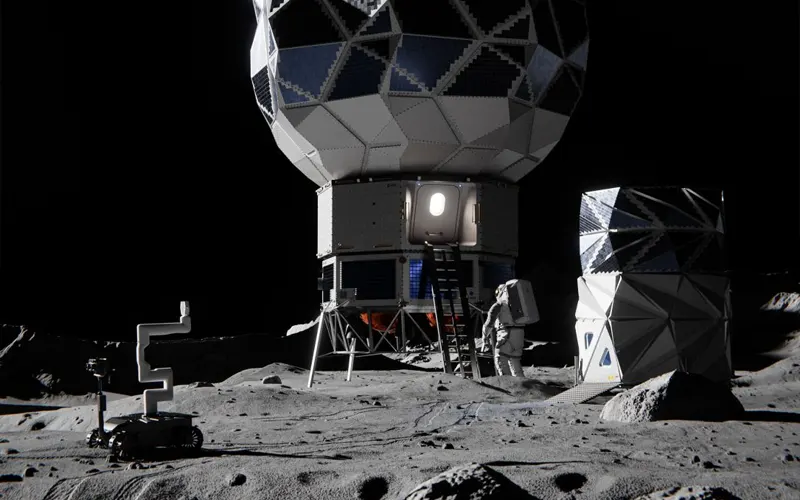
 Credit: SAGA Space Architects
The European Space Agency (ESA) has awarded a pair of contracts for studies focused on lunar habitat concepts that could support future operations on the surface of the Moon.
In late 2024, ESA issued a request for proposals for its Lunar Remote Camp study initiative. The programme aims to advance the early development of a “deployable protective unit” designed to protect robotic equipment, provide essential services, and, in future iterations, support short-duration human missions on the lunar surface. According to the agency’s call, the shelters would augment the capabilities of larger installations such as Artemis Base Camp, the Human Landing System, and the Multi-Purpose Habitat being developed by Thales Alenia Space under an Italian Space Agency (ASI) contract.
On 20 February, Copenhagen-based SAGA Space Architects announced that it had been selected to lead one of the two parallel studies. The company is heading up a consortium that includes The Exploration Company and Space Applications Services. According to ESA, the second contract is expected to be announced this week.
In an email to European Spaceflight, ESA’s Future Preparations Group Leader Didier Schmitt explained that the overall budget for the two studies is “quite low” and is being drawn from funds contributed at the agency’s Ministerial Council meeting in 2022. While the exact award to each consortium is not known, the Invitation to Tender states that the maximum budget for each study is €200,000, with an option for an additional €50,000 to support early de-risking for a subsequent phase.
The studies will examine use cases, consider available landing options, define subsystems, outline future evolutions of the crewed system, and explore communication options, including the agency’s Moonlight system, which aims to provide navigation and communications services for missions on and around the Moon. Finally, teams will be required to provide a comprehensive roadmap for further development, including potential demonstrators.
According to Schmitt, the two parallel studies are expected to be completed at the end of 2026. Any further development “will depend on the willingness of Member States to continue the study work in 2027 and beyond.”
Keep European Spaceflight Independent
Your donation will help European Spaceflight to continue digging into the stories others miss. Every euro keeps our reporting alive.