
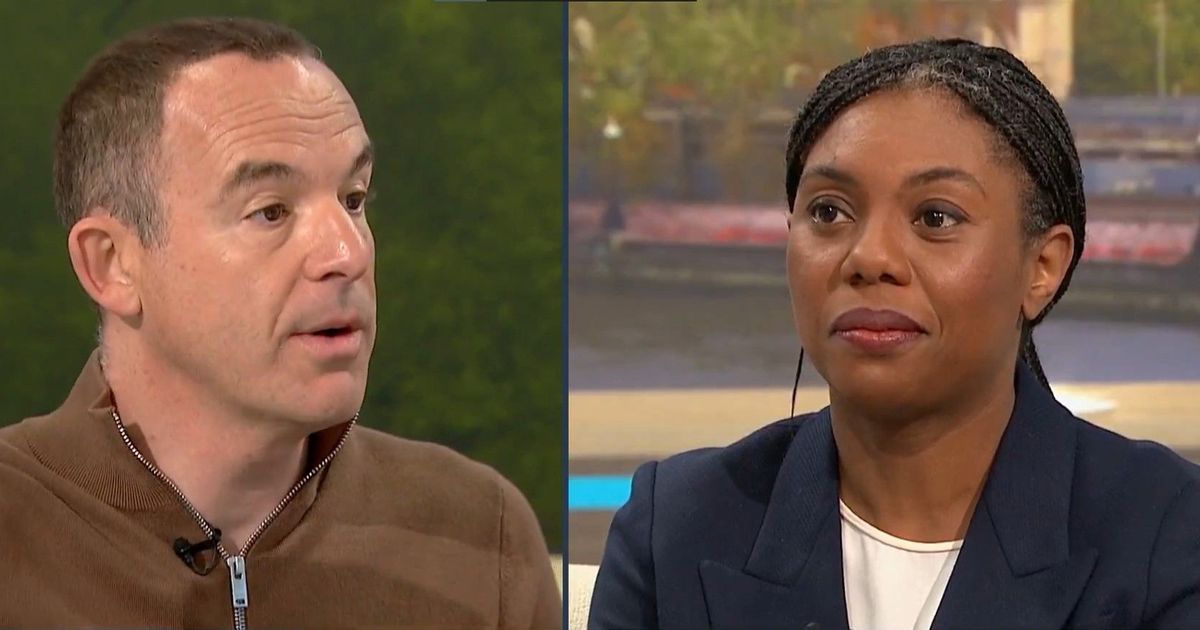
The confrontation was on Good Morning Britain, where the Money Saving Expert Martin Lewis confronted the Conservative leader Kemi Badenoch
The pair were discussing the controversial student loan system(Image: GMB/ITV)
In a shocking and passionate display, Martin Lewis walked onto the set where Conservative leader Kemi Badenoch was being interviewed, to take her to task on her proposals for plan 2 student loans. The Conservative – Lib Dem coalition government introduced Plan 2 loans in 2012 and tripled tuition fees to up to £9,000 a year.
Badenoch appeared on Good Morning Britain earlier today, speaking with presenters Ed Balls and Susanna Reid before the show’s money expert Martin Lewis appeared suddenly, saying, “If you want to help the middle-earning students, the most important thing is the repayment threshold should have been increased.”
Badenoch hit back: “Martin, this is exactly why young people are suffering. We’ve got lots of people who have finished university, where they didn’t have to pay fees, didn’t have to take out loans, and now you’re all saying nothing can be done. I’m the first person who’s even tried to solve this problem.”
Lewis interrupted her to say, “Shall we have a chat about it because I think you’ve got the right idea, but this is not a solution that will help middle and lower-earning students.”
The Tory leader defended, “I want to make sure that those young people who are paying and paying and their debt is not going down get a relief. If you think there’s a better offer, let’s look at it. But what’s made the difference now is that in her Budget, Rachel Reeves increased the number of people getting in because the threshold has been frozen. I don’t think this is fair.”
This is in reference to the controversial decision in the Budget to increase the fiscal drag on university graduates. By freezing the threshold of annual income people have to earn before having to repay, as wages increase through inflation, this means more people will be forced to repay the loans while barely making a dent in the interest. The threshold will increase in April to £29,385 per year, and stay at that figure for 3 years.
Badenoch continued, “The whole student loan system is not working properly, someone has to do something. And the thing that shocks me is the minute I say ‘let’s do something’, everyone says ‘oh no no no, this in not right’. We are going round in circles.”
But Lewis told her: “If you have a billion pounds to help students, the most direct thing that would help all students would be not freezing the repayment threshold, it would be increasing the repayment threshold.”
Many university graduates who had to take on plan 2 student loans are left with bills that increase each year, despite many paying in thousands, due to the high interest rate of up to 6.2%. Students who attended university in England or Wales between September 2012 and July 2023 have been left with unmanageable debt, with many imploring the current Labour government to reconsider the decision to freeze the repayment threshold for some borrowers.
Kemi Badenoch’s solution is a counter to the Labour proposal, a softening on the policy her party helped introduce. However, Lewis argues that if the politician is going to do something, it should have a tangible impact on the graduates who are suffering most from the debt.
Martin Lewis has been particularly passionate about this topic, speaking about it frequently on his social channels. Just this morning, he published that Kemi Badenoch’s proposal to reduce the burden on graduates by cutting the interest rate is simply “too late for most”.
He said the Conservative proposal to soften their own policy introduced over a decade ago was, “while psychologically appealing, won’t reduce by a penny the amount lower and middle-earning graduates repay.”
He added in a later post that the current Labour proposal to freeze the income threshold before people need to repay “hits lower and middle-earning graduates the hardest. They will end up repaying, at a guesstimate, £300/yr more due to it and do so for the rest of their loan’s 30yr life. While the highest earners will pay more each year too, at least for them it’ll mean they’ll clear the loan earlier so repay less interest.”