

Ryan Bushell, chief executive officer and portfolio manager at Newhaven Asset Management, joins BNN Bloomberg to discuss headwinds in the markets this week.
Canadian markets could be in for a volatile stretch as investors digest weaker U.S. GDP, persistent inflation and renewed tariff uncertainty.
BNN Bloomberg spoke with Ryan Bushell, CEO and portfolio manager at Newhaven Asset Management, who said shifting trade policy, rising oil prices and heavy concentration in technology stocks could amplify swings in risk appetite, while energy and infrastructure assets continue to attract capital.
Key TakeawaysWeaker-than-expected U.S. GDP and firmer inflation raise concerns about a potential stagflationary backdrop for equities.Rapid shifts in U.S. tariff policy, including a proposed 15 per cent across-the-board levy, are adding to business and investor uncertainty.Capital is rotating from high-multiple technology stocks toward tangible assets such as utilities, pipelines and infrastructure.Energy remains supported by rising oil prices, which could also complicate the inflation outlook.Unit shares of Brookfield Infrastructure and Brookfield Renewable have outperformed their corporate counterparts since Jan. 20, reflecting narrowing valuation gaps.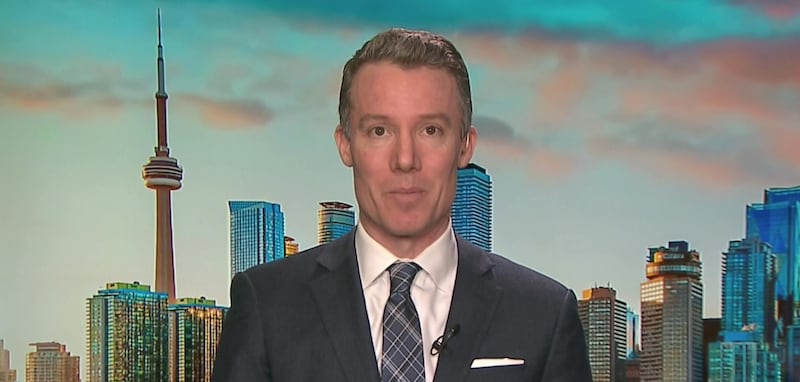 Ryan Bushell, chief executive officer and portfolio manager at Newhaven Asset Management Ryan Bushell, chief executive officer and portfolio manager at Newhaven Asset Management
Read the full transcript below:
ANDREW: Markets held up okay on Friday, even though U.S. GDP growth was weak and inflation persistent. Our guest says, though, that pressures are building with soft economic data, particularly south of the border, and uncertainty around tariffs. Let’s get more from Ryan Bushell, CEO and portfolio manager at Newhaven Asset Management. Ryan, thanks very much for joining us.
RYAN: Thanks for having me, Andy.
ANDREW: Start off with the U.S. economy. I mean, we’ve heard that it’s doing fine. There are no signs of big cracks, but you say there are some clouds here?
RYAN: Well, I was just sort of surprised on Friday to see weaker-than-expected economic data, GDP coming in at half what the expectation was. Now, some of that was related to the government shutdown, but regardless, the fourth-quarter blowout numbers we saw don’t appear to be repeating themselves. And so that, combined with a higher inflation number, is a scary prospect for markets. A stagflationary scenario is something nobody wants to see.
Then you combine that with the fact that the tariff ruling — I mean, we just got adjusted to these tariffs, now they’re, in theory, maybe being taken off. What does that do to the U.S. fiscal situation? Or potentially even being ramped up now, with what Donald Trump has done over the weekend, saying we’re putting in a 15 per cent tariff across the board. It started at 10 per cent, went to 15 per cent before markets opened. So quickly changing circumstances are not something anybody in business wants to see, and that’s what we’ve been dealing with for over a year. We just finally got to kind of a new normal, and now it’s being shaken up again. So all of those things point to uncertainty for me.
The other thing that’s happening is oil prices are back on the rise, and so that flows through to the inflation side of things as well. So a lot of crosscurrents now to be keeping track of.
ANDREW: What is your broad strategy? Are there areas of the market that you’re avoiding right now, Ryan, or underweighting?
RYAN: Yeah. So, I mean, anybody who understands the way we invest money knows that we are not tech investors. As that has been under pressure in the last few months, our type of portfolio has benefited. We’ve seen money flowing broadly out of the U.S. to anywhere but. So the performance in emerging markets and other tertiary markets like Canada — money seems to be flowing from, call it the digital space, the digital economy, back to the real economy.
So tangible assets, utilities, infrastructure, pipelines — all of those companies, we’ve seen massive moves, which we’re happy to see. We were investors in those when people were eschewing them. So it’s nice for us to see that come back around our way. And we think that this move could continue. Any sort of broader turmoil in markets — we still have huge concentration in technology, we still have higher multiples in technology — so any continued rebalancing of that, or any market panic, we would think is likely to be concentrated in that area, to the benefit of tangible infrastructure assets like the ones we own.
ANDREW: Broadly, how are you playing the excitement over copper? Do you feel that’s overplayed, Ryan, at this stage?
RYAN: It’s hard, right? I would like to have more exposure to base metals. It’s hard for us, as a conservative dividend investor, to find the right vehicle. You can buy the big miners, the BHPs, the Rios, but you’re not getting that pure exposure. And then on the smaller companies, as we’ve seen in places like Mexico and South America and Africa, there are geopolitical risks in securing that production.
So I think the hype is somewhat overblown. You also have this factor of China’s inventories and stockpiling, and how much they’re going to restrict output, because they refine the bulk of the copper in the world. So again, a lot of crosscurrents in that space.
We prefer to own the end-use product, which is going into utility-based infrastructure. It is going into electrification and construction, which we own a part of. So we’re not directly in that space, but it is worth watching. And for those that are there in a big way, you’re seeing, again, money flow from the digital economy to the real economy benefiting base metals and, obviously, gold as well.
ANDREW: You have an interesting trade idea here. Brookfield Infrastructure trades as units, BIP.UN, and Brookfield Renewable trades as BEP.UN. Now, the company, known for its convoluted structure, has also issued common shares that are the equivalent. I think part of it is to help some investors with tax planning, but you say that the units in both outfits are trading at a discount to the corporate shares.
RYAN: Yeah, material discounts. So I was on Jan. 20, and I just went back to that date and looked at the moves in both the unit trust structures versus the corporate structures. Again, the corporate structures, BIPC and BEPC, which trade on both New York and Toronto, are there to service the institutional investing community that can’t own a Bermuda-based limited partnership for governance reasons.
So the way they got around that was to offer it in a corporate structure, which is basically a fund that holds the units. So it’s the exact same underlying assets. And those premiums for the corporate structures over the unit trusts had blown out in January. Brookfield themselves came out with an at-the-market equity issuance program of the corporate units to buy the undervalued trust units.
So as a Canadian investor, where you can buy those trust units, still get dividend treatment — the full treatment — in your RRSP or TFSA, where you don’t have to worry about the different tax treatment in your taxable account, we think it’s a very good trade. Now, we’re not in it for the trade. We just think for our clients, if we can buy the exact same company with a three-quarters of a per cent higher yield, that’s going to do us well over time, and we’ve seen that.
So since Jan. 20, both unit trust structures have outperformed the corporate structures almost two to one. So it’s about 12 and a half per cent for the BEP units relative to the corporate units, up about seven per cent, and about 11 and a half per cent for the BIP units versus the corporate units, up about six per cent. So not bad for a month’s performance.
ANDREW: And just finally, Telus raised eyebrows by appointing a former boss of CIBC as its new CEO. You welcome that move? You think it’s plausible?
RYAN: I think it’s fantastic. When I heard that news, when Rebecca and I were talking about it in the morning and she said, “You’ll never guess who the new CEO of Telus is.” I started thinking about different people. I said, “Is it a telecom person?” She said, “No.” I said, “Is it Victor Dodig?” And she said, “Yes.” And I said, “Wow, that is best-case scenario.”
Victor did an amazing job at CIBC, turned a bank around that really didn’t have an identity, was struggling on the consumer side and really brought a cultural shift to that bank and strong earnings performance. So that’s all you want to see.
Telus is in exactly the same position now — different set of circumstances — and not to disparage anything Darren Entwistle has done over his long tenure at Telus, but they were in need of a refresh. They were in need of a cultural shift, and they’re in need of a leader that I think can bring this company forward into a new set of circumstances for the telecom sector in Canada, as the technology behind it changes as well. So I’m really positive on this move.
A lot of these former bank CEOs usually stay on the board and are still active in companies, but for him to actually take on the CEO role and put himself in the hot seat, I think that speaks volumes. I’m very positive on people who can lead culture.
ANDREW: Thank you very much, Ryan. Ryan Bushell, CEO and portfolio manager at Newhaven Asset Management.
—
This BNN Bloomberg summary and transcript of the Feb. 23, 2026 interview with Ryan Bushell are published with the assistance of AI. Original research, interview questions and added context was created by BNN Bloomberg journalists. An editor also reviewed this material before it was published to ensure its accuracy and adherence with BNN Bloomberg editorial policies and standards.