
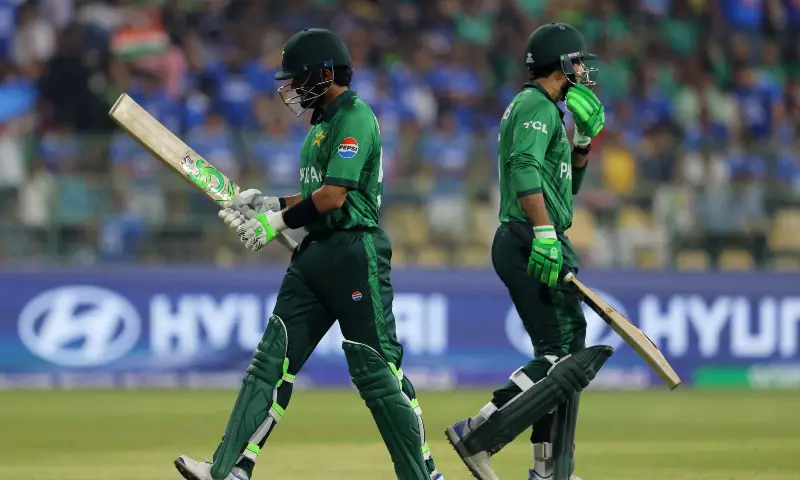
There are no cheat-codes to revert to at this level of the tournament. No shortcuts or calculations. If Pakistan wants to mix things up at this level, it must make sure they subsequently match.
In Ashutosh Gowariker’s Lagaan, most of the narratives are underpinned on an impossibility. It should not be possible for the villagers to beat the British — it is not their sport to begin with, and so the team of uninitiated villagers they assemble is haphazard, the equipment they use is makeshift.
They had some tricks up their sleeve though — the type of craftsmanship in sport that can only truly be borne by people who haven’t been indoctrinated by the rules. An enigmatic captain, a mystery spinner in Kachra whose bowling action kept the British confused.
But despite the zeal and the hours of training and the quirks of everyone involved, beating the British cavalry required a lot more than good cricket — it required not just this band of mismatched players to play out of their skins, but also for a certain level of divine intervention for things to go right.
First-timers?
Pakistan’s showing against India on the 15th of February was abysmal. The disparity when it comes to skill between the two sides, while not insurmountable, is still sizeable — so much so that Pakistan needed to be a livewire buzzing at a 100 per cent if they wanted to compete at any substantial level. Which they did not do.
It is disingenuous to compare Pakistan to a band of people playing cricket for the first time, even if the opposition was, fittingly, a side with both superior skill and institutional leverage. But at points, it did feel like the team that showed up to play against India was playing the sport for the first time.
When you know a side is better than you, you need to do absolutely everything right. Pakistan did not. The bowling was wayward and inconsistent, even from the likes of Abrar Ahmed, who are less susceptible to the waywardness than others. And even though fans have come to expect the batting to be as predictably fragile as it was, the state of affairs against India was particularly bad.
Pakistan’s Babar Azam is bowled out by India’s Axar Patel at the ICC Men’s T20 World Cup 2026 India v Pakistan match at the R. Premadasa International Cricket Stadium, Colombo, Sri Lanka on February 15, 2026. — Reuters
(It should be noted that like the team of villagers, Pakistan did have a mystery spinner that batters typically struggle to read, but the ‘outperforming expectations’ comparison ends here).
In the team’s defence, Pakistan’s loss against India was massive and discouraging, but it wasn’t all-conclusive. A win against Namibia — which did end up coming — would secure them a spot in the next round, which it did.
Pakistan beat Namibia by over a 100 runs, riding on the back of a clinical century by Sahibzada Farhan, making him only the second Pakistani to score one in a Men’s T20 World Cup. The bowling was sufficiently potent as well, with Usman Tariq claiming four wickets in a fielding effort that bundled the opposition out at a double digits score.
The Namibia match, however, while sufficiently convincing, made one thing clear — that the Pakistan cricket team might still be operating as a mix-and-matched unit well into the tournament.
The shuffle
Pakistan’s XI against Namibia had a gaping Abrar Ahmed shaped hole. While his figures in the match against India were a dismal wicketless 38 runs conceded in his three overs, it is important to note that out of all unfortunate performances in the India match, his was the most anomalous. Since the start of 2025, Abrar has averaged 18 with the ball in T20 international cricket, with standout performances in the Asia Cup and the series preceding the World Cup.
The matter of Babar Azam’s batting position was also one of the match’s major talking points, with him being moved down the order and eventually not needing to bat, as Pakistan put up a score of 199-3.
“I think Babar is well aware that his strike rate in the power play in the World Cup is less than 100 and that’s clearly not the role we think we need,” said coach Mike Hesson after Pakistan’s final practice session before the team’s first Super 8 fixture was washed out last Friday. According to his explanation, the situation the team found themselves in didn’t warrant the specific (anchoring, conservative) role that Babar finds himself in the team to fulfill.
Pakistan’s Mohammad Nawaz (R) celebrates with wicketkeeper Usman Khan after taking the wicket of Namibia’s Louren Steenkamp during the 2026 ICC Men’s T20 Cricket World Cup group stage match between Pakistan and Namibia at the Sinhalese Sports Club (SSC) Ground in Colombo on February 18, 2026. — AFP
Pakistan’s first Super 8 fixture against New Zealand fell victim to Colombo’s rain (as has much of Pakistan cricket, in retrospect).
What was concerning about the match that was not, however, was that Pakistan’s pre-game decision-making was questionable at best.
Decisions, decisions
Abrar was not brought back into the side, dispelling the possibility that his exclusion in the playing XI against Namibia was possibly to rest or rotate him, and that it was potentially a performance-based decision for his bad showing against India. This does not bode particularly well for the management, as it could be seen as a possible overreaction to a bad day from a bowler who has generally, for all intents and purposes, been excellent.
Another change that Pakistan made in the XI was to bring in Fakhar Zaman for Khawaja Nafay, who got his World Cup debut against Namibia, falling for a pedestrian 5 runs off 5 balls that did not necessarily sustain the promise of the glorious backfoot punch for 4 that he began his innings with.
While this Pakistan side under Salman Ali Agha’s captaincy and Hesson’s management has been more proactive tactically than its predecessors, this indecisiveness and the nature of these decisions makes one wonder how much confidence is inspired in the players through them.
Added to these was Pakistan’s decision to bat first at the toss, a questionable one considering the fact it is usually a wiser decision to opt to chase in a potential rain-affected game, keeping in mind possible DLS equations. Thankfully, to Pakistan’s benefit, the team drew a possible get-out-of-jail card with the match being washed out, and the consequences of what could have proven to be selection blunders never manifested.
Of course, it should be said that all of this critique comes from the vantage point of the viewer and fan — people who can never be fully sure of a team’s motives and working logics when it comes to strategy and tact. It is entirely possible that the choices made before the match would have been successful during it, should it have happened.
It is always a good idea for a fan to trust the process when it comes to supporting their team in an international tournament, mostly because a World Cup signifies a phase in a team’s metamorphosis where there isn’t much room for interpretation. At that point, all a team has to do is win, and all a fan has to do is watch.
The uncertainty of it all
That being said, what is unsettling about Pakistan’s run of form as they gear up to face England today, in what will hopefully be their first unblemished Super 8 Fixture, is the tepid sense of uncertainty that has threaded through it.
There is speculation that an out-of-form Shaheen Shah Afridi might be replacing the in-form Salman Mirza, or maybe even the phenomenal Usman Tariq. There are passionate calls for Babar to be replaced by Nafay, and the fact that Naseem Shah is yet to play a game in this tournament is not forgotten by fans, and neither are the two unconvincing toss decisions against India and New Zealand.
One might thus be compelled to compare Pakistan to at least a video game character that has made it this far in the game partially through skill but partially through hacking and bypassing the system, if not to a group of untrained villagers organising to defeat their colonial superiors.
But as Pakistan gears up to face the actual, 21st century British team, there are no cheat-codes to revert to at this level of the tournament. No shortcuts or calculations that could see Pakistan home. With a possible point lost to a wash-out already, Pakistan’s remaining fixtures are must-wins. If Pakistan wants to mix things up at this level, it must make sure that they subsequently match.
I still contend that the analogy to a sport-less village is still disingenuous for a team of the calibre I know Pakistan is capable of harbouring. But maybe it takes a village to win a World Cup.