
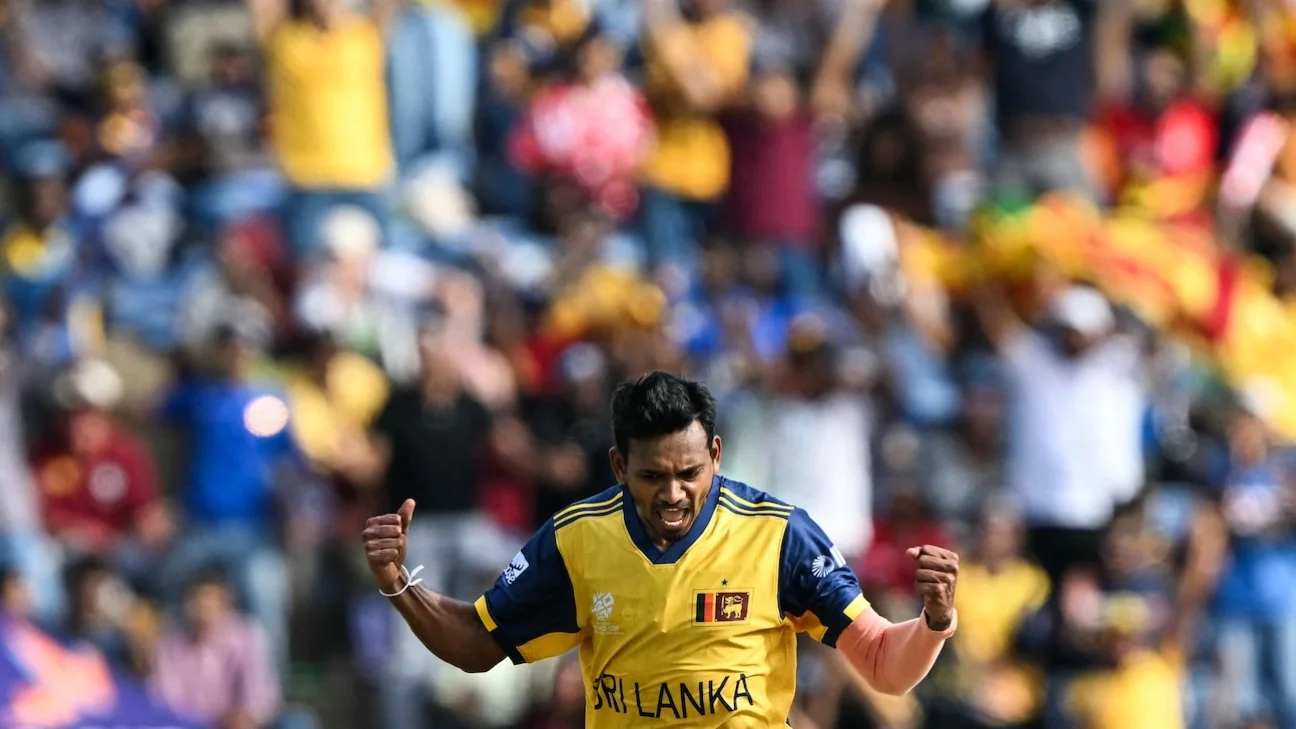
The scene in Pallekele was a familiar one for those of Sri Lankan persuasion, in fact probably one they wished they might have seen more frequently over the years: a lanky figure – perhaps one with a touch more muscle now than in the past – sprinting rhythmically towards the crease, that open-chested silhouette discernible even at a distance, the biomechanics tidy as ever, and the seam of the ball bolt upright like a student suddenly noticing the arrival of their headmaster.
No elaborate pauses, no 45-degree slinging releases, no awkward hyper-extended elbows, nothing at all really to try and put off the batter by way of any sort of unorthodoxy. It’s in fact a deceptively straightforward proposition: run in, bowl quick, bowl accurate.
The outcome, though, is anything but. This one has swung in sharply off a good length, and Ben Duckett is sweating. While the umpire remains unmoved, Dushmantha Chameera is convinced, and that conviction sways Dasun Shanaka, his skipper. The three reds of vindication arrive swiftly; this is destined for the top of middle stump, and England are one down after just two deliveries.
Less than 90 minutes later, Chameera is hurtling in again. This time it’s full and wide, but right on the margins. Sam Curran is looking to power it over cover but finds the grateful hands of deep third instead. The innings comes to a close, Sri Lanka pleased with a job well done. Chameera too walks off – 11 years, give or take a week, since he first turned out in Sri Lankan colours – with the match ball. He has just claimed his maiden five-wicket haul in T20I, finishing with figures of 5 for 24.
It was a spell – a week out of a World Cup – that reminded the world why, even at 34, he remains Sri Lanka’s most lethal fast-bowling weapon. Yet, for every moment like this, there is the shadow of the physio’s table that has defined much of his career – and the gnawing undercurrent of what could have been.
The narrative of Chameera’s career is inseparable from his medical file. From stress fractures in his lower back in 2016 to ankle and calf surgeries following an injury-shortened 2022 T20 World Cup, he has spent more time in rehabilitation than most of his contemporaries. As recently as July 2024, a respiratory infection forced him out of a major series against India, while he suffered a quadriceps injury in that same year.
But what makes Chameera a luxury Sri Lanka cannot do without is his remarkable consistency when returning from these untimely layoffs. He is the quintessential plug-and-play option; a cricketing T-1000, who, for every career setback, somehow manages to rebuild his liquid metal frame to re-emerge seemingly unscathed.
In June 2023, returning from a nine-month absence, he picked up figures of 2 for 18 in an ODI against Afghanistan, following it up with 4 for 63 in the next game. In July 2025, after more than a year out due to injury, he returned in a series against Bangladesh, again slipping back seamlessly with figures of 1 for 37 and 3 for 51, and instantly reclaimed his spot as the team’s leading seamer.

Dushmantha Chameera struck inside the powerplay against Australia•Getty Images
And Chameera’s most recent T20 form has been as abiding a testament as ever of his ability to simply never miss a beat. Despite a career defined by interruptions, he has maintained a strike rate of 18.3 in T20Is, but his most recent 20-month absence has been followed by a stretch of 20 T20Is starting September. This period has fetched him 34 wickets – 38% of his total T20I scalps – at a quite preposterous strike rate of 13.3, and only twice has he gone wicketless.
His role in the ongoing World Cup has therefore unsurprisingly been pivotal; he spearheaded the attack in key wins against Australia and Oman, proving that his raw pace – often clocking over 145kph – has not diminished with age, defying what would otherwise be career-ending levels of wear and tear.
And lately, he’s even been plugging holes with his versatility; the injury to Wanindu Hasaranga robbed Sri Lanka of a potent weapon through the middle overs, so Chameera stepped in. Against England in their Super Eight game, he wasn’t introduced till the eighth over so as to help keep things quiet through the middle.
He has refined his craft too, moving beyond just raw speed to master dainty floaters and gripping cutters – when conditions suit, his legcutter gets more turn than most spinners’ legbreak. But more impressively, these are not age-mitigating adaptations; he still hits the deck hard and can frequently be found rushing batters with his unyielding pace.
And now, as Sri Lanka seek to make a first World Cup semi-final since 2014 – a year prior to his debut – Chameera stands not only as a senior statesman, but a survivor, whose body may be increasingly wrapped in the proverbial cotton wool, but whose defiant spirit serves as living proof that no setback is insurmountable.