
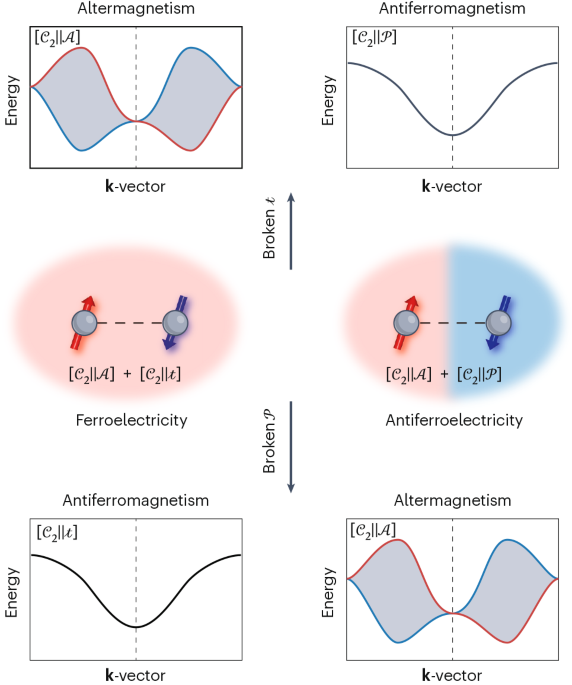
For collinear magnets, conventional antiferromagnets and altermagnets show similar compensated magnetic orders in real space; their key distinction lies in momentum space. Within the framework of non-relativistic spin space groups, spin and spatial degrees of freedom are decoupled and can be represented as \([{{\mathcal{R}}}_{i}{\rm{||}}{{\mathcal{R}}}_{j}]\), where the operations on either side of the double vertical bar denote spin and spatial symmetry operations, respectively. If the system’s Hamiltonian remains invariant under this symmetry, it transforms the energy eigenstates as \([{{\mathcal{R}}}_{i}{\rm{||}}{{\mathcal{R}}}_{j}]E(s,\)k\()=E({{\mathcal{R}}}_{i}\)s\(,{{\mathcal{R}}}_{j}\)k\()\). Furthermore, collinear magnets possess a \([{\bar{{\mathcal{C}}}}_{2}{\rm{||}}{\mathcal{T}}]\) symmetry. Here, \({\bar{{\mathcal{C}}}}_{2}\) represents the twofold rotation-inversion operation, and \({\mathcal{T}}\) denotes the time-reversal operation. This symmetry enforces the relation \(E(s,\)k\()=E(\)s\(,\)−k\()\).
The spin degeneracy in conventional antiferromagnets stems from symmetries that relate sublattices through translation (\({\mathcal{t}}\)) or spatial inversion (\({\mathcal{P}}\)) operations — although this connection is not explicitly accounted for in classical spin group theory. These symmetries, \([{{\mathcal{C}}}_{2}{||}{\mathcal{t}}]\) and \([{{\mathcal{C}}}_{2}{||}{\mathcal{P}}]\), involve twofold rotation (\({{\mathcal{C}}}_{2}\)) around an axis perpendicular to the collinear spin axis (thereby flipping the spin s), while \({\mathcal{P}}\) and \({\mathcal{t}}\) either reverse the wavevector k or leave it unchanged, respectively. The transformation properties of these symmetries are given by:
$$E\left(s,{\bf{k}}\right)=[{{\mathcal{C}}}_{2}{||}{\mathcal{t}}{\mathcal{]}}E\left(s,\,{\bf{k}}\right)=E\left(-s,\,{\bf{k}}\right)$$
(1)
$$E\left(s,\,{\bf{k}}\right)=[{\bar{{\mathcal{C}}}}_{2}{||}{\mathcal{T}}{\mathcal{]}}{\mathcal{[}}{{\mathcal{C}}}_{2}{||}{\mathcal{P}}{\mathcal{]}}E\left(s,\,{\bf{k}}\right)=E\left(-s,\,{\bf{k}}\right)$$
(2)
Thus, the system exhibits complete spin degeneracy at every k-point.
In contrast, altermagnetism exhibits momentum-dependent spin polarization with an alternating distribution in k-space. Its emergence requires the system to preserve specific rotational or mirror symmetries that couple spin-opposite sublattices, described by the symmetry relation:
$$E\left(s,{\bf{k}}\right)=[{{\mathcal{C}}}_{2}{||}{\mathcal{A}}]E\left(s,{\bf{k}}\right)=E\left(-s,{\mathcal{A}}{\bf{k}}\right),{\bf{k}}\,{{\ne }}\,{\mathcal{A}}{\bf{k}}$$
(3)
Here, \({\mathcal{A}}\) represents the set of symmetry operations satisfying altermagnetic constraints. Crucially, the system must break both \({\mathcal{P}}\) and \({\mathcal{t}}\) symmetries to lift spin degeneracy. Notably, in two-dimensional (2D) systems, \({{\mathcal{M}}}_{z}\) (mirror reflection along z axis) and \({{\mathcal{C}}}_{2z}\) (twofold rotation around the z axis) are functionally equivalent to \({\mathcal{P}}\) and \({\mathcal{t}}\), respectively. Therefore, the symmetry conditions for 2D altermagnetism demand the simultaneous absence of \({\mathcal{P}}\), \({\mathcal{t}}\), \({{\mathcal{M}}}_{z}\) and \({{\mathcal{C}}}_{2z}\) symmetries.