
Unlock the Editor’s Digest for free
Roula Khalaf, Editor of the FT, selects her favourite stories in this weekly newsletter.
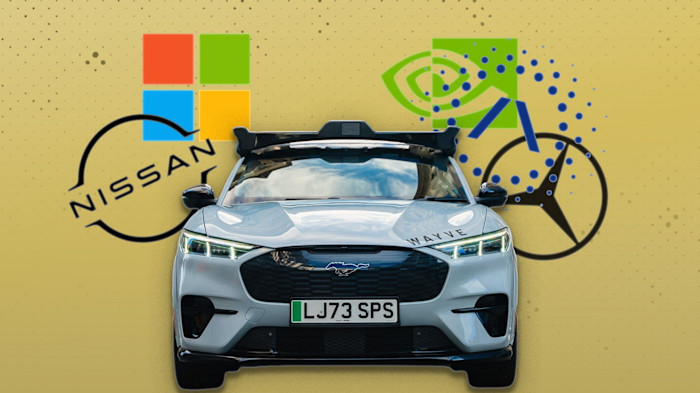
UK self-driving start-up Wayve has raised $1.2bn in new funding from investors including automakers Mercedes-Benz, Stellantis and Nissan, as it gears up to launch its first robotaxi service in London later this year.
The deal values London-based Wayve at $8.6bn, including the new funds, ranking it among the UK’s most valuable AI start-ups.
The round marks the first time that Wayve, founded in 2017, has raised capital from the automotive industry, after signing its first commercial partnership with Nissan last year.
The start-up said on Wednesday that Mercedes-Benz and Stellantis are exploring using Wayve’s autonomous driving systems, which can be used for both robotaxis and privately owned vehicles.
Existing investors Eclipse, Balderton and SoftBank Vision Fund 2 led Wayve’s latest round, alongside US tech groups Nvidia, Microsoft and Uber, bringing its total capital raised to $2.5bn.
“Wayve is moving from an R&D stage to a commercialisation phase,” Alex Kendall, Wayve’s co-founder and chief executive, told the FT.
 Alex Kendall, co-founder and chief executive, said: ‘Wayve is moving from an R&D stage to a commercialisation phase’ © Charlie Bibby/FT
“We’ve got the partnerships, the strategic support but also the capital we need to license software that’s going to be in vehicles that will be owned and operated for a decade plus. This continues to give us escape velocity to build this as an independent company.”
The financing comes as Wayve prepares for its first head-to-head battle with Alphabet-owned Waymo, the self-driving pioneer that raised $16bn at a $126bn valuation earlier this month. Both companies, alongside China’s Baidu, are expected to participate in the UK’s first robotaxi trials in London later this year.
Uber plans to invest in a fleet of robotaxis powered by Wayve’s software that will be deployed in 10 cities in multiple countries, including London. Its expanded alliance could unlock as much as $300mn in further investment into Wayve over the coming years, as Uber tries to ensure robotaxis become part of its service rather than a competitive threat.
Satya Nadella, Microsoft’s chief executive, said Wayve — which builds its AI systems using Nvidia chips running on Microsoft’s Azure cloud computing service — was “pushing the frontier of embodied AI”.
Wayve did not disclose how much each of its investors was contributing to the new round, but said last September that Nvidia was evaluating a $500mn strategic investment. Nvidia declined to comment.
In contrast to its much larger rivals Tesla and Waymo, which build their autonomous driving systems for specific vehicles and sensor equipment, Kendall argues that Wayve’s technology is “generalisable”, working in a wide range of different vehicles and urban environments.
He added that its software worked with automakers using non-Nvidia chips in their vehicles too, which helped Wayve to avoid being “pigeonholed to one manufacturer, one silicon, one use case or one mobility network”.
Recommended

Kendall predicted that Wayve’s “high-margin software model” could ultimately be a bigger business than companies like Tesla or Waymo that were “one manufacturer selling your own cars or running your own service with the high capex costs related to that”.
The first private vehicles using Wayve’s “AI driver” will go on sale next year, initially offering a more limited “hands-off” autonomous system that requires driver supervision. The company was talking to “every Western car maker who is not Tesla”, added Kendall.
Wayve’s fundraising comes as the car industry is struggling with both the financial and technological pressures to develop autonomous driving capabilities alongside deep-pocketed tech giants.
Analysts say one of the industry’s biggest fears is ending up building commodity hardware at thin margins for robotaxi operators.
Kendall said Wayve had taken a different approach of “collaboration” that he claimed would allay some of those concerns.
The start-up’s AI software can be adapted to existing hardware and software systems developed by carmakers or their suppliers, allowing them to choose their own sensors, design the “look and feel” of the vehicle and personalise the driving behaviour as well.
“The pressure is on the automotive industry right now and the ability to kill two birds with one stone — to invest with one autonomy integration that can service both consumer vehicles and robotaxis — is very attractive,” said Kendall.