
Published
February 23, 2026
Nearly 40 years ago, Melissa and Doug Bernstein started what would become a beloved, multimillion-dollar company, Melissa & Doug Toys.
Melissa, a 1987 Duke alumna, with husband Doug in 2013 created another meaningful venture: the Melissa and Doug Entrepreneurs program with Duke University’s Innovation & Entrepreneurship (Duke I&E).
Melissa & Doug Entrepreneurs is Duke’s premier program for student entrepreneurs. The highly selective, year-long, non-credit program is open to students who are actively building ventures and want to grow as effective founders.
“The program is for students who have started something real — and are looking to join a community of Duke’s top founders, focused on growing their ventures, accelerating their impact, and becoming exactly what their startup needs to succeed,” said Amy Linnane, managing director of co-curricular programs at Duke I&E.
Since its inception, 150 students have participated in the program. Forty-two of the ventures are still in operation, and more than “16 had exits,” Linnane said, meaning the ventures were acquired.
A diverse set of students from multiple Duke degree programs and class years are part of the 12-member, 2025-2026 cohort.
Graduate student Ewan Bradley points to the importance of the I&E network, whose members offer advice and connections to the student founders during one-on-one meetings. “I’ve met a bunch of different founders who … come from different business backgrounds and have different business ideas, but we have the shared (experience) of what it means to build your own thing, and to build your own startup to solve problems in society.”
The Melissa & Doug Entrepreneurs program supports students in other ways, including funding, mentorships, faculty expertise and an ecosystem where student entrepreneurs connect with their peers and form lasting friendships.
“(The program) is without a doubt, one of the most pivotal things I’ve ever experienced,” said senior Sydelle Bernstein, who is a daughter of Melissa and Doug, adding that it “gave me the most incredible community of other founders who have introduced me to their founder friends,” she said.
Junior Avihan Jain pointed to courses where he was assisted by “team members from the business school, from the graduate school and from the undergraduate school” who helped advance his business idea.
Damilola “Dami” Awofisayo, a senior, offered advice to students who are considering starting a new venture, with passion being key. “I would highly, highly say, don’t start a startup just for the sake of starting one.” She described the student founders as a “passionate community” whose zeal for their ventures fuels the journey from an idea to a sustainable product in the marketplace.
Playerbase
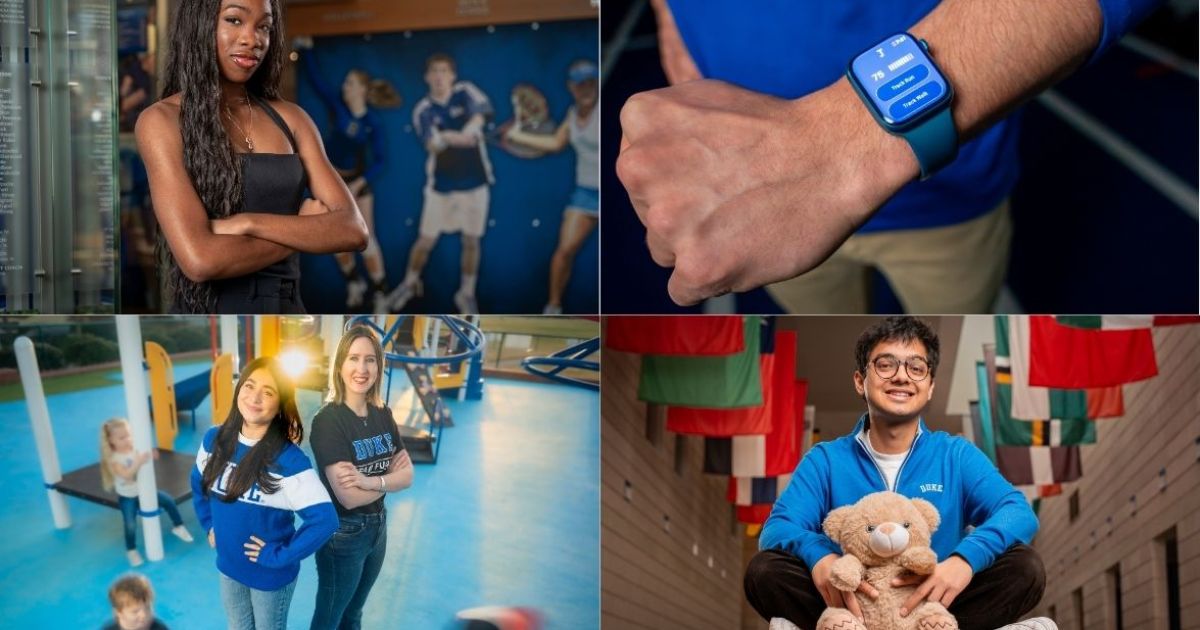
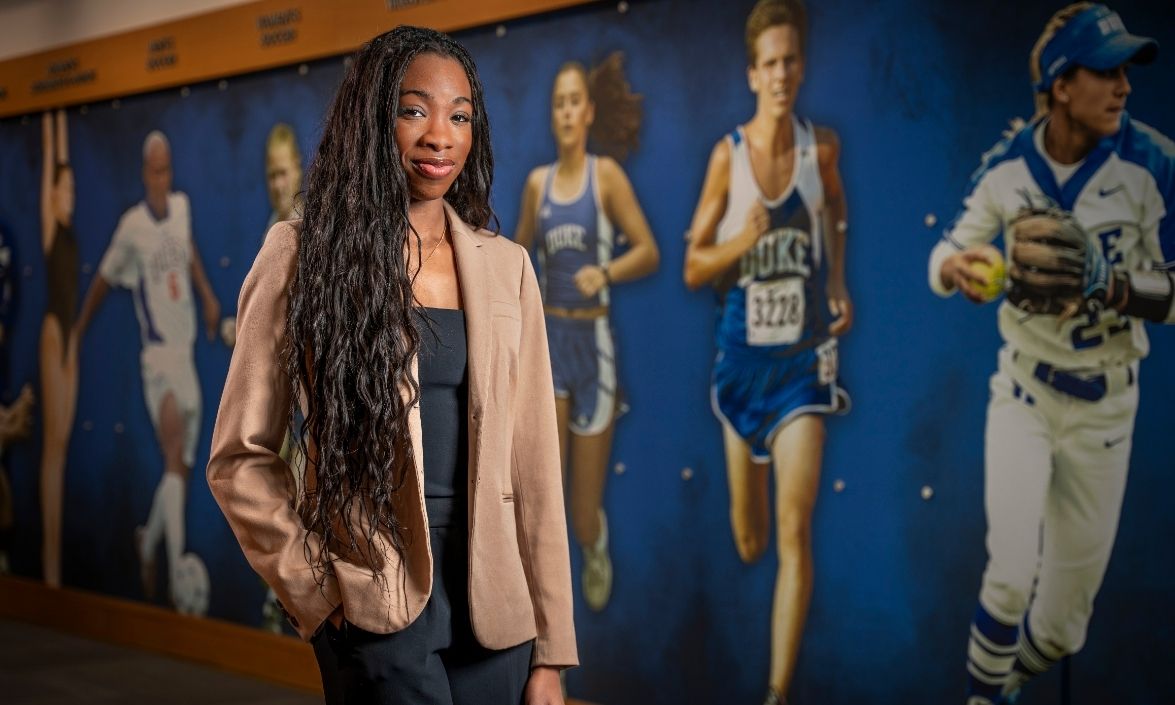 Playerbase co-founder Dami Awofisayo says the platform aims to help colleges with limited budgets recruit promising athletes.
Last year, at the beginning of the fall semester, Awofisayo, a computer science major, co-founded Playerbase, a platform that helps college coaches and recruiters identify promising high school athletes.
Awofisayo credits co-founder Marquist Allen, a graduate of Dartmouth College and member of the school’s football team, with the idea for Playerbase to address a recruiting system that hinders mid-major universities that may not have lucrative recruiting budgets.
The co-founders talked to college coaches for nearly a year and identified two issues, a “data problem” and a “discovery problem.”
The data issue considers quantitative information such as health records, height, weight, sprint times, bench press capabilities, points per game and touchdowns.
“Some of it is verifiable. Some of it is not,” explained Awofisayo, who added that Playerbase relies on AI to search disparate data sources to determine intangibles such as whether an athlete is a team player or has leadership abilities.
Awofisayo is a native of Alexandria, Va., where she grew up playing sports. She describes Playerbase as a cross between LinkedIn and a complex enterprise data tool.
In recent months, the co-founders have piloted the platform with multiple small college programs and several Division I volleyball teams. These live tests have generated direct coach feedback, repeat usage, and validation of the platform’s recruiting workflow, demonstrating early product-market fit and strong institutional interest.
The goal is to see measurable success to provide sports organizations over “a long-standing period,” Awofisayo said.
Students Who Sit
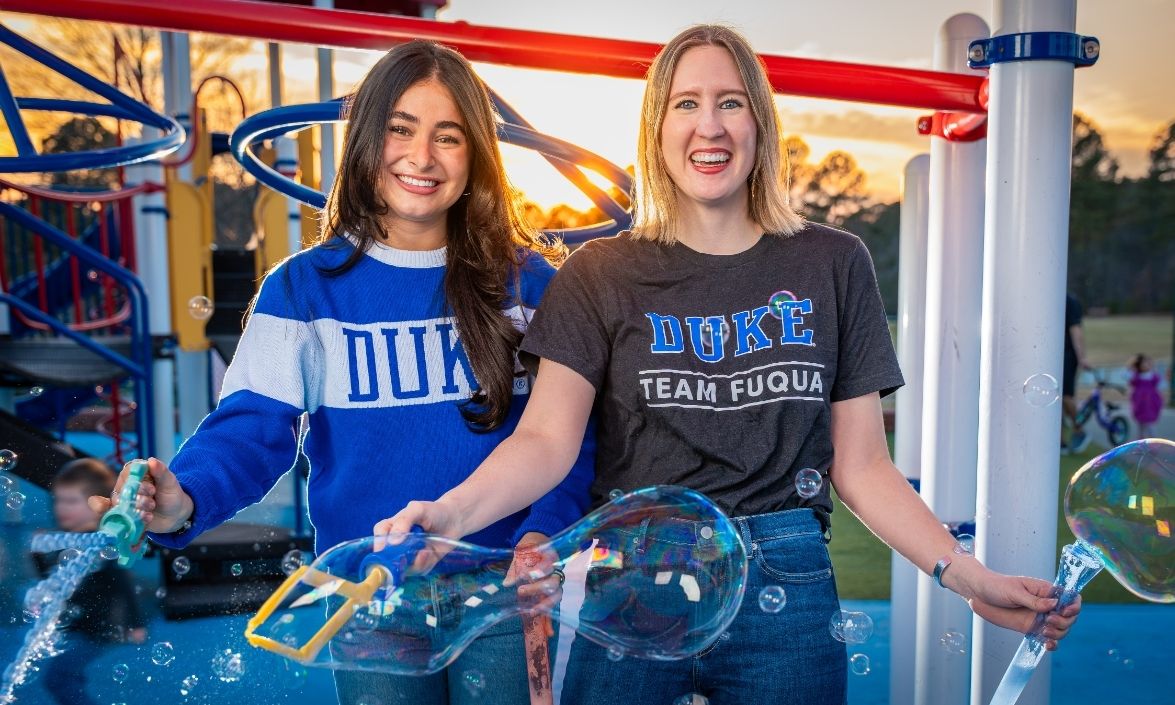 Students Who Sit co-founder Sydelle Bernstein (left) with partner Ann Marie Flushche. The venture connects college students who babysit with parents who need reliable babysitters.
Growing up in Connecticut as one of six children, babysitting not only enabled Sydelle Bernstein to earn money — it was her passion.
That passion began with Bernstein looking after siblings. (Some of her siblings are also Blue Devils.) “I became a nurturer early on,” said Bernstein. “Babysitting my siblings wasn’t a chore; it was genuinely my favorite hobby. Taking care of them felt instinctive and joyful.”
When Bernstein arrived at Duke, the senior psychology major struggled to find opportunities to continue doing the thing that she loved. She also observed that faculty members and campus staff struggled to find reliable babysitters. “I saw professors bringing kids to campus because they couldn’t find someone trustworthy to take care of their kids,” Bernstein said.
Bernstein explored babysitting opportunities through existing online platforms and ended up at homes babysitting for people she didn’t know or had mutual connections with. Sometimes it didn’t feel comfortable or safe.
“And it came to me, that hey, you know, there are these two underserved communities on campus,” she said. “There are students like me, who are looking for opportunities to work with kids, and parents who can’t find sitters, all within the same community. It feels seamless to connect the two through a platform.”
Students Who Sit officially launched in the fall of 2024. From the onset, the need was immediately evident. The venture’s first month saw child-sitting volume grow from three to 100 sessions.
In April 2025, during her junior year, Bernstein was invited to pitch Students Who Sit, a venture she thought could solve this two-sided problem, at the third annual Student Startup Showcase hosted by Duke I&E.
At that point, she did not see herself as a founder. “I just had an idea,” she said. ”But I had built this team around me, including Ann Marie Flusche, a founding member, to help establish the groundwork and foundation of what could be a business.”
She took home the Borchardt Runner-up Prize of $10,000, awarded to the most promising undergraduate student venture.
Last July, Bernstein was accepted into the Melissa & Doug Entrepreneurs program. Today, Students Who Sit has more than 1,200 registered users at Duke and has launched expansion efforts at college campuses regionally and nationally.
Movement Intelligence with Jeani
 Jeani co-founder Ewan Bradley says the new wearable tech AI platform aims to help prevent long-term injury risks.
Pain and injury are as much a part of sports as victory and defeat.
Ewan Bradley, a Duke graduate student in global health and member of Duke University’s track and field team, knows all too well about pain and injuries.
“I’m 23 and there are not too many parts of my body that I’ve not injured,” said Bradley, a track and field decathlete who will earn a master’s of science degree in May.
A year ago, Bradley and his teammates Stuart Bladon and Michael Bennett were in a training room submerged in ice baths when they considered the gap in wearable tech. They believe the gap exists in monitoring musculoskeletal health; products currently available typically measure only heart rate, sleep and stress.
“But we really felt as athletes, they missed [the] biggest part of the puzzle, which is how much you’re moving and how you’re moving,” Bradley said. “And whether or not there are imbalances in your movement that are contributing to injury risk long-term.”
Ewan, Blandon and Bennett decided they would build something that measured musculoskeletal health. They developed “Jeani,” a new AI platform that enhances movement, performance, and quality of life through personalized, real-time musculoskeletal monitoring, predictive analytics — which forecasts future outcomes, behaviors and trends — along with targeted exercise prescription.
“It was essentially something we needed in the early stages of our (athletic) careers, and that we wanted to build something to help people like ourselves to be more active,” he said. “And then we realized that it expands beyond just athletes. It expands to anyone who wants to be physically active, whether you’re 16 or whether you’re 50.”
The founders also worked with Duke Law’s Start-Up Ventures Clinic.
Learn with Bern
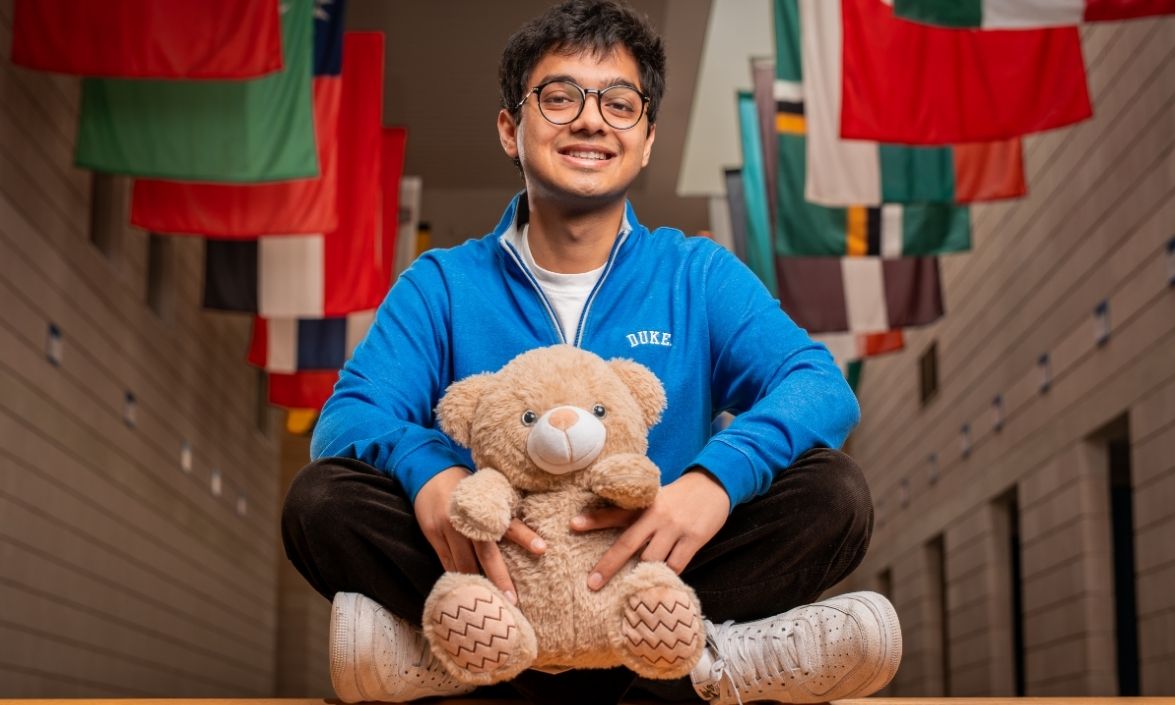 Avihan Jain was motivated by studies that determined children who learn a second language before the age of seven are likely to have higher IQs as adults.
Avihan Jain is hoping children will soon be able to learn a new language while playing with a familiar toy: a stuffed animal.
Bern is the first AI-powered, interactive stuffed animal designed to make learning a second language a fun, natural and screen-free activity for children aged 5-10.
Jain, a junior mechanical engineering major from New Delhi, India, considered a toy that would educate children while observing young people with their iPads.
Jain calls them “iPad Kids,” and “screenagers.”
He explained that children are supposed to engage in creation over passive consumption of images and information on their iPad screens.
“So, while you are at a screen, you’re just consuming content, which is not firing up neurons in your brain. You’re pretty passive,” Jain said. “When you actually engage with something; when you speak to a friend, or speak to a parent, your brain is developing faster.”
Jain reasoned: If a child does not have a friend or family member at home who they can consistently interact with, perhaps a talking teddy bear would be a great substitute.
Jainworked on Bern during the past academic year. His first iteration of Bern could talk and engage with children, which then evolved into the ability to teach language. Jain was motivated by studies that determined children who learned a second language before the age of seven were likely to have higher IQs.
Jain wants to target a higher income market that will enable him to give one at no charge to a low-income family for each one sold.
“I think Bern encapsulates a lot of skills in one,” he said. “You’re learning conversational skills as a kid. You avoid the iPad with passive content consumption, and you’re also learning a new language.”