
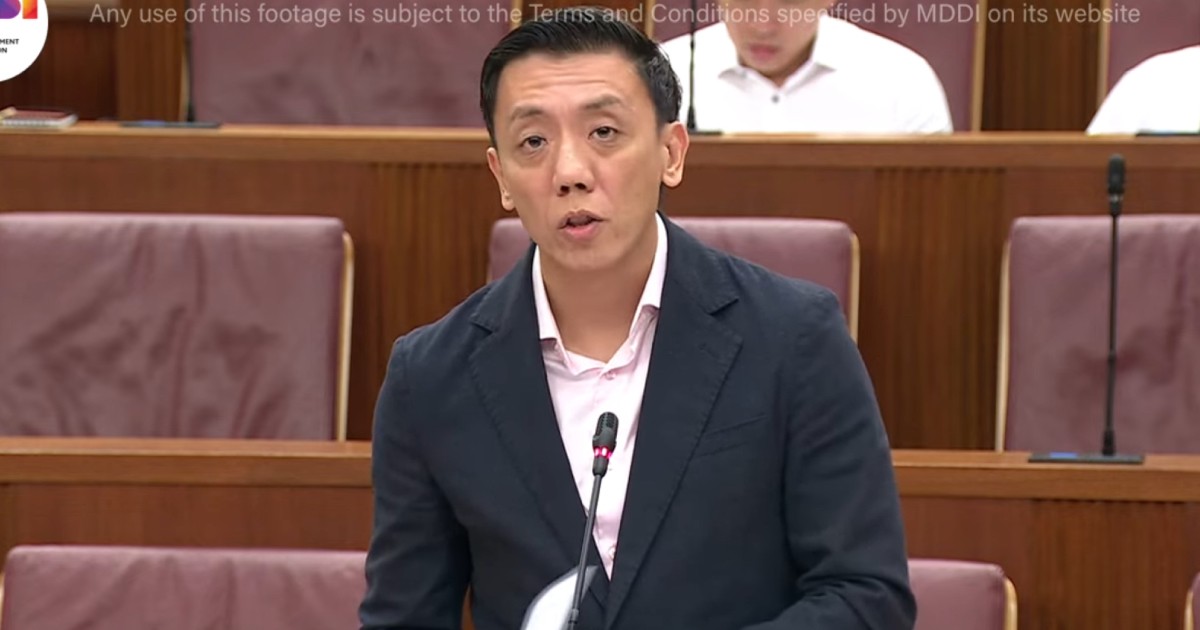
Data on wealth inequality in Singapore — showing that the top 5 per cent of households hold about one-third of the country’s wealth — should be interpreted with caution, Acting Transport Minister and Senior Minister of State for Finance Jeffrey Siow said in Parliament on Wednesday (Feb 25).
Siow was responding to parliamentary questions from several Members of Parliament about the Ministry of Finance’s (MOF) release of statistics on income growth, inequality and social mobility trends, which included market income and wealth for the first time on Feb 9.
Singapore’s wealth inequality coefficient stands at 0.55, comparable to estimates of other advanced economies like the United Kingdom, Japan and Germany, ranging from 0.6 to 0.7.
The top 1 per cent of households in Singapore own about 14 per cent of total wealth, while the top 5 per cent hold about 33 per cent, said Siow.
“However, these estimates should be interpreted with caution, due to sample size limitations and potential under-reporting in survey responses at both ends of the distribution,” he added.
Nominated Member of Parliament Kenneth Goh had asked how Singapore’s wealth Gini coefficient was measured and what the Government will do with the data.
Siow said that it was measured by combining data from surveys and data obtained from sources such as CPF and the Housing Board.
But he acknowledged the difficulties of measuring wealth, especially for overseas assets and unlisted assets.
According to MOF’s findings, 56 per cent of household wealth in 2023 came from property, while CPF balances and other financial assets make up 22 per cent.
For the bottom 20 per cent of households, property comprised 54 per cent of wealth, and CPF balances made up 39 per cent.
Meanwhile, for the top 20 per cent, property made up 58 per cent of their wealth, CPF balances at 15 per cent and the remaining 27 per cent went to other financial assets.
Siow said that the new stats are dependent on the Household Expenditure Survey, which is done every five years. The next cycle is in 2028.
He added that the data will improve the Government’s understanding of the state of inequality in Singapore, which will better help it develop more evidence-based and targeted policies to improve Singaporeans lives.
[[nid:729074]]
chingshijie@asiaone.com