
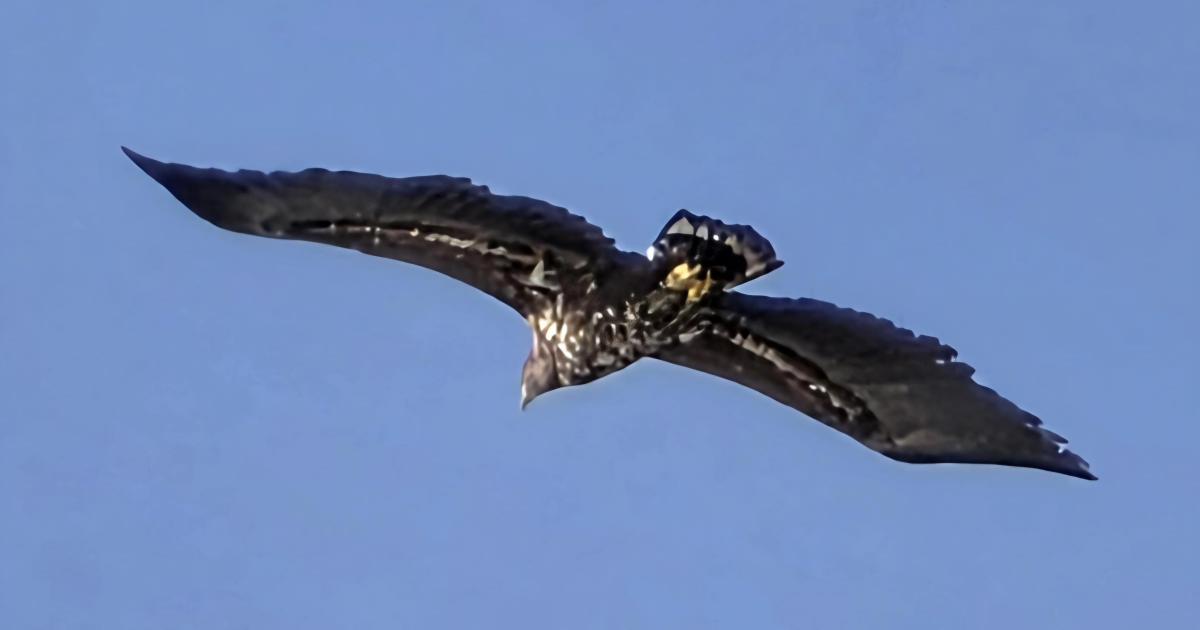
White-tailed eagles, known for their impressive wingspans and commanding presence, are the subject of ongoing reintroduction proposals in the county, raising hopes and concerns in equal measure.
A satellite-tagged female eagle from the Isle of Wight project, identified as G818, was recorded in early August along the Cumbria–Durham border at Stainmore, where she remained for several days.
Occasional sightings like these have been logged in Cumbria, with bird news services recording intermittent appearances rather than regular visits.
Some tagged birds have been reported roosting briefly along coastal headlands in the south of the county, including Humphrey Head.
These remain short-term stopovers, with no established breeding pairs in the area.
The best sources for current sightings are BirdGuides and the Cumbria Bird Club’s online records.
Cumbria’s location between the Scottish, Irish, and southern England populations of white-tailed eagles makes it strategically significant.
A pre-feasibility study by the University of Cumbria concluded that the county has ample suitable habitat and prey to support the species, particularly in the south and along the Solway coast.
However, natural recolonisation is expected to occur slowly without intervention.
The Cumbrian White-tailed Eagle Project, led by a partnership including the University of Cumbria, Cumbria Wildlife Trust, the RSPB, and the Lake District National Park, is actively exploring the possibility of a reintroduction in southern Cumbria.
Stakeholder questionnaires and public engagement activities have been underway since 2023.
Research suggests that the southern part of the county, with its mix of woodlands, lakes, and a productive coastline, offers especially favourable conditions for the species.
But the reintroduction proposals have not been universally welcomed.
Farmers and rural communities have raised concerns about the potential impact on livestock, particularly sheep.
Last year, MP for Westmorland and Lonsdale Tim Farron raised the issue publicly.
Mr Farron said: “There are well meaning motives behind this but the evidence strongly shows that this would not enhance biodiversity and would become a huge threat to animal welfare and see the loss of lambs.
“The evidence shows that sea eagles may not target lots of farms, but that for those farms they do target they will return over and over again and decimate flocks.
“Some may say that the sea eagles won’t be introduced near to farms, but these animals fly long distances and will of course move towards sources of food.
“This is a dangerous, poorly thought out move which is an unnecessary threat to animal welfare and we should stop it.”
The National Sheep Association has also called for a pause on further introductions of sea eagles into Britain, citing similar worries.
Cumbria could serve as a crucial “bridge” between these populations, potentially enabling wider dispersal and natural recolonisation across the UK.
Despite concerns, the conversation remains ongoing.
The University of Cumbria’s pre-feasibility study suggests that the region has the right environment to support white-tailed eagles safely.
The project partners continue to collect feedback, aiming to reach a decision that balances conservation opportunities with the concerns of farmers and rural communities.
In the meantime, sightings remain rare and unpredictable, with no regular presence yet recorded in the county.
The debate highlights the broader challenge of rewilding in landscapes shaped by both nature and human activity.
The outcome will shape not only Cumbria’s skies but also the future of wildlife restoration across the UK.