
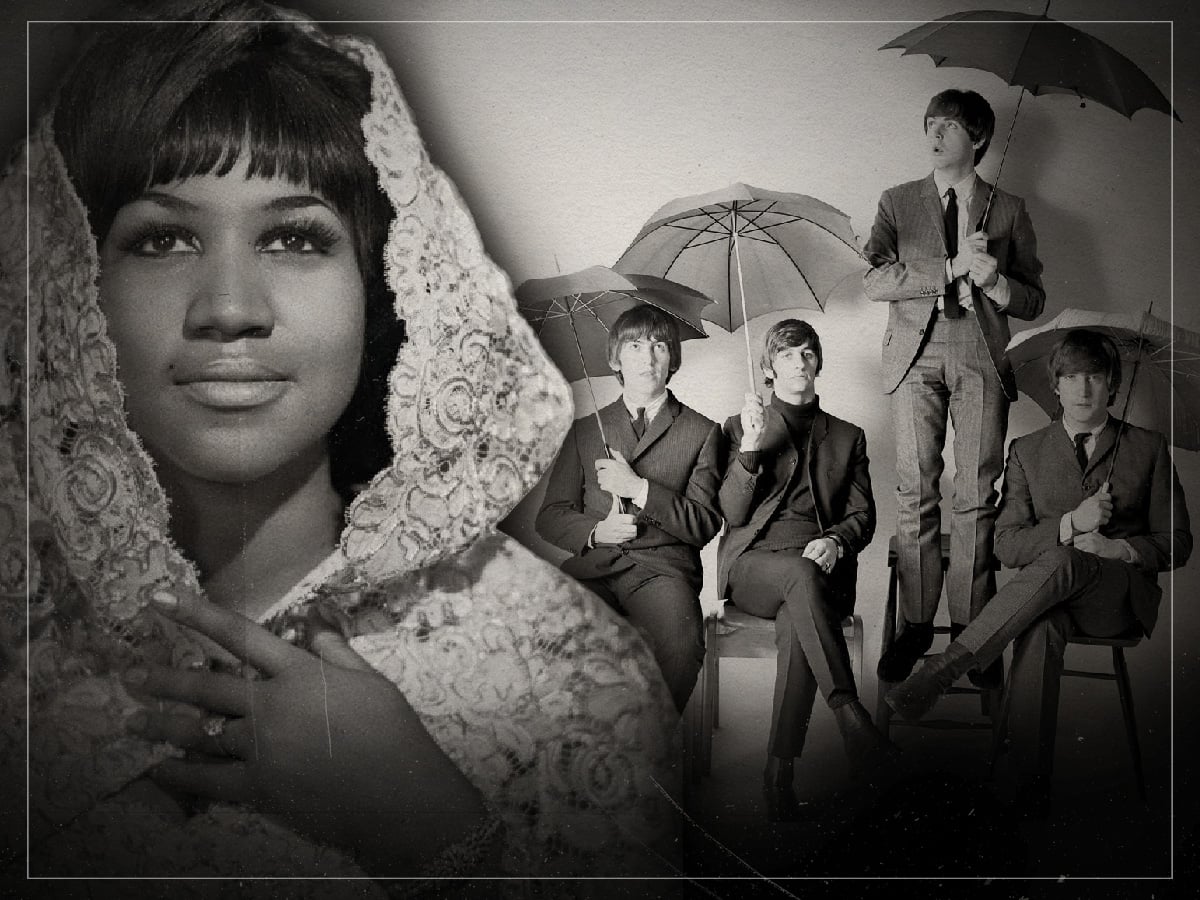
(Credits: Far Out / Album Cover / Apple Corps)
Thu 26 February 2026 2:00, UK
There’s a reason the 1960s are considered the golden era of music: it’s also the era that gave us some of our most enduring legends, from The Beatles to Diana Ross.
While the 1950s birthed some of our most revolutionary developments, introducing new sounds and approaches to rock ‘n’ roll that expanded it into a mainstream force of energy, the 1960s built on this, repurposing the value of artistic expression and transforming music from a vessel of entertainment to something with a stronger cultural foundation.
Of course, The Beatles were a major driving force of this change, reinventing the game entirely when it came to the hype and hysteria of mass popularity. At the core of this was their music and charisma, which took familiar, formulaic tropes in rock ‘n’ roll and pushed them even further, testing the boundaries of style and creative control in mainstream music.
As a result, the Fabs had more chart dominance than most of their peers, achieving 17 number-one singles across the entire decade, which was more than any other artist, with songs at the top including ‘Help!’ and Hey Jude’, and several others, establishing a monopoly that few could come close to.
However, on the other side of the coin, labels like Motown were revolutionising in a different way, by breaking down social barriers and giving people who wouldn’t otherwise have access to opportunities or a platform to let their talent shine, with several names born out of the institution making it big throughout the ’60s, including names like The Supremes, Marvin Gaye, Stevie Wonder, Smokey Robinson, among others.
So, what was the last number one song of the 1960s?
Towards the end of the decade, it became clear that many of these names were still setting the standard in terms of style and excellence, and even those who would be left behind had already revolutionised the space in ways that ensured their lasting impact, so while the ’70s brought its own standards and shifts, especially the post-counterculture scene as well as all the uncertainties that came with navigating a new era, many of the final chart-toppers proved that certain tropes will always resonate with audiences.
For instance, the last number one of the 1960s on the Billboard Hot 100 was Diana Ross & The Supremes’ ‘Someday We’ll Be Together’, a song that seemed rather poignant at the time considering the unease that many felt at the tail-end of the era, and even more so later when Ross connected the song to ongoing Civil Rights activism and anti-Vietnam War sentiments.
In the UK, however, the final number one was far less impressive, when in December 1969, Rolf Harris earned his final charting hit with his ill-titled ‘Two Little Boys’, initially an early-1900s song inspired by the story of two boys who grow up to be soldiers, and re-recorded by Harris in 1969, by which point it became a charting hit.
While The Supremes’ entry proves that some messages strengthen with time, Harris’ proves that not everything can withstand its test, not even songs with strong messages of those reimagined for modern audiences. The ’60s gave us an extensive platter when it came to reinvention and innovation, though many, even the era’s biggest chart-toppers, got left behind.