
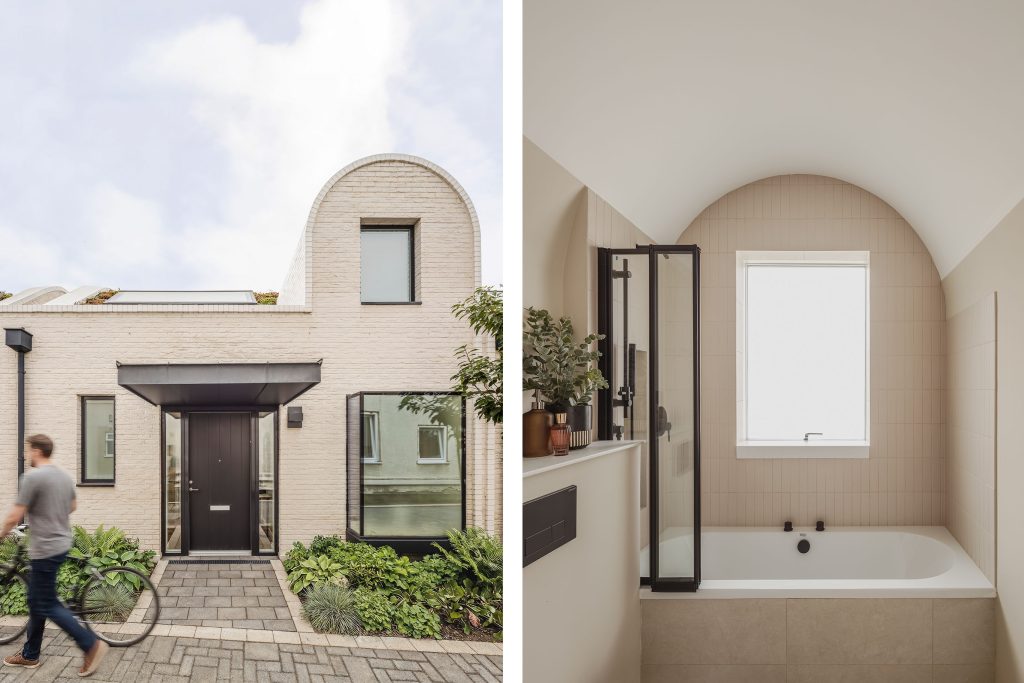
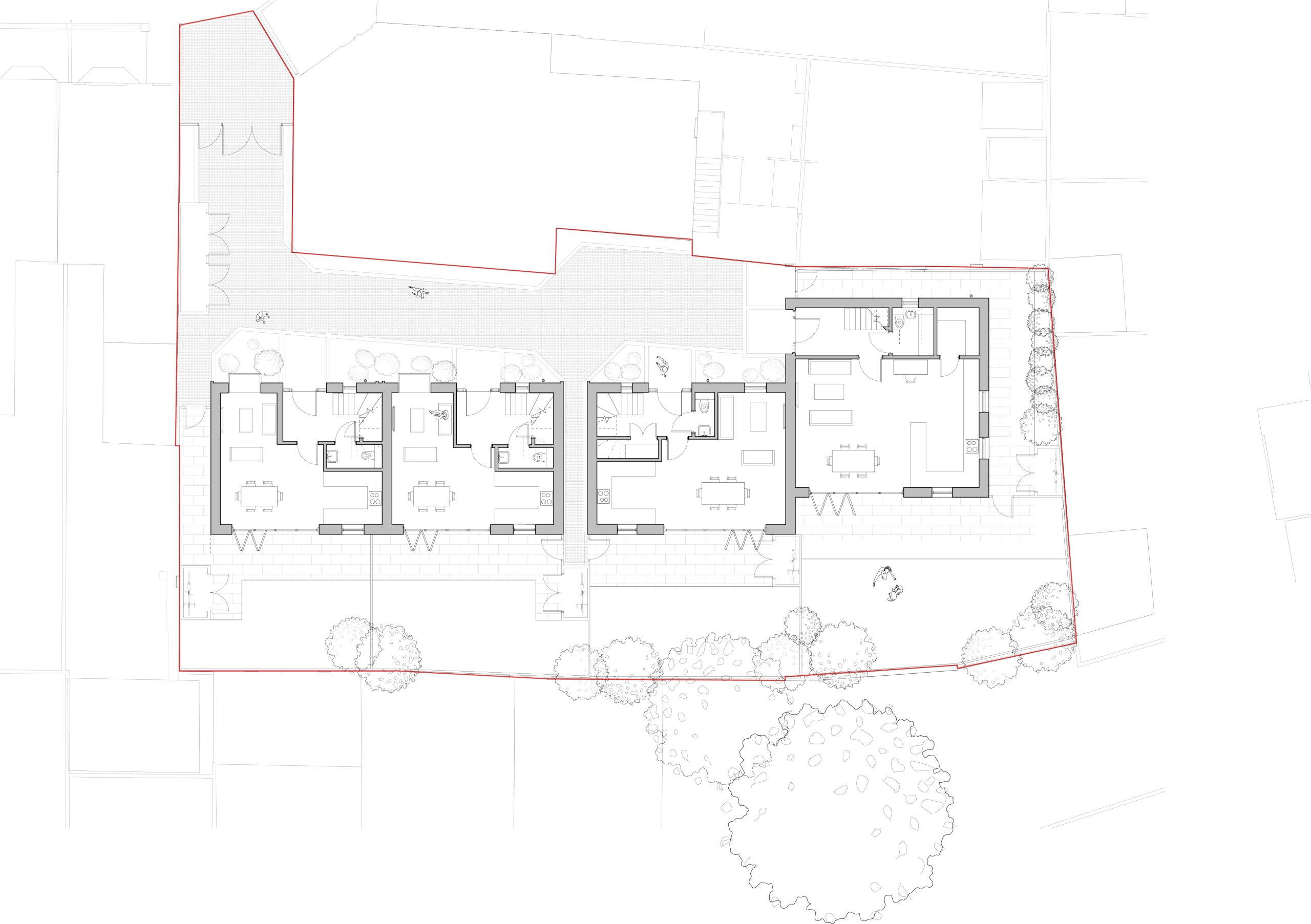
The scheme was approved by Waltham Forest Council in 2022 and started on site in August the next year. It delivers four houses in a mews-style development on an 18 x 36m backlands plot off Wolsey Avenue in Walthamstow.
The homes are arranged in two semi-detached blocks to avoid overlooking from a neighbouring apartment block and are clad in ‘rustic’ white brick. They feature sedum roofs and all have their own private south-facing gardens.
Brick vaulted roofs, which act like rainscreen cladding, are formed by chamfering brick slips on cementitious board, fixed to a metal frame.
The brickwork has been finished with a white cement, lime and washed river sand mortar – a surface treatment known in Scandinavia as ‘sækkeskuring’ – used as a way of creating a more monolithic appearance without losing the identity of each brick.
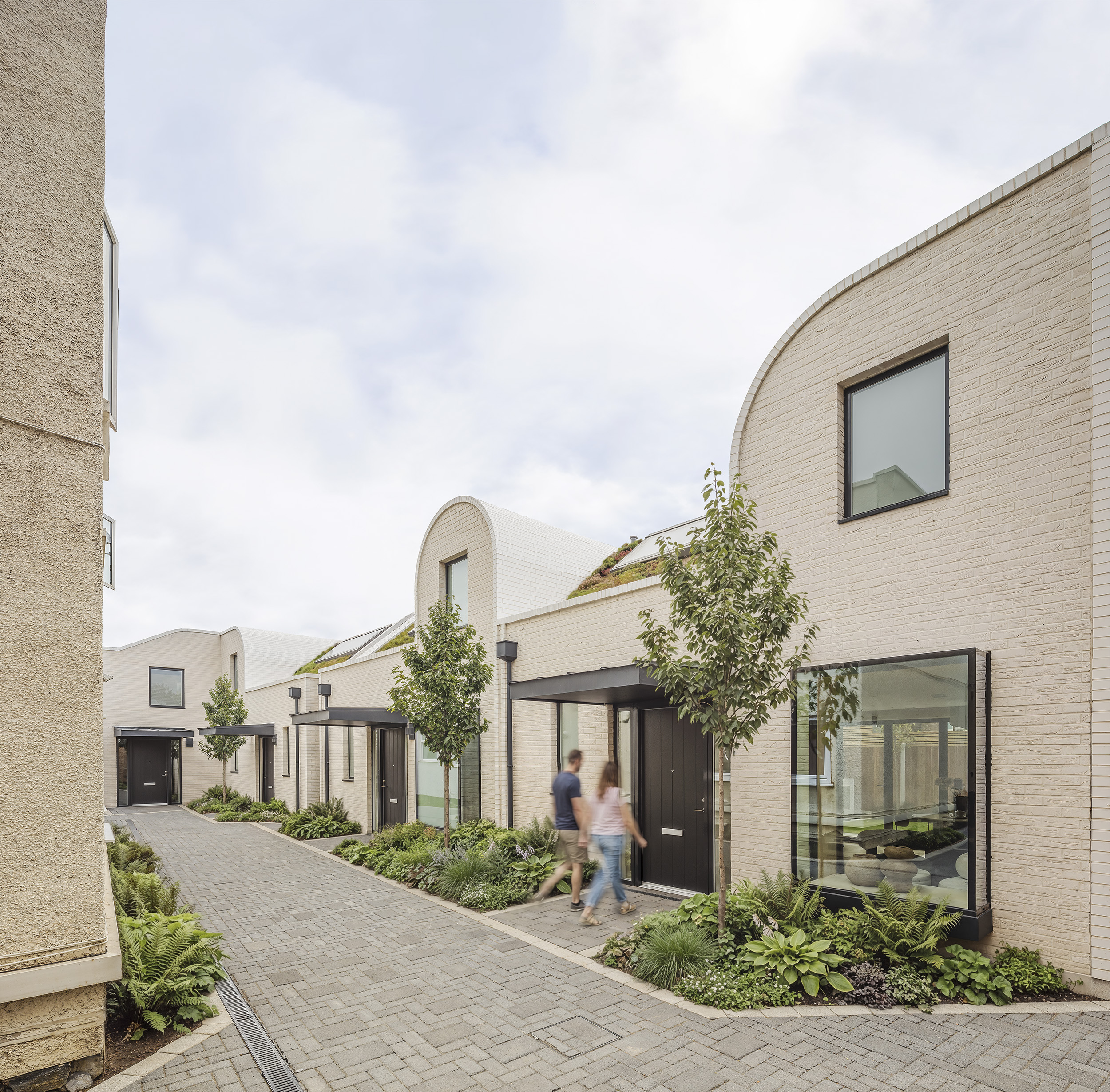
Building corners, coping and roofs are of glazed white brick for added robustness and to assist water run-off from the curved roof surfaces.
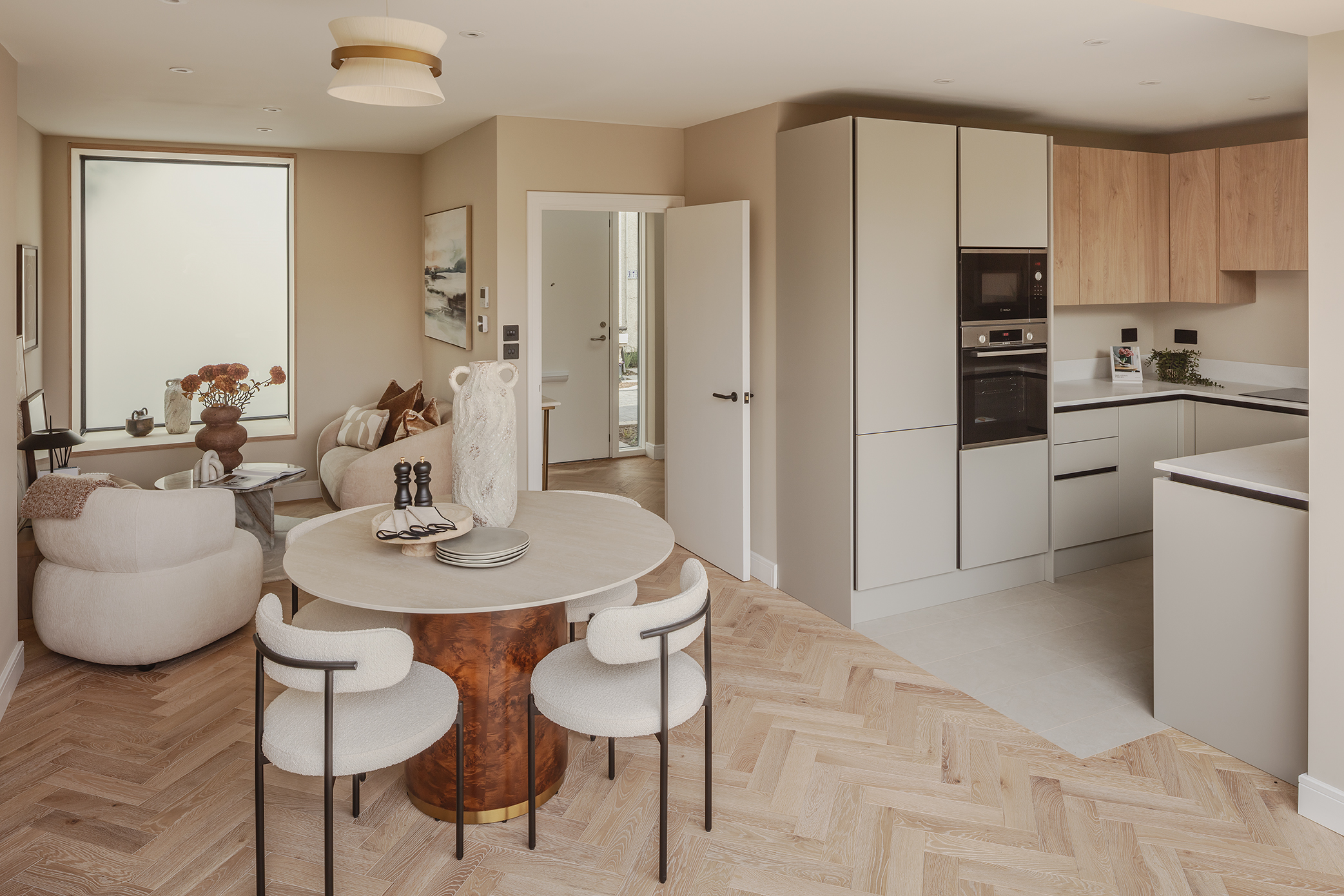
Internally, each entrance hall is double-height and lit by a large rooflight. Each unit features a gallery walkway to access first-floor bedrooms.
All open-plan living and dining spaces open onto outdoor spaces. Glazing is shaded by cantilevered overhangs at first-floor level.
The emerging London-based practice, which has studios in London and Winchester, was set up in 2022 by former DLA Architecture architects Alex Giles and Ian Liptrot.
Last year, Enfield Council granted planning approval to Metashape Architects for a four-home infill scheme in Winchmore Hill, north London, replacing eight lock-up garages backing onto railway tracks.
Architect’s view
The site came with its challenges being close to the windows of a neighbouring apartment building, therefore the floorplan was arranged so that any potential for overlooking was avoided and the massing modelled to meet daylight and sunlight standards.
The design includes a combination of clever technical solutions such as the brick vaulted roofs formed by chamfering brick slips on cementitious board and fixed to a metal frame which acts similar to rainscreen cladding.
The walls of the building are built using a rustic white brick with white mortar, influenced by a Scandinavian technique known as ‘Sækkeskuring’ so that the surface finish is appreciated as a way of creating a more monolithic architecture, without losing the identity of each and every brick. The building corners, coping and roofs are proposed in a glazed white brick for added robustness at the edges, and to assist water runoff from the roof surfaces.
The entrance hall is double height, top-lit by a large rooflight and features a gallery walkway to access the bedrooms on the first floor.
The buildings are orientated to create south-facing gardens with open plan kitchen/living/dining spaces that open out onto the outdoor space. The large areas of glazing at ground floor level are protected from the sun by a cantilevered overhang on the first floor.
A green pitched roof is a bit of a novelty – most green roofs are flat – and adds biodiversity, bringing floral enrichment complimenting the landscaped mews and south-facing rear gardens.
Ian Liptrot, founding director, Metashape Architects
Project data
Location London E17
Start on site March 2024
Completion July 2025
Gross internal floor area 345m2
Gross (internal + external) floor area 553m2 (including the rear gardens)
Form of contract Design and build
Construction cost £1.2 million
Architect Metashape Architects
Client Eastbank
Structural engineer AWA Consulting Engineers
M&E consultant Irvineering
Drainage consultant JPChick
Landscape consultant Studio 413
Acoustic consultant E3P
Project manager Eastbank
Principal designer Eastbank
CDM co-ordinator TWS Consulting
Approved building inspector Waltham Forest Local Authority
Main contractor Eastbank
CAD software used Revit
Environmental performance data
Percentage of floor area with daylight factor >2% Not calculated
Percentage of floor area with daylight factor >5% Not calculated
On-site energy generation Nil
Annual mains water consumption 105 l/occupant
Airtightness at 50Pa Unit 1: 4.8 m3/h.m2, Unit 2: 4.7 m3/h.m2, Unit 3: 4.7 m3/h.m2, Unit 4: 4.6 m3/h.m2
Heating and hot water load Not calculated
Operational energy Not calculated
Total energy load Not calculated
Overall area-weighted U-value Not calculated
Predicted design life 60 years
Embodied carbon Not calculated
Whole-life carbon Not calculated
Annual CO2 emissions Not calculated
Energy Performance Certificate rating Units 1,2 and 3: C, Unit 4: B