
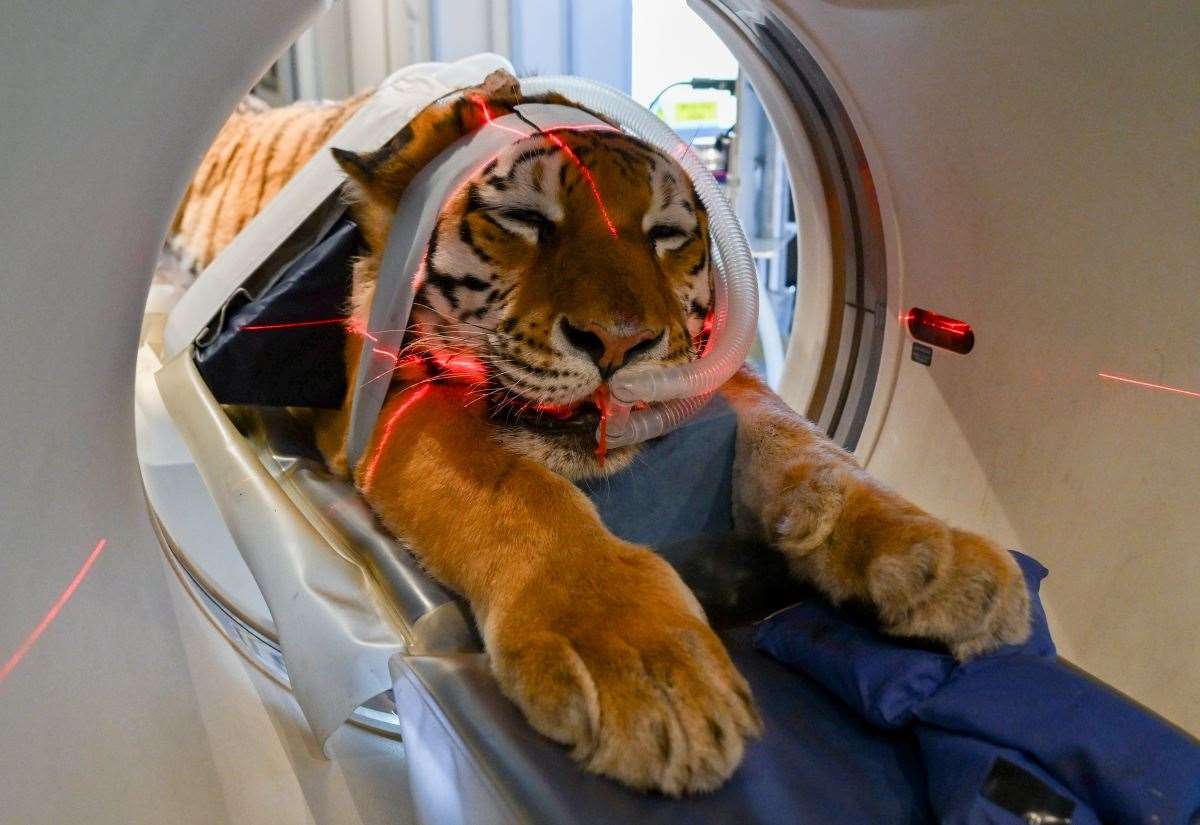
Keepers at a Kent animal park say the use of a new mobile CT scanner has led to “a major step forward in sanctuary medicine” which is already set to prolong the lives of its cats.
In November, The Big Cat Sanctuary introduced the medical device for the first time to investigate the medical mysteries of three of its residents.
 Django the clouded leopard being scanned. Picture: The Big Cat Sanctuary
Mobile CT scanners bring advanced, high-resolution 3D diagnostic imaging directly to animals, eliminating the need for stressful transportation to specialised centres.
The human-grade technology is valuable for improving diagnostic accuracy in orthopaedics, neurology and oncology, while also allowing for faster scans which reduce prolonged anaesthesia.
Three months on and keepers at the Smarden park, near Ashford, say it is already proving beneficial by providing treatment plans to its residents such as clouded leopard, Django.
The scan potentially saved the 10-year-old’s life by detecting an abdominal mass and a testicular tumour at an early stage.
Keepers say they can now act fast to ensure he remains part of the vital European Breeding Programme after ensuring he has the strongest possible outlook.
Four-year-old tiger Luca had a scan which revealed a rare narrowing of the spine. Picture: The Big Cat Sanctuary
Meanwhile, four-year-old tiger Luca had a scan which revealed a rare narrowing of the spine.
Described as “an unusual find for a young tiger”, park bosses say the diagnosis will allow them to pivot his care plan and inform the EAZA breeding programme.
Finally, cheetah Mo has finally received a diagnosis for his intermittent lameness in his left forelimb – significant arthritis and tendon inflammation – due to the scanner.
The imaging confirmed significant osteoarthritis in his right shoulder and tendon inflammation in his left shoulder.
While surgery is not necessary, the scan has allowed the team to implement a structured long-term analgesia plan to manage discomfort and maintain mobility.
Mo finally received a diagnosis for his intermittent lameness. Picture: The Big Cat Sanctuary
A spokesperson for the sanctuary said: “The results have provided our team with the vital clarity needed to safeguard the future of these incredible animals.
“While not all findings were straightforward, the scan has provided invaluable clarity and allowed keepers to refine treatment plans and make informed decisions which will help safeguard the animals’ long-term welfare.
“It has delivered exactly what keepers at The Big Cat Sanctuary hoped for – answers.
“The ability to access advanced diagnostics of this calibre represents a major step forward in sanctuary medicine and ensures the best possible care for the cats.
“Most importantly, this procedure has strengthened the sanctuary’s commitment to deliver the highest possible standard of welfare, ensuring each cat receives tailored, informed and compassionate care for years to come.”