
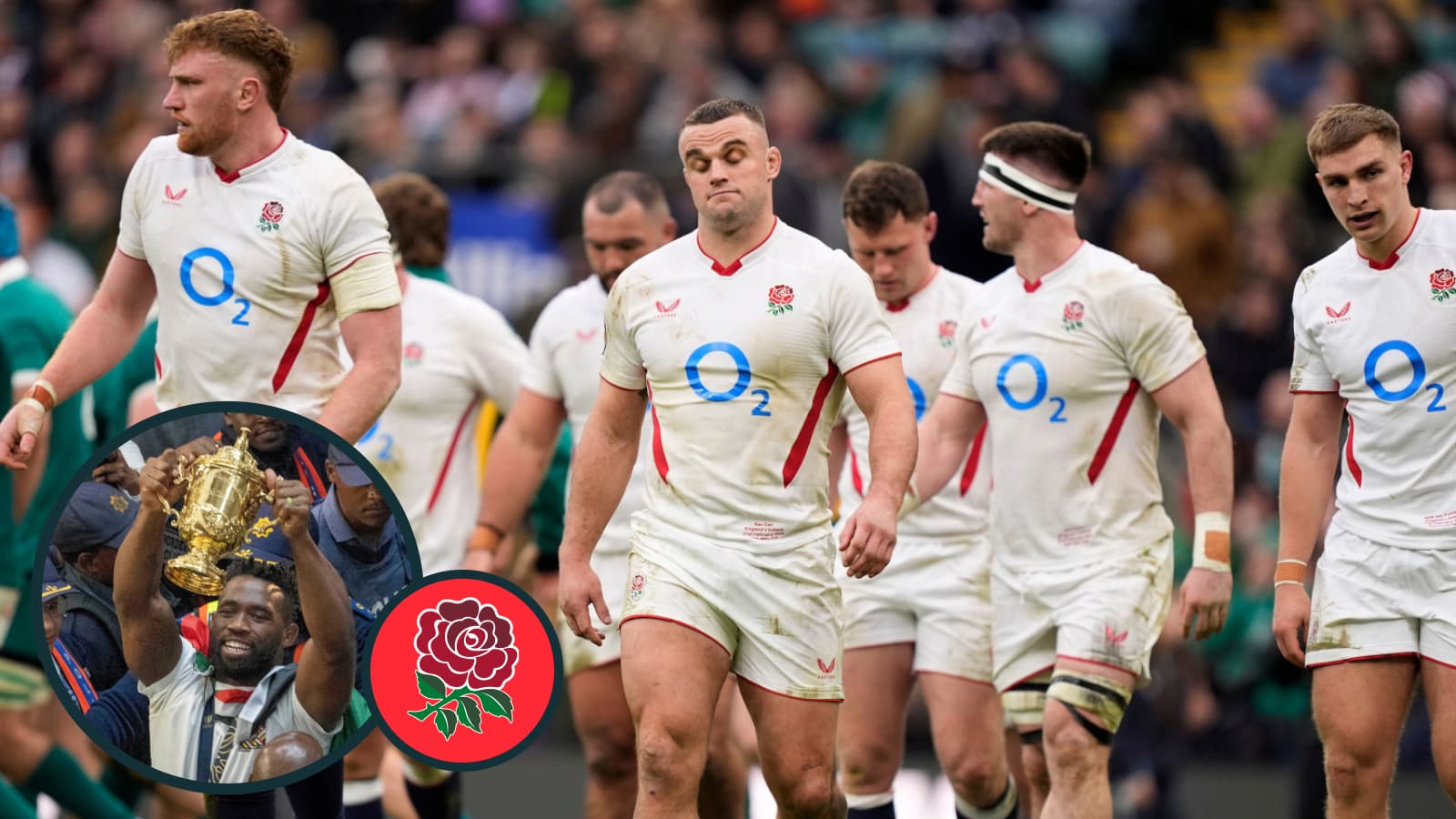
Yet again we appear to be having the wrong conversation and, rather annoyingly, we’ve been having it for years and nobody seems to notice, or care, or feel sufficient discomfort to stop.
After every England defeat, the same reliable fan and punditry machinery cranks into life. Should Smith start at 10? Is the six a fetcher or a carrier? Do we play wider, tighter, deeper, flatter? The positions shuffle, the names rotate, the tactical theories accumulate like sediment. And underneath all of it, untouched and unexamined, sits the actual problem.
Siya Kolisi was asked, after South Africa won the 2019 Rugby World Cup, whether he had dreamed as a boy of lifting that trophy? He looked at the interviewer for a moment. Then he said no; he had dreamed of where his next meal was coming from.
Eddie Jones told me this story; he let it breathe for a second and then asked a question he already knew the answer to. How do you coach that level of emotional resilience, he said, when the worst thing that has happened to most of your players is detention at Millfield? It is the most honest thing I have heard said about English rugby in 20 years. Everything else is rearranging the furniture.
Rugby at Test level is played in the top two inches. You can get the selection perfectly right, the tactical architecture immaculate, the set-piece precise, and still lose if the men executing it do not believe with complete conviction in what they are doing. In most cases, and the evidence of the last two World Cups makes this hard to argue with, a mediocre plan delivered with total conviction will beat a brilliant plan delivered with hesitation. The plan is not the weapon, the belief and the desire are the weapons. The plan is the container that belief and desire is poured into.
Boks to basics
People talk about the Springbok system. Rassie‘s structures, the Bomb Squad, the analytical precision. What they talk about less, because it is harder to put in a graphic and does not lend itself to a 32nd television breakdown, is what Erasmus actually built before any of that: the alignment camps and fun time together. Room after room of players sitting together not talking about rugby but about their lives, their families, their fears, what they are playing for and why it matters. Men who would not naturally share those things learning to be completely open with each other. Learning that the man beside them in the trenches at 78 minutes is not a colleague but someone who knows everything about them and has chosen to stand there anyway.
Eddie Jones: Steve Borthwick made some ‘uncharacteristic comments’ and the RFU could be at fault
Some might call this a team-building exercise, but rather it is the construction of something that functions in an entirely different register from professional obligation. Those players do not perform for each other, they fight for each other. The difference is everything when the match is in the balance and the body is asking to stop and the only thing that keeps a man going is that he cannot let down the person who told him something true about himself in a room in Johannesburg six months ago. England keep changing the container but the belief question goes unasked. The love question is never even raised.
This is not an argument that England lack players of character. The 2019 run to the final and the 2023 semi-final showed a team capable of genuine ferocity and psychological commitment. And before the counter-argument arrives about struggle being the only forge, it is worth addressing it directly. Dan Carter grew up comfortably, the 2003 England side that won in Sydney was full of privately educated men who conquered the world through pathological professional standards, not hardship. Comfortable people win World Cups so the argument that remains is that identity is the forge.
Carter knew with absolute precision who he was and what the All Black jersey demanded; Richie McCaw understood at a cellular level what losing would cost him as a man. Kolisi’s story is the extreme and luminous illustration of a broader truth; the players who win the moments that cannot be coached are the ones who know, without ambiguity, exactly what they are playing for and why it is non-negotiable. That clarity does not require poverty, it requires honesty. And that is precisely where the question for England becomes uncomfortable.
Comfort killers
Modern English players are exquisitely coached. Every scenario has a prescribed response, every decision anticipated and pre-loaded. The system is comprehensive yet the system is precisely the problem. Because when setbacks and stress arrives, and in the roasting heat of Test rugby they always arrive, the player who has been given decisions rather than taught to make them looks to the touchline, and the touchline cannot always help.
In that gap between the moment and the instruction, matches are lost. Watch Antoine Dupont when a move breaks down. He does not look anywhere. He acts from somewhere the analysts have never found because it is not in the data. It is in the man, in 10,000 hours of being trusted to solve problems himself.
Want more from Planet Rugby? Add us as a preferred source on Google to your favourites list for world-class coverage you can trust.
Dupont, it’s well known, enjoys a sly smoke after matches. And whilst the performance scientists presumably have views, the point is not the cigarette. The point is that Dupont has never been coached out of owning his own decisions, and it shows most clearly in the moments when the structure collapses and everything depends on what one player chooses to do next.
Jones and I share another view. England are afraid of winning. Not of playing well, but of the raw and unapologetic act of winning with hunger.
Perhaps it goes deeper than sport. England has spent a long time apologising for its past and something of that apology has leached into the sporting culture. Grace in defeat has been elevated into a kind of virtue. And grace in defeat, practised long enough, becomes a habit you stop noticing. The All Blacks win because losing dishonours the ancestors. The Springboks win because Kolisi’s story and the history of the Rainbow Nation makes every match feel like something with real stakes for real people. The Irish win because eight centuries of history turns every fixture against England into something that was always a lot more than just rugby.
Love and hate
Ask yourself honestly what England hate enough, love enough, need enough, to win when winning requires everything. Embarrassment is a thin fuel and it runs out at precisely the moment you need it most.
No coach can manufacture Kolisi’s childhood; that foundation is not available to England and pretending otherwise helps nobody. But what Erasmus built in those alignment camps is invaluable. Not the history, not the hunger born of hardship, but the choice to be genuinely known by the person beside you. The choice to share goals that have nothing to do with contracts or selection and everything to do with something bigger than any of that. England could build those rooms. The question is whether they have the courage to sit in them honestly rather than perform the version of honesty that looks good in a squad culture document.
Stop rotating the positions. Stop revising the tactics after every loss as though the problem were structural when it is psychological. Start asking whether the players in those positions have ever been trusted to decide anything for themselves under genuine pressure. Start creating conditions where the system is deliberately taken away and the player discovers what they actually are. Build from the academy upward a culture that does not apologise for wanting to win, that understands the difference between a team executing instructions and a team that has genuinely decided.
The debate will continue and another 10 will be tried, another formation theorised. Another selection controversy will ignite and leave nothing behind. And in the moments that matter, decided in the top two inches by what a man carries that nobody put there, England will keep finding that the conversation they were having was never the one that needed having.
Kolisi dreamed of his next meal. Until England find a hunger that runs anywhere near as deep, the top two inches will keep costing them.
READ MORE: Loose Pass on Coach killers in the Six Nations and why Suva snub leaves a sour taste