
(Credits: Far Out / Megaforce Records / MaryLane)
Thu 26 February 2026 20:30, UK
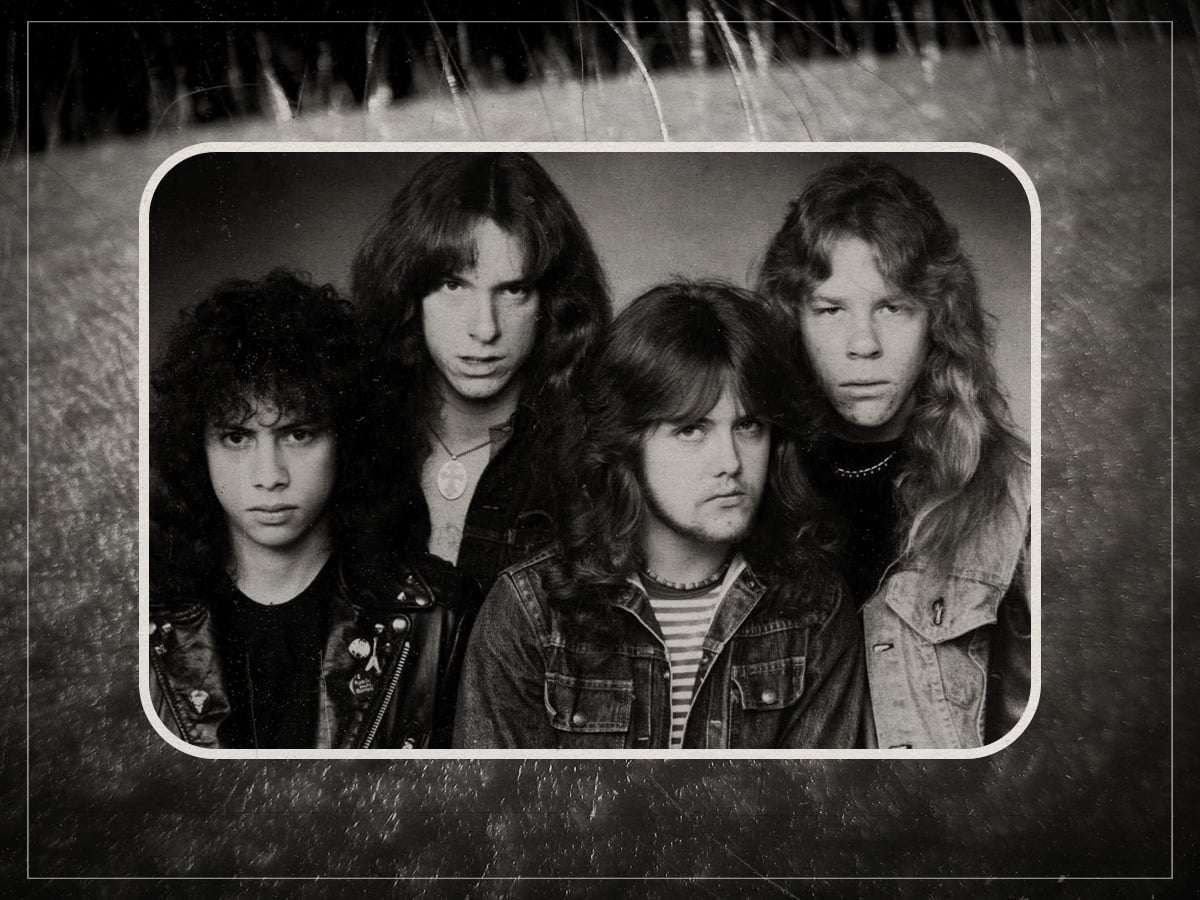
Metallica’s self-titled fifth studio album, known to the die-hards as The Black Album, debuted in 1991 with a poignant shift. Where the thrash metal soon-to-be legends thrived on the adrenalised chaos they channelled into unforgiving riffs and anger-fueled lyrics, the 1990s were a period of reckoning for the already-infamous band.
Straying away from their signature sound, Metallica wanted to conjure the spirit of a live gig in the studio, and this meant learning how to write and record as a unit, rather than as a fractured group, split between the songwriting duo of James Hetfield and Lars Ulrich and the rhythm section of Kirk Hammett and Jason Newsted.
Gone were the days of pure thrash and, in their place, was a refined and more commercial sound – to their benefit. “We had pretty much done the longer song format to death,” Hetfield told Guitar World in 2008, and instead, they were writing songs with two riffs and “only taking two minutes to get the point across.”
As a songwriter, Hetfield was shifting gears, too. This time, he favoured introspection above all, leaning into his personal narratives in a way that no previous Metallica album had heard before. ‘The God That Failed’, the first song from The Black Album to be heard by the public, hears Hetfield reckon with the passing of his mother from cancer and her belief in Christian Science, which prompted her refusal of medical treatment. ‘Enter Sandman’ is a direct confrontation of imposing nightmares, while ‘Wherever I May Roam’ chronicles the nomadic nature of life on tour.
 (Credits: Far Out / Kreepin Deth)
While vulnerable in his songwriting, Hetfield intentionally wanted to write “lyrics that the band could stand behind,” he told Playboy in 2001, “But we are four completely different individuals. So the only way to go was in.”
One song that came from this period in particular was, in Hetfield’s mind, a story unfit for the band’s usual hedonistic, aggressive inclinations. Written while on tour, ‘Nothing Else Matters’ was a song that Hetfield was unprepared to share with anyone.
“At first I didn’t even want to play it for the guys,” he revealed to Mojo in 2008. “I thought that Metallica could only be the four of us. These are songs about destroying things, head banging, bleeding for the crowd, whatever it is, as long as it wasn’t about chicks and fast cars, even though that’s what we liked”.
“The song was about a girlfriend at the time. It turned out to be a pretty big song.”
James Hetfield
Taking over guitar duties from lead guitarist Hammett, Hetfield’s echoing guitar chords are unforgettable, eventually merging with orchestral arrangements from composer Michael Kamen that create a dreamlike quality for the rock ballad. With lyrics like “Trust I seek and I find in you”, ‘Nothing Else Matters’ gives us a rare glimpse at a softer side to Metallica, one certain to linger in your mind long after the guitars fade to black. And, according to science, the song is one that is guaranteed to give you chills with each listen.
In 2022, Rémi de Fleurian, then a PhD candidate in the music cognition lab at Queen Mary University of London, sought to understand why songs have the tendency to give people “chills”, or “frisson”, as they are known by scientists: tingling, shivering sensations that give literal goosebumps.
De Fleurian found that sad songs, above all others, are the ones to usually trigger such chills. To further test his findings, he and his co-author, Marcus Peace, compiled a 700+ list of songs that have been deemed as chill-inducing, then matched each song with another from the artist’s discography that was similar in length but differing in mood.
Metallica’s ‘Nothing Else Matters’ made the cut, fitting de Fleurian and Pearce’s finding that “sadder, slower, less intense and more instrumental” songs were most likely to produce chills, as explained in their paper, published in i-Perception.
And to think that ‘Nothing Else Matters’ could have remained hidden in Hetfield’s songbook, a mere footnote in Metallica history. Now a staple at Metallica’s live shows, the aftershocks of the song’s emotional resonance continue to be felt.