
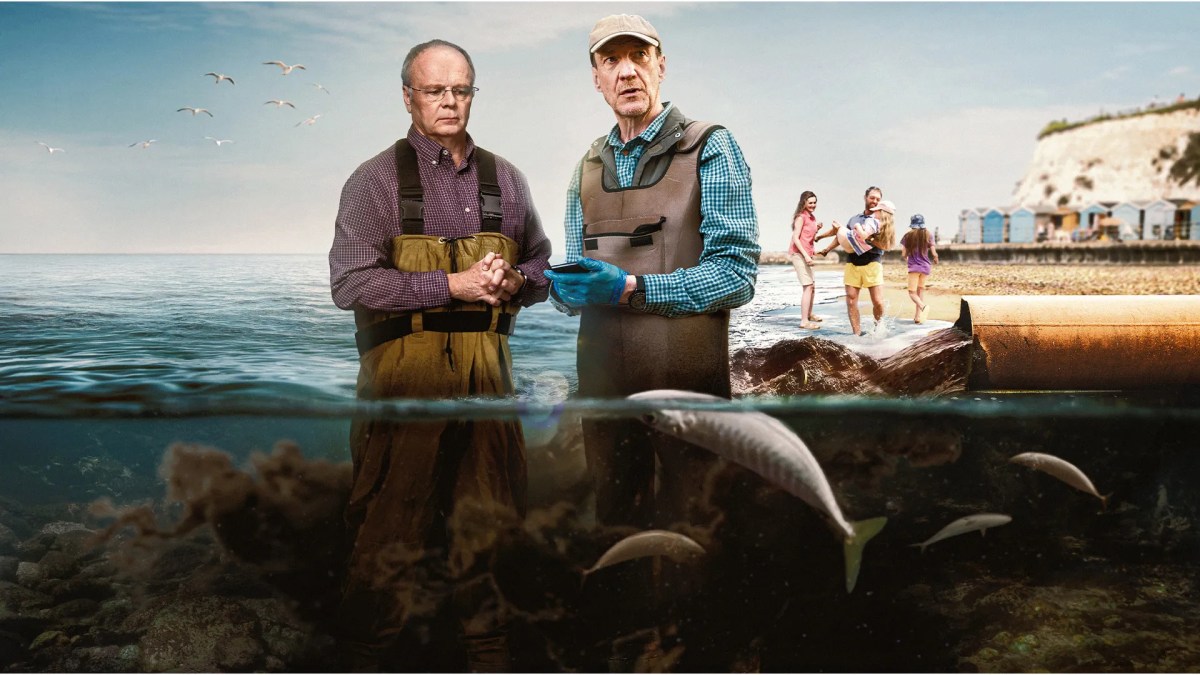

Channel 4’s Dirty Business arrives in the long shadow cast by Mr Bates vs The Post Office, the landmark drama that demonstrated – rightly or wrongly – how dramatised retellings of real corporate failure can succeed where investigations alone sometimes struggle, bringing public attention, sympathy and renewed scrutiny to scandals that might otherwise fade from view. Like that earlier series, this three-part drama turns systemic incompetence, corporate opacity and regulatory failure into compelling television.
The story follows retired friends Peter Hammond and Ashley Smith, played by Jason Watkins and David Thewlis, whose quiet fishing sessions along the River Windrush take a quite literal darker turn when they notice the water has turned murky and brown. Pub conversations spark curiosity, and Hammond – a former academic specialising in machine learning – begins analysing publicly available data connected to Thames Water. What emerges is genuinely shocking: soaring sewage discharges, failing treatment centres, creaking infrastructure, and privatised water companies ultimately controlled by vast profit-driven financial institutions.
This site isn’t here to review causes or campaign points, but storytelling, and in pure dramatic terms, Dirty Business is really good. The script is lean and confident, transforming dense exposition into natural, conversational dialogue that more often than not never feels like a lecture. Particularly effective is the ingenious blending of real footage of sewage dumping into the fictional narrative, grounding the drama in uncomfortable reality without breaking immersion.
Crucially, the series never forgets the human cost. Early on, young Heather Preen steps into contaminated water during a seaside trip with her family and later dies from E. coli poisoning; the devastating aftermath, including her father’s suicide after a court case delivers no meaningful justice, provides the show’s emotional core. Elsewhere, surfer Reuben Santer’s illness following exposure to polluted water reinforces the consequences beyond statistics and headlines.
The drama spreads its criticism widely – from water companies themselves to the Environment Agency, and even the anti-regulation policies of the David Cameron government (oh hi Liz Truss), whose government’s cuts reduced inspections and oversight.
It’s fast-paced, angry television that will leave viewers seething. The only misstep is tonal: at times the drama veers unexpectedly into comedy, perhaps unsurprising given a supporting cast that’s weirdly packed with comic talent, including Alice Lowe, Tom Walker, Vicki Pepperdine, Jon Culshaw, Sunil Patel, and Charlotte Ritchie. (They must have been having a sale on comedians in the casting supermarket.)
Even so, Dirty Business remains gripping, furious and expertly constructed drama. Television that’s designed not just to inform, but to provoke.
Paul Hirons
⭐⭐⭐⭐⭐
Rating: 4.5 out of 5.
Dirty Business is broadcast in the UK on Channel 4 and Channel 4 streaming