
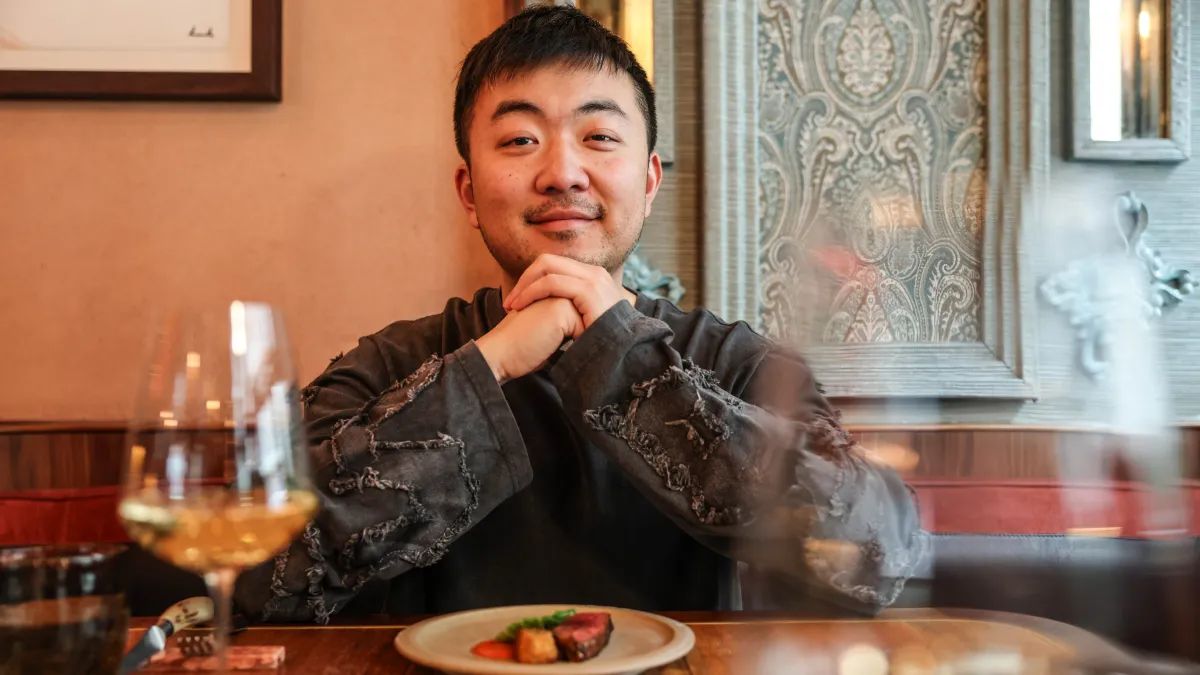
Carl Pei’s choice of lunch venue risks reigniting an international incident. The founder and chief executive of Nothing, the London-based smartphone maker, caused a furore last year when he claimed London’s Indian food is better than it is in India.
The ensuing row went viral, including in India, a key market for Nothing, one of the UK’s most promising private companies.
Now Pei, 36, is lunching with The Times at BiBi, a modern, Mayfair-based Indian fine-dining restaurant, a choice that he believes will support his position on the quality of the capital’s Indian cuisine.
Enterprise newsletter
Advice and inspiration for entrepreneurs in The Times Enterprise Network’s briefing.
Sign up with one click
Lunch is a four-course set menu, which starts at £65 a head, rising to £100 if you pick beef instead of paneer for one of the courses and £170 if you want a caviar supplement.
“It’s a modern take on Indian food, not these huge plates,” enthuses Pei, who is returning to BiBi for a second visit after a recommendation from one of Nothing’s investors, who once flew from New York especially to eat here. It’s certainly a far cry from chicken tikka masala and a pint.
Before we’ve had a chance to look at the menu, Pei pulls a yet-to-be-released Nothing phone from his pocket. He is excited about what’s about to hatch from an egg portrayed in a small pixel matrix on the back of his device.
He explains: “I’ve been making a lot of things with vibe coding,” the term for programming with artificial intelligence rather than traditional coding skills. Inspired by a revival in the 1990s Tamagotchi craze, Pei has spawned a creature in his phone’s matrix. When the egg hatches, he will have a digital pet to nurture.
“I told it to make the Tamagotchi more healthy the more steps I walk and less healthy with more screen time,” Pei says.
It’s these kinds of offbeat ideas that have helped Nothing to emerge from a standing start in 2020 to a “unicorn” valuation of $1.3 billion (Pei argues it’s undervalued) and well over $1 billion in lifetime sales.
Its first phone stood out thanks to “glyph interface”: a back inset with LEDs that could be illuminated in different ways silently to communicate notifications from the phone even when it is face down. Other innovations have included its “essential apps”, whereby customers help determine which apps get built by describing what they want.
The company employs almost 900 staff and also makes other gadgets including headphones and smartwatches. It has a retail presence in London, India and the United States and its devices have won several design and technology awards.
Not bad, especially given Nothing is one of the only smartphone makers of any scale to emerge in recent years in a mature market dominated by Apple and Samsung. Pei, however, insists the progress represents little more than a “warm-up”. “Less than 10 per cent of the UK knows we exist, there’s a long way to go.”
Pei is a computer gamer and he likens running Nothing to an “increasing difficulty for each level”. “But it’s fun. I could never go to a corporate after this. It’s too much freedom.”
When the waiter arrives for our drinks orders, Pei asks for a diet coke, but is told BiBi doesn’t offer soft drinks of that sort.
He responds that he’s fine with water but when I remind him that our meal is on The Times, he adds: ”Oh, in that case … why not, it’s Friday!” We each have a glass of champagne.
Pei was born in Beijing in 1989 but soon moved with his parents, academics specialising in Alzheimer’s disease research, first to the United States, and then Sweden.
He says he was a loud child while growing up in Staten Island, New York, but an introverted side emerged in Sweden. “I always felt a bit like an outsider. Maybe that’s where I got the feeling I had to prove myself.”
An interest in money emerged from the age of 12, partly because his parents didn’t provide an allowance, he says.
Over Sweden’s dark winters, a teenage Pei built websites. A service that allowed people to download “backup” copies of computer games, which he claims was briefly the most popular of its type in the world, was closed on the orders of his dad.
His parents were dismayed when he dropped out of Stockholm School of Economics over his frustration with the teaching. “They were trying to get us into management consulting and investment banking, not to set us up for success in business.”
By then, Pei already had experience of trading in Chinese products and he got a job at a smartphone company in China in 2011. Two years later, at the age of 24, he co-founded OnePlus, a smartphone maker which had sales of about $5 billion by 2024.
“I was probably [good at] marketing and partnerships. But I was really terrible at everything else including managing and leading teams,” he recalls. He did well enough to buy his parents an apartment in Stockholm in 2017, at which point they stopped asking him when he might go back to school.
He left OnePlus in 2020 amid rumours of a rift with co-founder Pete Lau. “They want to run a stable business, don’t take too much risk. I wanted a platform to be able to shape the future of how people use technology. I knew I had to be independent to do that.”
Pei thought he would take a career break after OnePlus. It lasted ten days. “I was staying at fancy hotels, drinking good wine, hanging out in the pool. I felt, I’m burning my life away. I felt this anxiety to be productive.”
He decided to enter the smartphone market because “the industry got really boring”.
Nothing launched its first phone in 2022 and had sold more than two million devices by the end of 2023.
Pei says he found the company’s launch period so stressful he had an irregular heartbeat. A recurrent nightmare involved calling a staff meeting and telling them the business was going bust. His doctor said he was “overwhelmed at work, too stressed, that I need to calm down a bit”, Pei says.
A two-day blowout nightclubbing in China provided a reset. “I think a lot of stress desensitises you. So now I’m kind of numb to stress. These days I’m pretty relaxed. I bounce back a lot faster.”
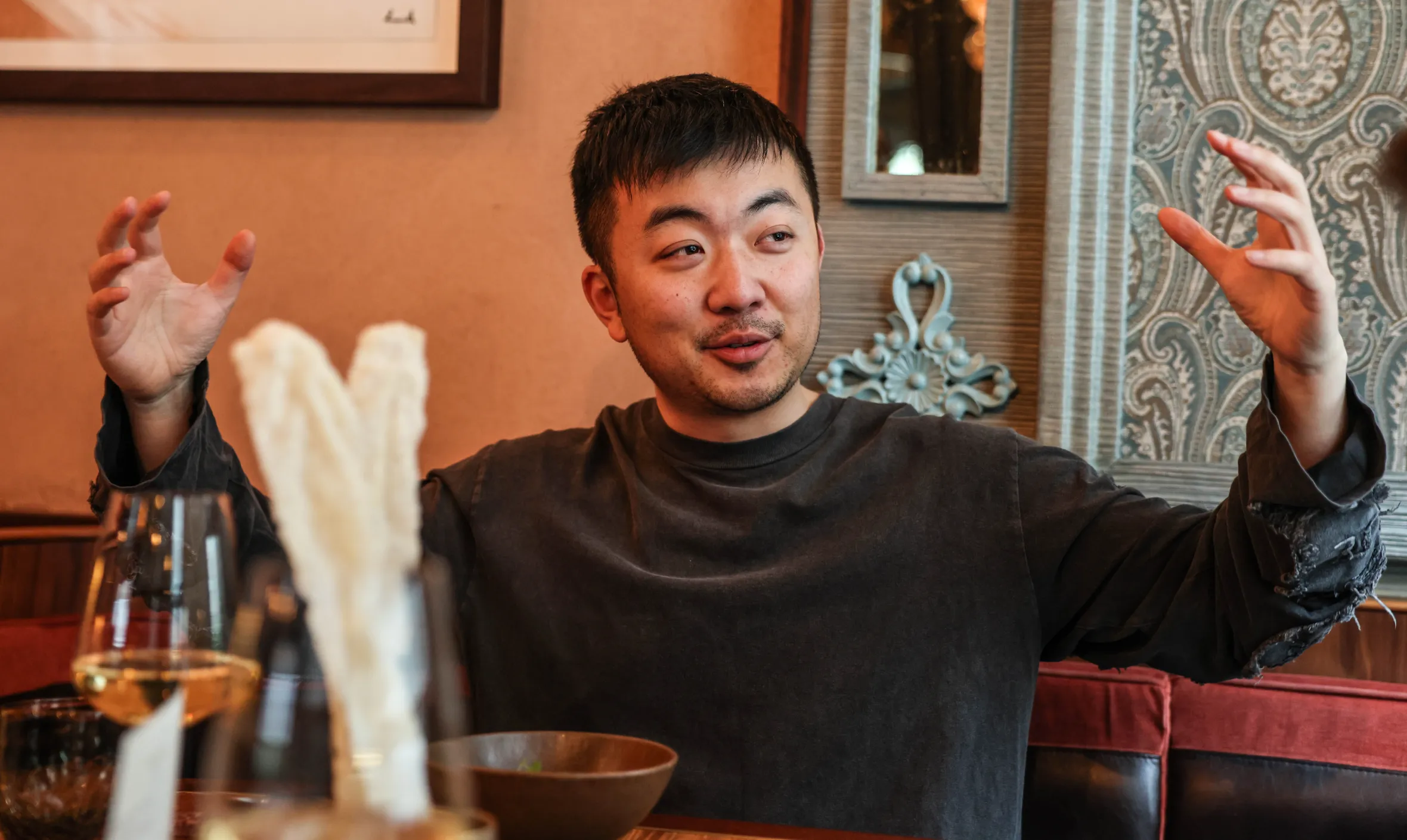 “It’s fun. I could never go to a corporate after this. It’s too much freedom,” Pei says of running Nothingrichard pohle for The Times
Pei is engaged, he proposed shortly before a visit to Taipei night market, and likes skiing, eating out and gaming, although his passion for vibe coding risks overtaking the last of these. “Once you realise anything you can imagine can just happen, you get a much bigger dopamine hit than with games.”
As the closest thing to a traditional curry dish arrives, a delicious Lahori chicken said to be a recreation of a beloved dish of the grandfather of Chet Sharma, BiBi’s patron, we discuss Pei’s role as the face of the brand. Nothing attracts a cultish devotion among some of its users and Pei says he is recognised in the street enough that he has taken to using Ubers instead of the London Underground in case he is photographed with prototypes.
He appears to regard the role as a necessary evil, although he has dropped the stylist he hired to improve his look. “Ideally, I think the strength of a business is when the founders are not needed. I think now, early days, a lot of the opportunities are not available if I don’t show up. But I would love to be in the background.”
Pei says Nothing wants to be ready for a potential stock market float by the end of 2028, but he is in no hurry to cash in his chips. “I just see floating as another round of fundraising. There’s no real exit in mind. I think we can build something really cool over time. Hopefully, this is a place where I can retire.”
He doesn’t rule out London as a float destination but is concerned about what he sees as hostility towards entrepreneurs: “It feels a bit like, ‘you’re the capitalists, we’re the workers, you’re just exploiting us’.”
After our Kulfi desserts and an espresso each, Pei heads off in an Uber to meet product designers. He says the company is aiming to get to the point that product launches slow down, and where its ambitions for its launches grow.
“Now that we’ve built the capabilities, we can take the next step. “Nothing is between us and becoming a trillion dollar company. Only our skill level and whether we can evolve fast enough and improve fast enough.”
Receipt
Hildon still water £7
Hildon sparkling water £7
2 x glasses of Pol Roger champagne £64
2 x lunch set menu £130
2 x Wagyu beef supplement £70
2 glasses of Raj Parr pinot noir £54
2 espressos £16
Service: £52.20
Total: £400.20
CV
Age: 36
Education: Stockholm School of Economics, 2008-2011 (dropped out)
Career: OnePlus, 2013-2020; Nothing, (2020 – present)
Family: Engaged to be married