
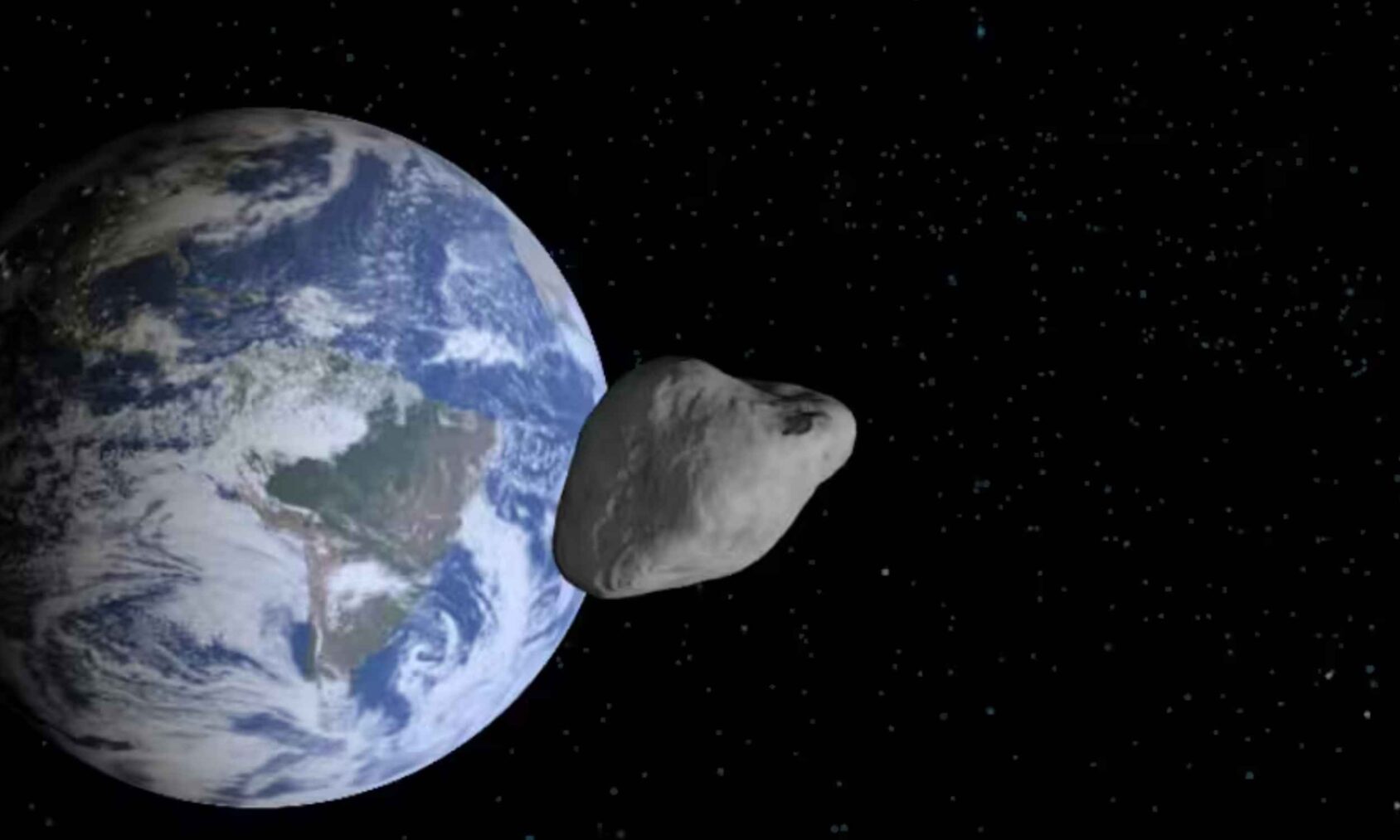
What if the most spectacular sky show of the century came with a very down-to-Earth problem for your GPS, your weather app, even the satellites that track climate change? That is the puzzle scientists are wrestling with as they study asteroid 2024 YR4 and its small but real chance of slamming into the Moon in late December 2032.
Right now, astronomers estimate that this building-sized rock, roughly 60 meters across, has about a 4% chance of striking the lunar surface on 22 December, 2032. It no longer poses any significant threat to Earth itself and would not disturb the Moon’s orbit, according to updates from NASA and other space agencies.
Even so, new studies suggest the consequences in near Earth space could ripple through the technology that underpins everything from navigation to environmental monitoring.
A once-in-ten-thousand-years lunar impact
On paper, 2024 YR4 is not huge. It is comparable in size to a ten-story building and far smaller than the asteroid that wiped out the dinosaurs. Yet if it hits the Moon, the energy released would be similar to a medium nuclear detonation and likely the largest lunar impact in around five thousand years.
Numerical simulations led by researchers at Tsinghua University show that such a collision would blast out a crater about one kilometer wide and up to a few hundred meters deep, with a glowing pool of molten rock roughly one hundred meters across at its center.
The impact would also trigger a global moonquake around magnitude 5, strong enough for seismometers across future lunar bases to pick up clear signals and use them to map the Moon’s interior layer by layer.
In other words, the Moon would briefly turn into a natural geophysics laboratory.
A free window into the Moon’s hidden layers
For planetary scientists, that violent moment would be a goldmine. The Tsinghua team lays out an observing plan that runs from the first flash of impact to the slow cooling of the crater.
Telescopes on Earth could catch the brilliant burst of light and the expanding plume of vaporized rock. Instruments like the James Webb Space Telescope could then watch the still-glowing melt pool in infrared as it cools over hours and days.
By tracking how heat radiates away, scientists can refine models of how craters form on airless worlds. Seismic waves from the moonquake would crisscross the interior, revealing density changes that hint at deep structure and maybe buried reservoirs of useful minerals for future lunar bases.
Some of the blasted material would not stay on the Moon at all. Simulations suggest that a fraction of the ejecta would escape lunar gravity, drift through space, then fall toward Earth as meteorites with known “return addresses” on the Moon.
In the most favorable scenario, roughly 400 kilograms of lunar rock could reach the surface within the first year, with many fragments landing in dry regions like parts of South America, North Africa and the Arabian Peninsula that are ideal for meteorite searches.
Imagine holding a fresh piece of Moon in your hand that you did not have to launch a spacecraft to collect.
A meteor storm made of Moon rock
The headline grabbing part of the story is the meteor shower. Studies by the Tsinghua group and a separate team at University of Western Ontario show that an impact of this size could loft up to one hundred million kilograms of lunar material into space.
In some impact geometries, especially if the asteroid hits the side of the Moon facing Earth, a few percent of that material could be pulled into our atmosphere within days. Meteor rates in the upper air could spike to many orders of magnitude above normal.
One analysis based on the new models envisions peak rates of up to twenty million meteors per hour on the side of Earth that faces into the stream, including roughly one to several hundred bright fireballs each hour.
For people on the ground, this would mostly be a light show. The vast majority of fragments would be millimeter sized grains that burn up high overhead. A relatively small amount of larger material would survive to reach the surface and current maps suggest that it would fall mainly over sparsely populated belts of desert and grassland.
So where is the catch?
When orbital debris threatens climate satellites
The real concern lives higher up, in the crowded lanes where satellites orbit Earth. The Western Ontario team, publishing in Astrophysical Journal Letters, found that a 2024 YR4 impact could expose satellites in low Earth orbit to the equivalent of years to a decade of normal meteoroid hits compressed into a short interval around the end of 2032.
Even tiny rocks moving at tens of thousands of kilometers per hour carry enough kinetic energy to pit solar panels, shred thermal blankets or damage delicate instruments. That matters for everyday life. These orbits host the satellites that carry internet signals, route transoceanic calls and guide aircraft through crowded skies.
They are also home to the Earth observation fleets that watch wildfires spread, track hurricanes, measure sea level rise and monitor illegal logging or methane leaks in remote regions.
If enough satellites were damaged or destroyed, their fragments could collide with other spacecraft, creating more debris and raising the risk of a cascading chain of impacts known as Kessler syndrome.
Some researchers warn that an unlucky impact geometry might nudge the space environment in that direction, complicating plans to launch new satellites safely and potentially degrading navigation and climate monitoring services for years.
You might not notice the first small hit. A glitch in satellite internet here, a slightly fuzzier weather forecast there. Over time, though, the loss of key instruments could make it harder to track droughts, heat waves and storms in the detail that modern climate adaptation efforts depend on.
Deflect the rock or take the risk
Because the odds of a lunar impact are still low and the asteroid is currently hidden behind the Sun, 2024 YR4 will not be in anyone’s crosshairs tomorrow morning. Astronomers expect to see it again in 2028 and only then will they be able to tighten the impact probability.
If the chance of a hit stays around a few percent, agencies will face a tricky choice. Planetary defense tools tested by NASA’s DART mission show that gently nudging an asteroid off course is possible in principle.
Using that technology here could protect satellite networks and future lunar infrastructure but it would also erase a once-in-ten-thousand-years opportunity to study a major lunar impact in real time and to collect pristine samples of Moon rock.
At the end of the day, the scenario is a reminder that “space weather” is not only about solar storms. It is also about rocks hitting rocks and the delicate web of technology that now hangs between Earth and the Moon.
The detailed impact and observing scenarios come from the preprint Observation Timelines for the Potential Lunar Impact of Asteroid 2024 YR4, and the study was published on arXiv.