
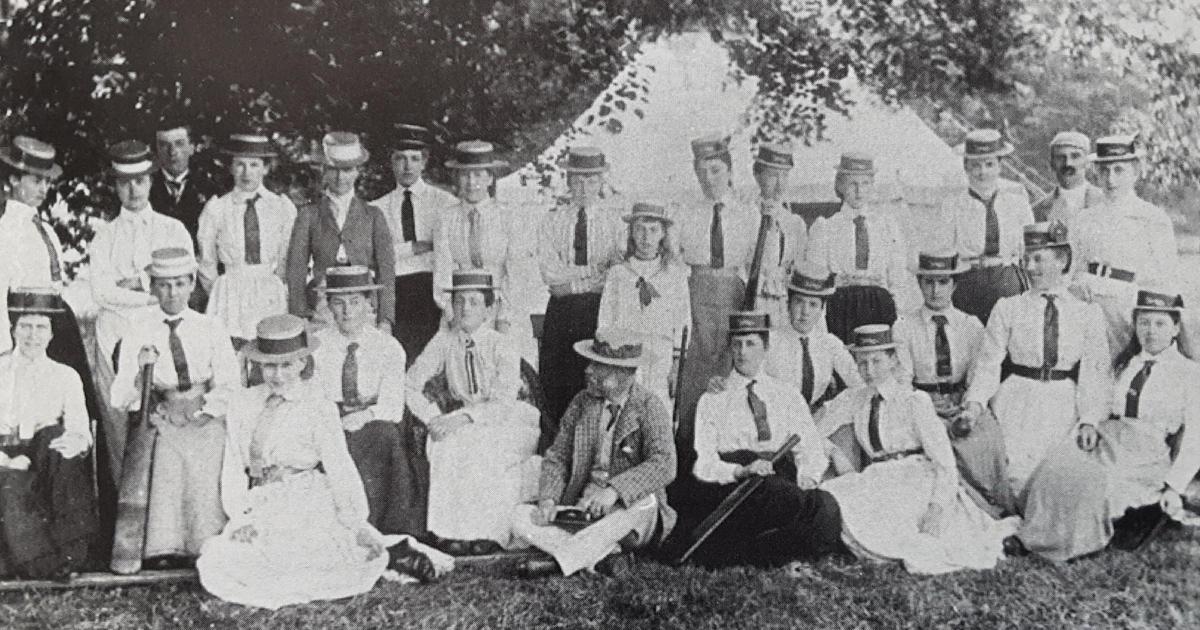
For example:
In 1823, at Hockwold-cum-Wilton, 11 married women defeated 11 single women for a prize of 11 gloves.
The gardens at grand country houses across Norfolk were ideal settings for ladies’ matches.
The Gentlemen of Norfolk who played the wandering side I. Zingari at Gunton Park in 1862 (Image: M.C.C)
They were popular at Narborough Hall Park, the home of Joseph and Constance Martin, where, in 1890, the “Norfolk Foxhounds” took on the “Suffolk Harriers.”
At Morley Hall, near Wymondham, in 1909, Miss Jacob’s Morley X1 defeated Miss Upcher’s Hingham X1 by 24 runs, and in the 1920s Rosalind, the daughter of Sir Edard Stracey of Rackheath Hall, often turned out for the village team.
And matches for women were popular before the last war with teams such as Aylsham, Dereham Jentique, Sennowe Park, and a county side.
There is so much to say about cricket across the county, and the story is told so well in a book written by Philip Yaxley of Wymondham in 1997.
This was Looking Back at Norfolk Cricket published by Nostalgia Publications of Toftwood, and when I spoke to historian Philip this week, he said: “I was so pleased to see how popular it was.
“It was my bestseller!” he said.
Born at Horningtoft, Fuller Pilch was only 17 when he first appeared at Lord’s in 1820 and went on to become England’s top batsman (Image: Philip Yaxley Collection)
His large collection of stories, memories, and rare photographs paint a colourful picture of the game, highlighting matches, teams, and personalities.
From village greens to the county ground at Lakenham.
The foreword was written by our own world-famous John Edrich.
The first mention of cricket in Norfolk was in the Norwich Mercury in May 1745, and by the 1760s there were teams in Diss, Great Yarmouth, Norwich, Shipdham, and Swaffham.
Clubs in Brinton, Castle Acre, Docking, East Dereham, Holt, and Wells followed.
In 1764, there was a report of a match when the Gentlemen of Norfolk beat those of Suffolk at Bury St Edmunds, and in 1789 it was reported that Castle Acre beat Docking, a team which was described as “champions of this county.”
Many of Norfolk’s landed gentry loved the game, and in the summer of 1797 at Swaffham Racecourse, 33 players from Norfolk and an All-England X1 gathered for what was described as “the greatest cricket match ever played in this county.”
The epic encounter was contested for a huge purse of 500 guineas, and many of the nobility arrived from London and across the country to watch the game.
A contemporary engraving of the game played at Swaffham racecourse between Norfolk and an All-England team in 1797 for a purse of 500 guineas. Norfolk lost (Image: Philip Yaxley Collection)
Norfolk was thrashed by an innings and 13 runs.
This was followed by a match between teams raised by the 9th Earl of Winchelsea and Lord Beauclerk, whose side included Thomas Lord, the founder of Lord’s Cricket Ground, who had spent some of childhood at Diss.
In 1815, there was a game played on Hempton Green, between the parishes of Litcham, Dunham, and Brisleyy, and those of Walsingham and Fakenham, who failed to score a single run!
There was one young man from Horningtoft in Norfolk who was an outstanding player.
Fuller Pitch first played at Lords for the county in 1820 at the age of 17.
He went on to become England’s top batsman, and in famous single-wicket contests in 1833, he beat Yorkshire’s top player Tom Marsden, first at Norwich and then at Sheffield, in front of more than 12,000 spectators.
A boy cricketer captured by Cleer Algar (Junior), the Diss photographer between 1865-75 (Image: Gressenhall Rural Life Museum)
He went on to play for Kent.
Two hundred years ago, moves were made to form Norfolk County Cricket Club, and in 1831 it was described as “now the next club to Marylebone”.
There were, however, tough times ahead.
Probably the earliest surviving photographs of Norfolk teams are of their match with I Zingari, the famous wandering club, at Gunton Hall in 1862, and four years later, an event called “The Great Cricket Match at Sandringham” between I Zingari and the Gentlemen of Norfolk took place.
The Prince of Wales was included in the I Zingari team.
As you can imagine, it was a very classy affair with members of the Royal Family and local gentry in attendance, enjoying sumptuous food while listening to a band.
The Prince of Wales opened for I Zingari and was bowled for a duck by Dereham solicitor Charles Wright.
Born at Carleton Forehoe in 1873 the Rev. George Barkley Raikes was an outstanding sportsman. He was featured in Famous cricketers and Cricket Grounds, edited by Charles Alcock and published by the News of the World in 1895 (Image: Family collection)
Mind you, the visitors went on to beat Norfolk.
And there was an extraordinary game at Lakenham in the summer of 1868 when the first overseas tourists to England, the Aboriginal Australians, played Carrow.
The home side won, and at the end of the second day, the Aboriginals delighted a large crowd by demonstrating spear and boomerang throwing.
To be continued…