
The first thing that strikes me is the darkness. I can’t see any stars – only clouds.
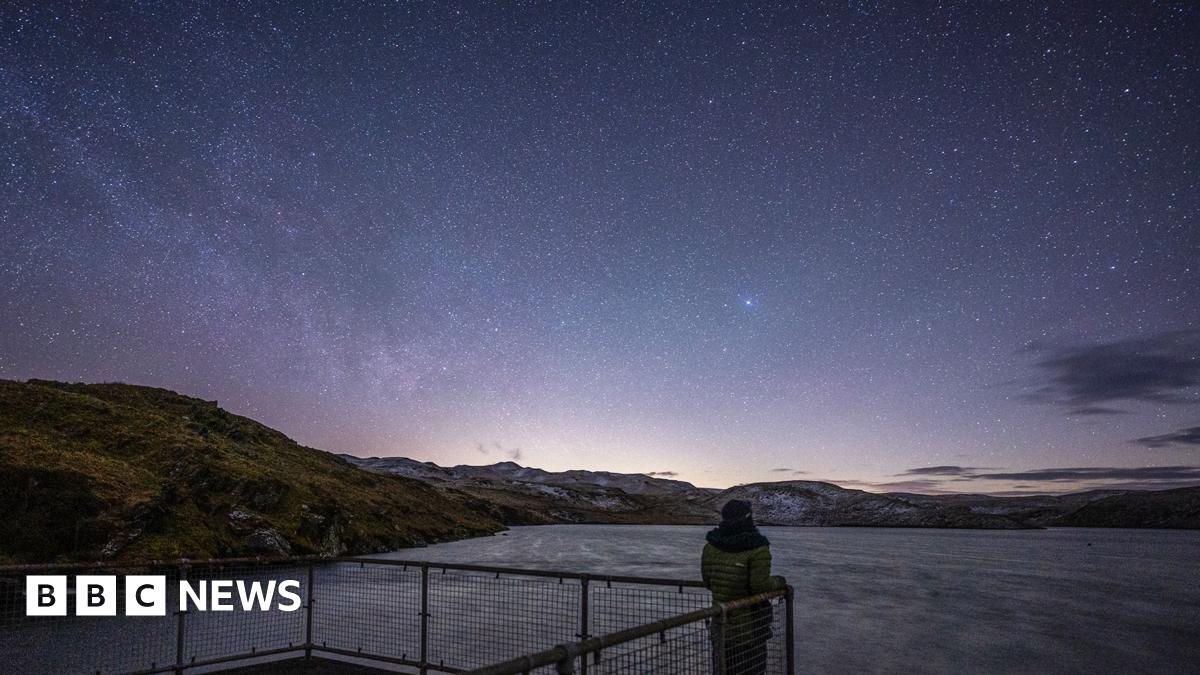
Four-and-a-half hours later, at 22:30, the stars finally emerge, and it is breathtaking.
The stars extend as far as the eye can see, in every direction.
I’m with Siân and James Harrison, two avid star fans who’ve travelled from Cardiff to the tiny hamlet of Gogoyan, in the sweeping Ceredigion countryside in west Wales.
We’re here to immerse ourselves in the night sky with the help of a guide.
Lying on a blanket spread out on the ground, we gaze up at Jupiter, one of the brightest planets in the sky.
Poiting with a green laser which extends into the night sky, Dafydd Wyn Morgan, owner of astrotourism company Serydda, shows us three stars in a line, telling us he loves Orion’s Belt.
James chimes in, saying it’s his favourite constellation, as the region surrounding it is a part of space where stars are constantly being born.
“I’ll focus on something and it’ll be 150 million light years away,” James says. “I can’t quantify that.”
A sense of calm washes over me. I feel like I’m looking at the same sky my ancestors would have seen.