
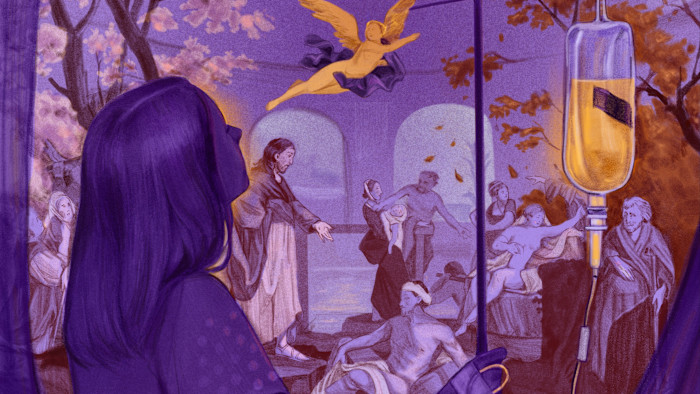
It is early September 2024 when I first walk through the Henry VIII gatehouse of St Bartholomew’s Hospital, the oldest hospital in Britain still working on its original site. Founded in 1123 as part of the Priory of St Bartholomew, it is situated at the entangled junctures of ancient and modern London, skirted by the Barbican to the east, Smithfield meat market to the north, the Old Bailey to the south. The church of St Bartholomew the Less inside the grounds is the only remaining medieval structure, and the main hospital was rebuilt around a piazza courtyard in the 18th century.
I pass construction work and scaffolding and elegant hoardings declaring an ambitious scope of works that are hidden from view. The 18th-century North Wing section, housing the Great Hall and Stair painted by William Hogarth, who was born nearby on Bartholomew Close, is undergoing a huge restoration project. A reproduction self-portrait of the artist and his pug hangs jauntily upon a section of building site.
I barely register it, barely look. For now, my gaze is fixed upon the bright modern atrium building where I am about to be told if I have made the cut for an experimental new vaccine trial to treat kidney cancer. Like a character in a Russian folk tale, I have had to undergo a series of exacting tests before Baba Yaga will grant me access to the fabled 27th kingdom, and one of these is a brain scan. There will be 272 people enlisted on the trial around the world, and there is a chance I might be one.
This is how it begins. One night in February, a dangerously high blood-pressure reading causes my husband to Google the Mayo clinic, which suggests a medical emergency. I’d been monitoring it since January after a GP’s nurse flagged it up during a routine check. “I’ll take you to hospital,” he says, and I resist. It is late, and I am already cocooned in pyjamas, my finger in the page of a novel I am about to sink into. “I really think you should go,” he says. “I’ll drive you, don’t worry. Better to be safe.”
Then the late-night drive to hospital, the incidental find of a mass, silent and unobtrusive. An incidentaloma, a neologism that describes a tumour found by chance during a diagnostic imaging test performed for another (unrelated) medical reason.
In the weeks that follow, my husband is the search engine, researching and sifting and organising; it is he who presses for a second opinion, who finds a surgeon. He crunches medical data on immunotherapy and statistical outcomes and returns it to me in bite-sized portions that I nibble and metabolise.
My tumour is 5cm in diameter, and it is designated Stage 1B, which means it has been detected at an early stage. A stroke of luck. During robotic laparoscopic surgery, the surgeon removes a margin of several millimetres around its perimeter and checks it is clear while still in theatre. I wake up to the news that I still possess two kidneys, which feels like a gain until the revelation that there are microscopic indications of invasion into the fatty layer beside the kidney.
This translates into the cold hard statistic that the chances of recurrence are high, and I leap from Stage 1 to Stage 3 and into a new threshold of inchoate fear. “But overall, it is positive news,” the surgeon reassures me, because the tumour itself has been successfully removed with no evidence of spread to other organs. His work is impeccable, leaving scant visible trace; a series of punctuation marks, five dots and a bracket on my abdomen. We shake hands and say goodbye, and he wishes me the best of luck before I walk back down the sun-drenched corridor.
At airports, there is the strange frisson of being made to stand with two feet spread apart on decal footprints, and two hands raised in surrender to the millimetre-wave body scanner. Yet after all these years of surveillance, the steel screw in my left metatarsal, an innocent old fix for an awkward fracture, has never been caught on screen by the security staff, never set off an incriminatory beep. Nor does it get any mention by Professor Thomas Powles, the puckish consultant leading the mRNA vaccine trial at St Bartholomew’s Hospital. “Your CT scans are all normal,” he says. “But there was something unusual about your brain scan.” He spins around from his computer to face me.
I sit on the edge of the Vitra chair in his office of the bright atrium building, and brace for shock. I see the empty Coke Zero can and the Twix packet on his desk, signs of a carefree approach to snacking, and decide that he is not about to deliver bad news. In fact, he gives Willy Wonka energy in the moment, mischievous and excited: he’s going to give me the golden ticket, I know he is!
“Did you know you had a stroke,” he asks curiously, “a minor infarction, a very long time ago? The white squiggle, right here.” Like a silent erasure, an infarction occurs when the blood supply is blocked, leaving behind a small area of necrotised tissue. “I did not know,” I say, though I do recall straightaway, exactly when it happened. To the year, the date, the moment.
The infarction is like a wormhole, spinning me back three decades to a cold dark January night on a road in Scotland. My father was moving house, moving north from Huddersfield to Edinburgh. In a harried, middle-of-the night kind of way, I had driven up that evening to help. He was in his late fifties, divorced and living precariously on income support. The van I was driving skidded on black ice and sent me flying through snowflakes on to frosted tarmac, a muddle of shattered toes and legs, a knee, a foot. Scattered around me were all his worldly possessions, his gas stove and his suitcases of clothing, his chests of drawers and boxes of books.
Ten days later, as I lay on a geriatric ward in the Edinburgh Royal Infirmary, a nurse gave me an injection that seemed to trigger another ill-fated journey. An air bubble in the syringe entered my bloodstream and raced up to my brain to produce an embolism that briefly paralysed the left half of my body. And while the right-hand side of my mouth screamed for help, the left-hand side enacted a vivid struggle against it, tugging me across the threshold into Lethe, the dark river of oblivion. The infarction evanesced in minutes, or seconds, or nanoseconds and, like a miracle, I was back with the living, back to 1989 on the noisy geriatric ward in the dying days of Tory rule and the osteoporotic NHS, and a nurse in a panicky voice insisting, “Oh you’re fine, you’re all right, hen. You’re not dying!”
But I nearly had. And in another century, in an ancient hospital that is now shiny and new, the experience is finally named and categorised. Here is visual evidence, a white blotch on the scan. The scan is a threshold into another form of seeing, a palimpsest of time and place, and I sift back through the fragments of what happened all those years ago.
Something else was lost in the jumble of possessions spilled on the roadside. Something that I urgently needed to retrieve that night: a portfolio of work, my application for graduate school, that had to be posted to New York University the following day. In the final minutes before I went into surgery, I begged my father to find it and make sure it was sent.
Do not go to Google in the event of a diagnosis is the usual advice. But why not? I feel the need to seek out images of the kidney, an organ to which I have paid scant attention until this moment.
In the blank days between surgery and treatment, I hunt down ancient images of kidneys online. How did people visualise their organs, their pathologies, in the centuries before scanning made our innards so patently readable? I find a 16th-century Chinese woodcut engraving of Shenzang in an archive of medical ephemera, and learn that Shen means kidney, and the kidney is a Zang organ, one of the five Zang viscera. There are two of them, resembling stones, located adjacent to the 14th vertebra in the back, below the stomach, on both sides. “The left kidney, or kidney (shen) proper, partakes of the nature of water, while the right kidney, the mingmen (Portal of Life) partakes of the nature of fire. The mingmen is crucial to life; it is the place where innate Qi is stored, the origin of life processes, the very root of existence.”
Then I search for “infarction” and am rewarded with an image from the distant past, a 17th-century engraving of a crooked Chinese man after suffering a zhongfeng (wind stroke), a phrase which holds both violence and lyricism, another way of seeing a white squiggle.
“Is there just one person that we are meant to meet in the world,” my daughter muses one day in the kitchen in London. “The perfect match, the love of your life?” A dreamy question she floats now and again, and I wonder if there is a cache of data somewhere that would furnish a satisfying answer once and for all.
“I don’t know,” I say. “I don’t think so.” But here is the thing. If the portfolio had not made it over the Atlantic, if it had been lost and my place at graduate school forfeited, I would never have met my husband; we would not have found each other. Then the incidentaloma might not have been found either, the infarction might still be hidden, the vaccine trial another path in the gameplay not chosen.
I am bad at reading instruction manuals, and I never bother with the enclosed slip of side effects in small print found in a packet of pills. The vaccine trial consent file lands in my email inbox with a nagging alert: Read Me! which makes me think of Alice Through the Looking Glass. The thick document has been sent in advance of my first meeting with the clinical trial team, but I cannot bring myself to open it.
The next day, I shuttle back to the clinic on my bicycle, and meet the senior clinical research practitioner, a woman in her thirties named V. She has long dark hair and calm brown eyes, and her manner is gentle, focused. She hands me a clipboard holding the consent form that has been languishing in my Downloads. Everyone is excited about the prospect of my joining the trial; everyone, it seems, except me. V ushers me in the direction of the scales and the blood pressure monitor before I manage: “I need to think about this, I’m not quite sure I’m ready to sign yet!” Time is passing, time is of the essence, the window is closing. I sign.
A tissue sample from my kidney tumour and blood samples will be sent to Switzerland to be tested, before being dispatched to a Merck lab in New Jersey, where an individualised vaccine will be designed and made. The cancer vaccine was developed by Moderna, the biotech company specialising in mRNA research, who created one of the first Covid-19 vaccines.
My roll-call of side effects is moderate: itchy skin, nasal congestion, gargantuan sneezes that terrify the cat
The trial is a Phase 2, randomised, double-blind clinical study of (mRNA 4157), as yet unnamed, and it will last eight years. A combination of immunotherapy using checkpoint inhibitors, magical molecules that stop cancer cells from hiding within the body, in tandem with the vaccine to further boost the immune system response.
You, your trial doctor, and the trial staff won’t know what treatment you are getting, says the consent form. You can choose to withdraw from the trial at any time without giving a reason.
Half of us will be given a placebo, and I may never find out whether I have actually received my individualised vaccine or just a vial of plain saline. After nine jabs administered every three weeks, I will undergo regular surveillance: blood tests and full-body scans, for months and years to come. During treatment, I will visit the trial site about 14 times for blood tests, scans and infusions. I will be given a card that identifies me as a trial participant, to be carried at all times, in case of emergency.
One day in early October, I walk past the church of St Bartholomew the Great where Hogarth was baptised, past the restoration team in their hard hats and high-vis jackets, past the scaffolding and dusty hoardings, the memorial benches and the pigeons, and into the atrium building for my very first immunotherapy infusion on the seventh floor. My treatment chair has an enviable view of St Paul’s Cathedral, and peeping out through the rooftops is Lady Justice on the dome of the Old Bailey, balancing the sword of authority in her right hand, the scales of justice in her left.
“Right or left arm?” the nurse asks, and I tell her I don’t mind. She admires my fulsome veins as she tightens the tourniquet on my left upper arm, and inserts the needle. A bag of clear liquid, the infusion, is hung upon a stand connected to an electronic monitor, which is fed into my body via the drip in my arm. All around me there are people receiving their own individualised cocktails of high-tech infusions, and a sleepy atmosphere of placid acceptance prevails.
I tune into signals from my body, hoping that I have won the golden ticket
In the weeks that follow, I meet the professor for my consultation, who seems genuinely gripped by his own question: “What have you got for me?” Luckily, I don’t have much. My roll-call of side effects is moderate: itchy skin, nasal congestion, gargantuan sneezes that terrify the cat. “Beautiful,” he says, and means it. “We’re very happy with how things are going.” And when I prompt him about when the actual vaccine treatment will start, he whirls off down the corridor to find the answer. “They’re saying December,” he says, crestfallen. “Bit of a wait, I’m afraid.”
I adjust myself to another shift on the horizon of uncertainty. The wait won’t kill me. In truth, it is barely a wrinkle in time, and I cannot help thinking my timing has been good. If my diagnosis had happened five years ago, or 10, or 400, none of this would be even possible. I have become grateful for alerts and schedules, and for the incidentaloma that has landed me in this place, right here, right now. “You’ll be well taken care of by the trial team,” the professor says reassuringly. “It’s Merck running the show, and they keep us all on track here.”
November comes, and with it, the re-election of Donald Trump. This time, the win is decisive, passing the critical threshold of 270 electoral college votes. “The autumn winds blow chilly and cold”, sing Simon and Garfunkel through my earphones as I wait my turn for the phlebotomist. The sentiment has never seemed truer than now. In the countdown to Christmas, the nights grow longer and days are compressed ever more tightly into brief lozenges of cold grey light. At the end of my street, the Caribbean family who are always first with their Christmas tree somehow beat their own record and put it up before Advent, a personal best of blue fairy lights against the gathering gloom.
On the 17th day of Advent, a celestial figure appears in the calendar window when I open it, heralding the day of my first vaccination. In St Bartholomew’s Hospital, the North Wing restorations remain hidden behind scaffolding, and somewhere inside the King George V Building, a patient is haltingly playing John Lennon’s “Imagine” on the piano. Flyers for carol services have appeared inside the lift, and patients and relatives arrive bearing gifts. Thank You cards are slid shyly beneath the Perspex shield at reception to Marvin, who is never not fielding questions from waiting patients.
Today the wait feels longer than ever, like waiting for Christmas when you are a child. And then a treatment chair becomes free, and my clinical trial nurse appears from nowhere, toting a sunshine yellow insulated bag stamped with black lettering that holds the vaccine, or possibly the placebo. I am not afraid as the nurse approaches my left arm with the needle and injects.
The morning after, I lie in bed and tune into any signals from my body, hoping for somatic confirmation that I have won the golden ticket. I hope for vertigo and nausea, for shivering and aches — my symptoms after the first Covid-19 vaccine shot — but nothing is broadcast, nothing to see here.
After his inauguration in January 2025, President Trump appoints the longstanding vaccine sceptic Robert F Kennedy Jr to be the new US health secretary. The news is like a blast of arctic wind for anyone who is sick, or who will fall sick, in other words everyone, everybody with any filament of connection to the US. Trump sneezes and the world catches a cold, or cancer, from which it may not recover.
In her book The Origins of Totalitarianism, Hannah Arendt wrote, “totalitarianism replaces all first-rate talent with crackpots and fools, whose lack of intelligence and creativity is still the best guarantee of their loyalty.” When we look back on this era, will we marvel at how quickly institutions were dismantled and degraded, how rapidly it came to pass, when we were not concentrating, too absorbed, too distracted, and just not paying attention?
My final treatment is at the end of August. Another thing happens that month too. The US Department of Health and Human Services announces it plans to cancel $500mn in funding for mRNA vaccines. The war on science is ramping up. The dismantling and the degrading is happening in plain sight. With slow queasy logic, I begin to perceive that the pandemic was the best of times and the worst of times for vaccine development. A successful vaccine was rapidly made and mass-produced. The success fuelled conspiracy theories about mRNA vaccines that proliferated with viral speed. Mutating stories about how your DNA is spookily changed by a Covid-19 shot. About how many millions died because of the vaccine. About how Covid-19 vaccines will implant microchips into humans and track them forever more. How they are linked to cases of turbo cancers in the British royal family.
For the first time since being on the trial, I am anxious. “Does this mean it will impact the vaccine trial I am on?” I ask V, the next time I go into clinic. “Given what’s happening in the US, the backlash against medical science?” She darts between the BP machine and the little storage room where urine samples are collected, a jumble of plastic pots in sealed bags. I stand on the scales to record that my weight has not changed. “Oh no, no, it won’t,” V says, “We don’t need to worry.”
But we do, don’t we? Surely we do.
I think about the multitude of clinicians toiling away in labs out of sight, pushing life-changing boundaries against a tide of stupidity, sifting through scans to make sense of it all. Trying and failing and trying again will take years and years, and at the end of it, will I turn out to be one of the survivors? I choose not to ask ChatGPT this question. Instead, I put my (blind) faith in the clinical team, who will be vigilant, alert. I will subject myself to attentive seeing of the highest order.
In early October, I am back in the parish of St Bartholomew’s for surveillance. It just so happens that my appointment coincides with the unveiling of the Great Hall and the Hogarth Stair in the north wing of St Bart’s, the day of its reopening to the public. I cross the courtyard towards the restored building, which is no longer shrouded from view. The dark green heritage-compliant paint on the front door is slightly tacky to the touch, and I step gingerly over the threshold. Sweeping up the grand staircase are William Hogarth’s two vast oil canvases, “The Pool of Bethesda” (1736) and “The Good Samaritan” (1737), both still hanging in their original locations. Each canvas is magnificent, but it is the scene depicted in “The Pool of Bethesda” that captures and stills me.
The figure of Christ is at the centre, his miraculous healing powers concentrated upon a lame man, his head bandaged, reclining close to the pool. I read that the actual Pool of Bethesda is an archaeological site in Jerusalem, comprising two mikvas, ancient ritual bathing pools, for healing and ablutions; the etymology of the Hebrew or Aramaic name means “house of mercy” or “grace”. Legend has it that the moment the watery ripples of the pool began, the first person to plunge in would be instantly cured, whatever their ailment.
The painting throngs with the afflicted poor, pressing around Christ and the transformative pool, in desperate hope of a miracle. The artist appears to have deliberately staged their bodies as visibly sick, to be seen and cured; here is a pearl-clad gentlewoman with an inflamed breast, possibly denoting mastitis or cancer, and there, among the lame and the jaundiced, is a stunted figure with what might be hyperthyroidism. For centuries, visual signs of illness were the only markers for disease and its diagnosis. In Hogarth’s time, the sick filed through the gatehouse and were observed for signs and portents of maladies before being admitted into the healing space of the hospital. Little by way of medical treatment was available, but the courtyard and surrounding buildings offered a place of protection, of succour and respite, as forms of care.
In 1791, nearly 30 years after Hogarth’s death, an anatomical theatre was established in the hospital, advancing pathological research and allowing physicians to see a plethora of diseases that lurked unseen.
This 21st-century hospital is a trial site for an experimental cancer vaccine, and it is also, has always been, will always be, a medieval site of healing and celestial auguries, of miracle cures performed and witnessed. It is a nexus of contradiction and resistance, of the ancient and modern entwined. Plucked from the streets of London, Hogarth’s characters represent the legions of patients who still stream through the gatehouse, each one of them, like me, in search of a cure.
Find out about our latest stories first — follow FT Weekend Magazine on X and FT Weekend on Instagram