
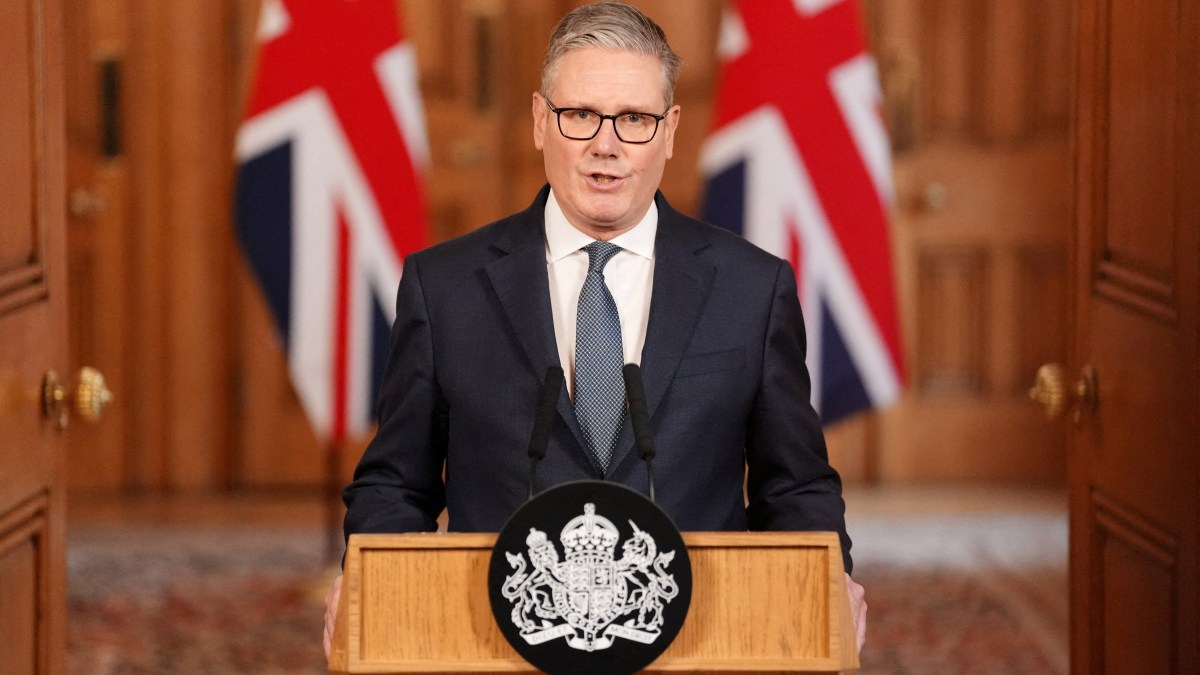
Sir Keir Starmer backed Donald Trump’s attempts to force a regime change in Iran on Saturday but faced questions over why his government had refused to allow the United States access to its military facilities in the region.
In Downing Street, the prime minister said: “The United Kingdom played no role in these strikes, but we have long been clear: the regime in Iran is utterly abhorrent. They have murdered thousands of their own people, brutally crushed dissent and sought to destabilise the region.”
He said Iran “must never be allowed to develop a nuclear weapon. That remains the primary aim of the United Kingdom and our allies, including the US.” A Ministry of Defence source said no British bases were used during the strikes.
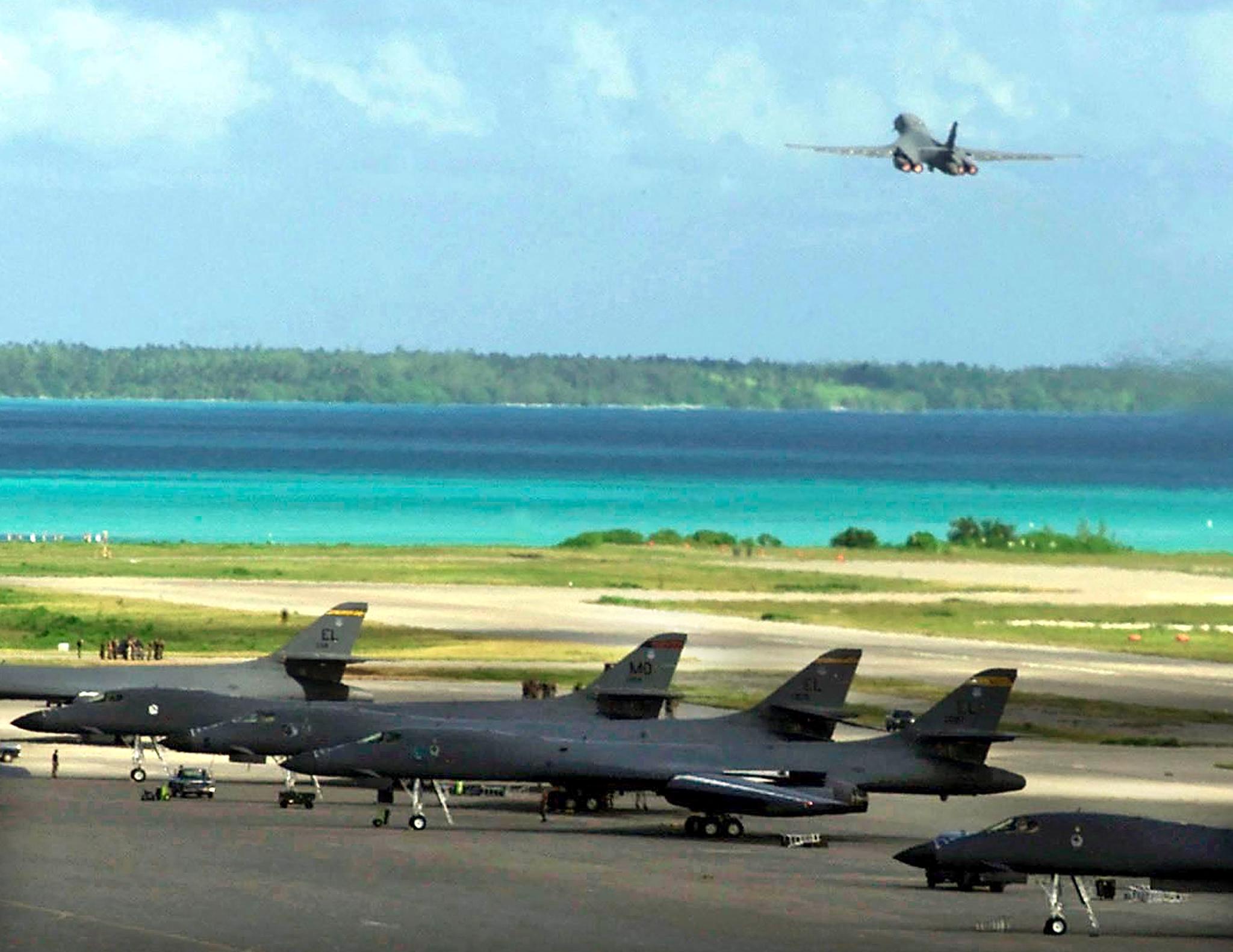
US bomber taking off from the Diego Garcia military base in 2001
AFP
The White House had considered using the British-owned military base on Diego Garcia, one of the Chagos Islands, for the strikes. In February President Trump posted on social media: “Should Iran decide not to make a Deal [on its nuclear programme], it may be necessary for the United States to use Diego Garcia, and the Airfield located in Fairford [the Gloucestershire home of America’s fleet of heavy bombers in Europe], in order to eradicate a potential attack by a highly unstable and dangerous Regime.”
However, Starmer is understood to have previously warned Trump that the UK would not allow the use of British facilities for any pre-emptive military action. Under a long-held agreement, the US would have to first request to use any UK sovereign military bases before conducting military operations.
Trump ultimately chose to launch Saturday’s attacks from a series of bases across the Middle East and at least one of the two aircraft carriers stationed in the region. The disagreement reportedly soured the relationship between Starmer and the American president, leading Trump to reverse his earlier support for the UK’s deal to lease the Chagos Islands from Mauritius.

Starmer and Trump at a Nato summit in June
KIN CHEUNG
The reason for Britain’s position to refuse co-operation from its military installations flows primarily from a legal opinion drafted for the prime minister by Lord Hermer, the attorney-general, that emphasised the primacy of international law.
In his Downing Street speech on Saturday, Starmer reasserted this position when he said that British fighter jets had been launched “as part of co-ordinated regional defensive operations to protect our people, our interests and our allies as Britain has done before in line with international law”.
• I was in the room last time Iran was hit. This is what I learnt
Before the last round of military strikes against Iran, as part of Operation Midnight Hammer in June last year, advice drafted by Lord Hermer is reported to have advised the government that any UK military involvement must be purely defensive in nature to remain within the law.
In the run-up to Operation Midnight Hammer, in which the US bombed Iranian nuclear facilities, a number of B-2s were deployed to Diego Garcia, although the attack was eventually carried out by planes flying non-stop from an airbase in Missouri.
On Saturday, Lord Ricketts, the UK’s former national security adviser, said it is unlikely the strikes complied with international law. “None of this, I think, is in any sense legal in a way that the UK would recognise,” he told the BBC.
“There was really no imminent threat to the US. This is action that they chose to undertake, or were dragged into it by the Israelis.”
But others suggested there is a legal justification that Britain could pursue if it chose to support the Americans and Israelis. Ben Wallace, the former defence secretary, said Trump had already set out “terms where the United Kingdom could support him in a mutual defence position where we would come to the air or support of an ally on request”.
He said it is for the US to “lay out its evidence to the British government,” after which it could argue they are under “an imminent threat and we would like your support”.
• Fifa holds World Cup crisis talks over US strikes on Iran
Kemi Badenoch, the Conservative Party leader, posted on X: “I stand with our allies in the US and Israel as they take on the threat of the Islamic Republic of Iran and its vile regime. The same regime that carries out attacks on the UK and on our citizens, that seeks to build nuclear weapons that would threaten our country and that brutally repressed pro-democracy protests only months ago and murdered thousands of its own people.”
The Conservative Party has previously called on Starmer to allow the use of the bases. James Cartlidge, the shadow defence secretary, said in February: “Iran’s nuclear programme has been a grave threat to Britain and our allies. If the US judges that further action is needed to deal with that specific threat, and if again we believe such action is in our national interest and to protect vital UK security interests, then we should grant the use of our bases.”
Nigel Farage, the leader of Reform UK, posted on social media: “The Prime Minister needs to change his mind on the use of our military bases and back the Americans in this vital fight against Iran!”
A spokesman for the British government said: “Iran must never be allowed to develop a nuclear weapon and that is why we have continually supported efforts to reach a negotiated solution. We do not want to see further escalation into a wider regional conflict.”
There is a long history of British military installations being used to support American military action. Most recently, RAF Fairford and other bases were used by the US to support the operation to seize a Russian shadow fleet tanker known as Bella 1 in January.

Sir Keir Starmer at the RAF base in Akrotiri, Cyprus, in 2024
AP PHOTO/KIRSTY WIGGLESWORT
In 2024, the UK joined the US to launch a series of cruise missile and airstrike attacks against the Houthi movement in Yemen, in response to Houthi attacks on ships in the Red Sea. Four RAF Typhoon jets and one Voyager air-to-air refuelling tanker flew from the RAF Akrotiri airbase in Cyprus as part of the operation.
Akrotiri was also a major hub of British operations against the regime of Muammar Gaddafi in Libya, during the Nato-led intervention in 2011 to enforce a no-fly zone over Gaddafi’s forces.
During Syria’s civil war, British sovereign bases acted as forward reconnaissance and signals intelligence against Islamic State. British bases also supported strikes against the Syrian government in 2018.
In the aftermath of the 9/11 terrorist attacks, tankers that had refuelled American B-2 stealth bombers operated from the Diego Garcia base. In the subsequent “war on terror”, aircraft were also sent directly from the Chagos Islands to Afghanistan and Iraq.