
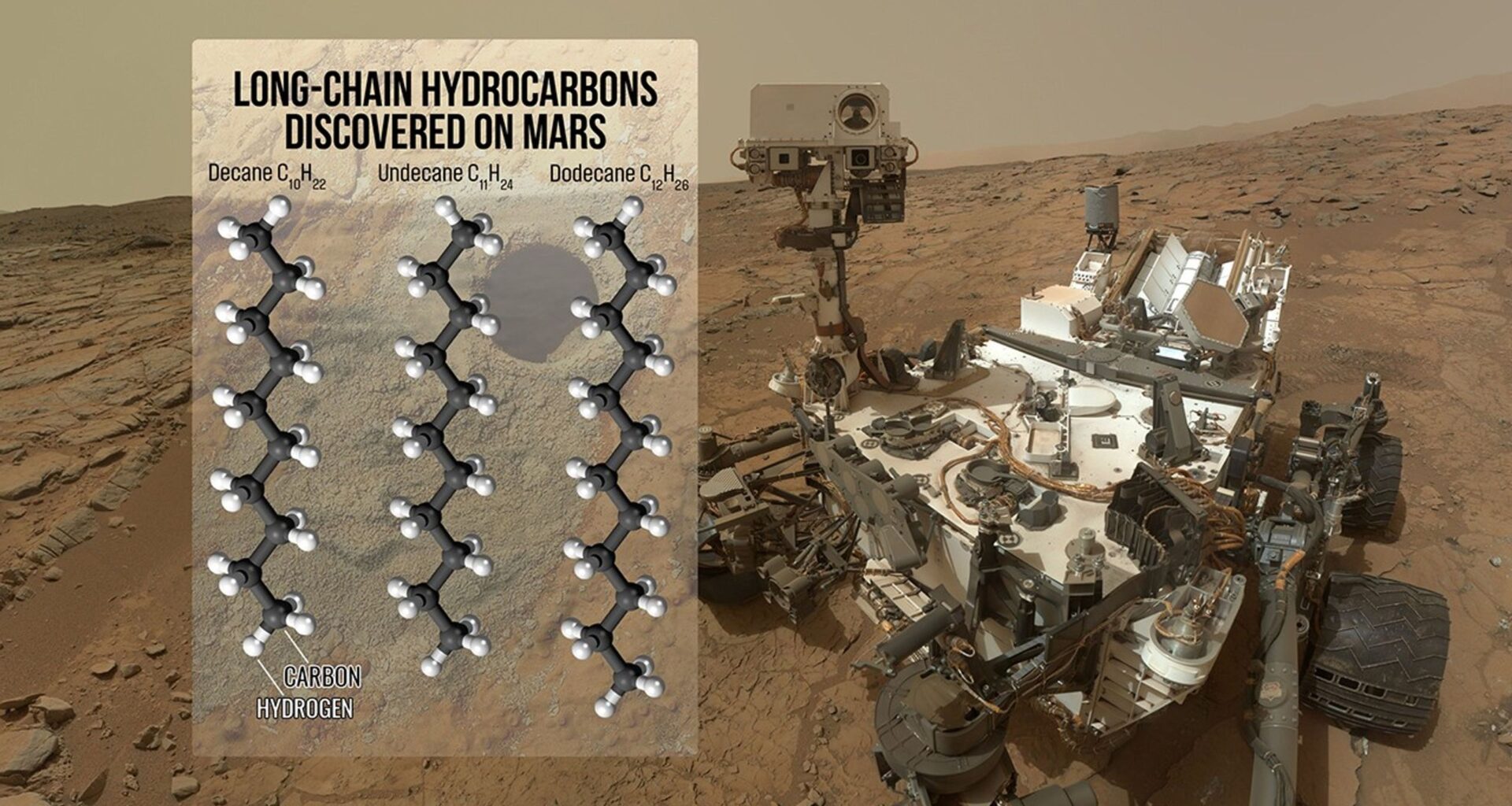
Organic molecules discovered within a stone on Mars cannot be fully explained by nonbiological processes, and it’s “reasonable to hypothesize” that living things could have formed these odd organic molecules, a NASA-led team reports in a new study. However, this doesn’t mean scientists have found definitive proof of life on Mars, they cautioned.
In March 2025, scientists reported the discovery of the largest organic molecules ever found on Mars. These long chains made of hydrogen and carbon may be the fragments of fatty acids, which are often created through biological processes.
You may like
A discovery more than a decade in the making
The organic molecules in question are called alkanes. They are hydrocarbons, long chains of 10 to 12 carbon atoms with multiple hydrogen atoms attached to each carbon. If the ending of their names sounds vaguely familiar, it’s because the alkane chemical family includes ethane, methane, propane and butane — though these are much shorter chains. Alkane chains of 12 carbons or more are more likely to be made by biological processes.
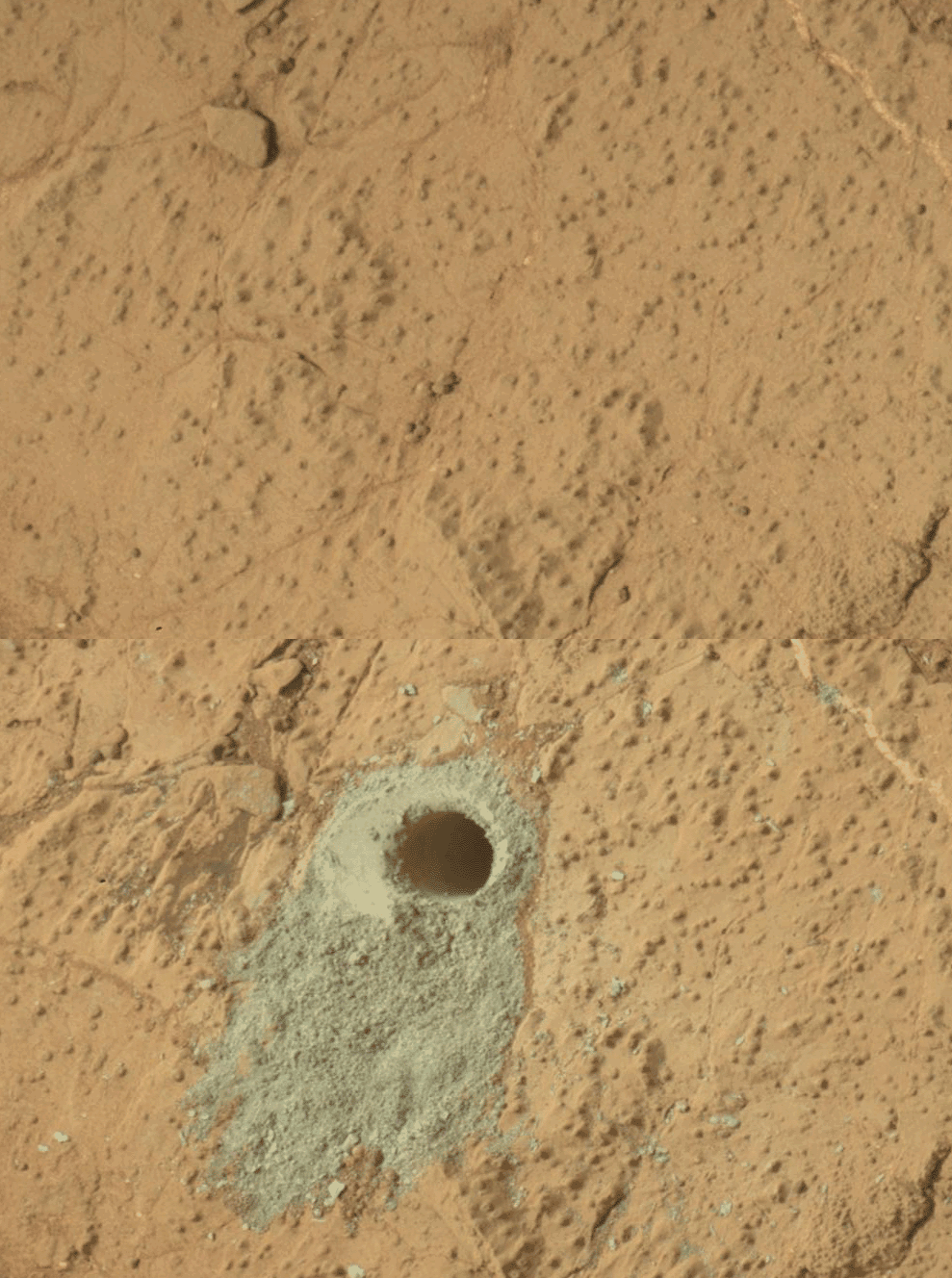
A gif showing the Cumberland Drill Hole, where Curiosity took a sample containing organic molecules. (Image credit: NASA/JPL-Caltech/MSSS)
These tantalizingly large molecules are embedded within the Cumberland mudstone, a fine-grained sedimentary rock in an ancient Martian lake bed named Yellowknife Bay. Curiosity initially drilled into this stone back in 2013 and has since performed various analyses using its onboard chemistry lab, the Sample Analysis at Mars instrument.
However, researchers discovered the organic molecules only around a year ago, after preheating the sample to 2,012 degrees Fahrenheit (1,100 degrees Celsius) in a search for amino acids. Instead of the building blocks of proteins, however, they found the traces of the largest organic molecules ever discovered on Mars.
Rewinding the clock on a Martian mudstone
In the recent study, researchers wound back the clock on this sample, extrapolating how abundant these molecules would have been billions of years ago when they were deposited in the mudstone.
The alkanes in the sample have a measured abundance of 30 to 50 parts per billion (ppb), but the Cumberland mudstone has been exposed to the harsh effects of radiation on Mars’ surface for about 80 million years. As a result, its organics have been degraded by the eons-long bombardment of energetic particles from the sun and from the universe at large.
“Given the geologic history and thermal maturation of the organics preserved in the Cumberland sample, it is reasonable to presume that the recovered material is only a fraction (possibly several orders of magnitude less) of the primary lipid content that would have been entrained in the sedimentary unit when it was deposited two and a half billion years ago,” the researchers explained in the paper.
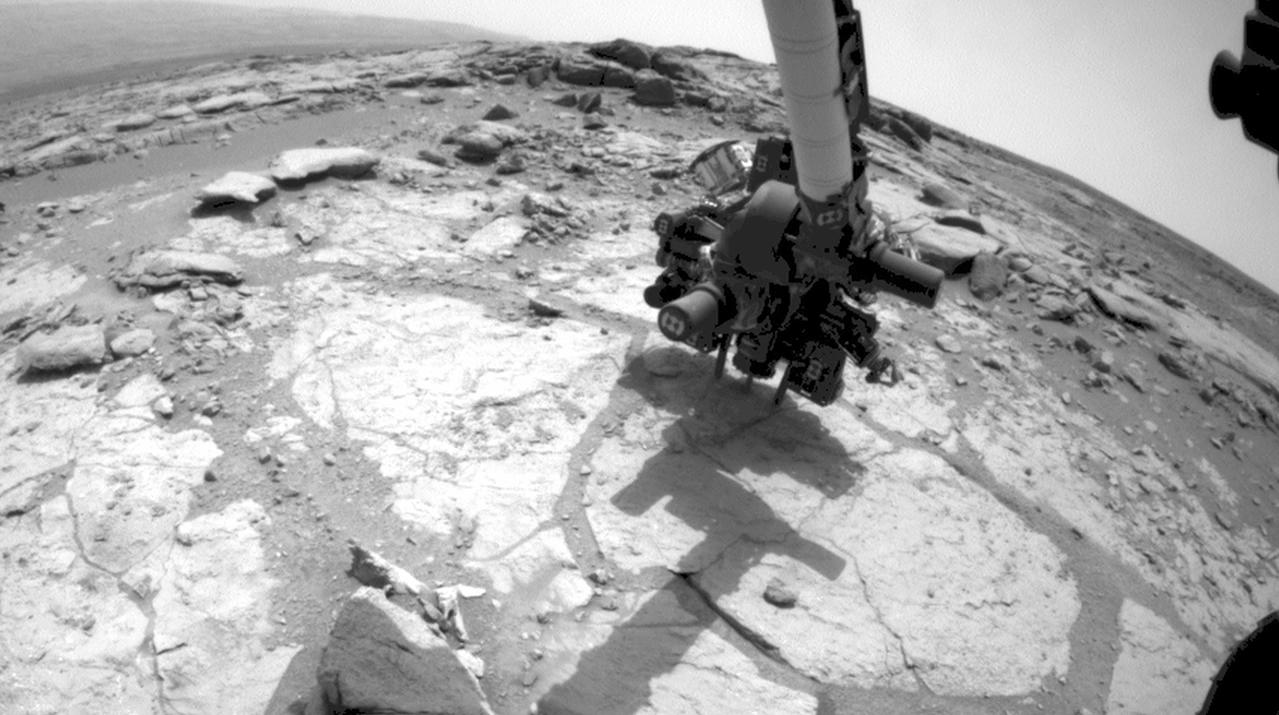
Curiosity drills into Cumberland, collecting its second Martian sample. (Image credit: NASA/JPL-Caltech)
Using previous radiolysis experiments as a gauge, the researchers calculated a “conservative” initial abundance of 120 to 7,700 ppb for the alkanes, or the fatty acids from which they fragmented. So, could abiotic sources account for substantial quantities of these substances, or did they form through biological processes?
You may like
The researchers assessed numerous scenarios. First, they explored a space-based origin. Interplanetary dust particles (IDPs) and meteorites frequently deliver organic molecules to the Martian surface. But the researchers concluded that it is unlikely that these processes account for the organic abundance in the Cumberland sample because IDPs cannot penetrate rock and there are no signs of meteorite impacts.
In the second scenario, organic molecules settle on the surface after separating from the atmosphere, but Mars’ ancient atmospheric haze wasn’t foggy enough to explain the observed abundance.
Water-rock interactions could have contributed, but they generally produce smaller organic molecules. Fatty acid molecules can occur via a different pathway; but it requires high temperatures, and Cumberland shows no signs of having been appropriately heated.
Proof of alien life?
Despite these ruled-out theories, one non-biological process did hold water: the researchers cannot rule out that some of the organics formed abiotically in Mars’ hydrothermal systems and were transported to the surface by watery, organic-rich fluids.
“To be clear, we do not claim that proof of ancient martian life was found in the Cumberland mudstone,” the researchers said in the paper.
Still, the Cumberland sample is rich in many biologically implicated molecular goodies. These include clay minerals that form in the presence of water, nutritious nitrates, a type of carbon linked with biological processes, and the sulfur that helps preserve organic molecules.
Gale Crater, the site of Yellowknife Bay, also held water for untold millions of years, ostensibly giving life-forming chemistry plenty of time to mix and match a multitude of molecules.
Yet the Curiosity rover may be limited in its ability to analyze even larger molecules — which are more likely to be associated with biological processes — because of the way it must separate and identify them. Analyses like these, even on Earth, “always have tradeoffs,” study co-author Christopher House, geosciences professor at Penn State College of Earth and Mineral Sciences, told Live Science via email. “So, Curiosity might be able to find larger organic molecules, but not with the [precision] that made the identification of these specific molecules convincing.”
The next step is to perform experimental studies on Earth that mimic the Cumberland mudstone and the Martian environment, in order to ascertain how organic molecules like fatty acids react to Martian conditions. (The ultimate goal is for scientists to get their hands on some real Martian mudstone via a Mars sample-return mission, though that is currently a murky proposition at best.)
The existence of past or present Martian life is also hazy, but there’s reason for optimism among ET aficionados. The “researchers say that as the non-biological sources they considered could not fully explain the abundance of organic compounds, it is therefore reasonable to hypothesize that living things could have formed them,” NASA officials said in a statement.
Coincidentally, the microbial processes that could have produced these organics may have emerged on Earth around the same time, during the Archean eon. Considering that the Perseverance rover also discovered potential biosignatures in 2025, the answer to the ultimate question is more beguiling than ever.
Pavlov, A. A., Freissinet, C., Glavin, D. P., House, C. H., Stern, J. C., McAdam, A. C., Roussel, A., Dworkin, J. P., Chou, L., Steele, A., Mahaffy, P. R., Buckner, D., & Gomez, F. (2026). Does the measured abundance suggest a biological origin for the ancient alkanes preserved in a Martian mudstone? Astrobiology, 15311074261417879. https://doi.org/10.1177/15311074261417879