
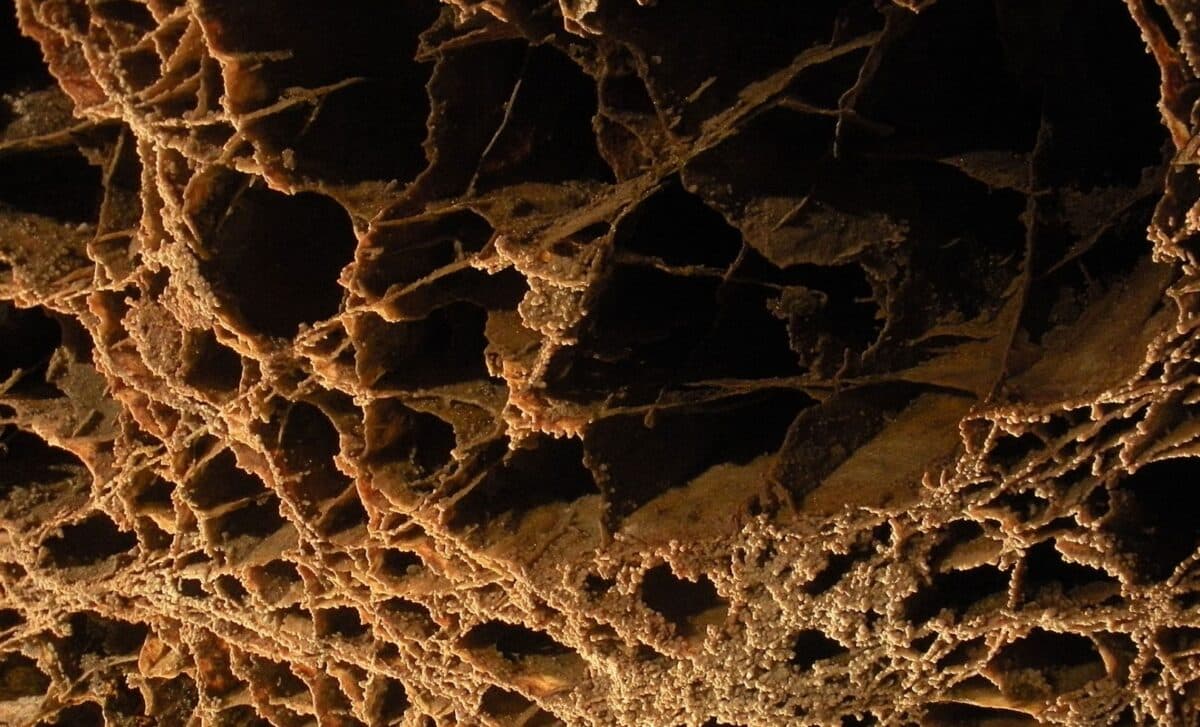
Curiosity is investigating “boxwork” ridges: low mineral walls that crisscross the ground and surround sand-filled hollows, creating patterns that look like giant spiderwebs from above. According to NASA’s Jet Propulsion Laboratory write-up shared in June 2025, these ridges likely formed when groundwater moved through fractures in bedrock, left minerals behind, and later wind erosion exposed the hardened lattice.
Up Close, the “Spiderwebs” Turn into Fractures, Ridges, and a Debate That’s Finally Testable
From orbit, scientists could see the broad spiderweb pattern, but not the fine-scale textures that decide between competing formation ideas. Curiosity’s ground-level work is filling that gap with images, chemistry, and the unglamorous reality of rover driving.
The rover has to travel on ridge crests that can be only a little wider than the rover itself, then dip into sandy hollows where traction becomes risky. “It almost feels like a highway we can drive on. But then we have to go down into the hollows, where you need to be mindful of Curiosity’s wheels slipping or having trouble turning in the sand,” Ashley Stroupe of NASA’s Jet Propulsion Laboratory said in mission.
The leading explanation is a familiar sequence for Mars: water first, wind later. Scientists think groundwater once flowed through fractures in bedrock, depositing minerals that hardened those zones. Over long spans of time, wind eroded the surrounding weaker rock, leaving mineral-reinforced ridges behind. According to the rover team’s findings, one long-standing clue involved dark lines seen in orbital images: a 2014 proposal suggested they were central fractures where groundwater once concentrated minerals, and Curiosity has now confirmed those dark lines are fractures.
The Nodules Are Real, Widespread, and Not Where the Team Expected Them to Be
The most eye-catching surprise in Curiosity’s close-ups is the nodules, small, bumpy mineral features on and around the ridges. The rover imaged pea-size nodules while exploring the boxwork region on Aug. 21, 2025, and later captured a panorama on Sept. 26, 2025.
What’s strange is their placement. Mission scientists expected nodules to cluster near the central fractures, but Curiosity found them along ridge walls and down in the hollows between ridges. According to the rover-team: “We can’t quite explain yet why the nodules appear where they do,” said Tina Seeger of Rice University, one of the scientists leading the boxwork investigation. She added a working idea, “Maybe the ridges were cemented by minerals first, and later episodes of groundwater left nodules around them”, while also signaling that it’s not settled.
Live Science described the nodules as “egg-like spheroids” and stressed that researchers are struggling to explain them, while also noting there is “no suggestion” they are directly tied to life. The point that survives across the sources is simpler and more careful: the nodules strengthen the case for groundwater involvement, but their distribution hints at more than one episode of groundwater activity, rather than a single, clean event.
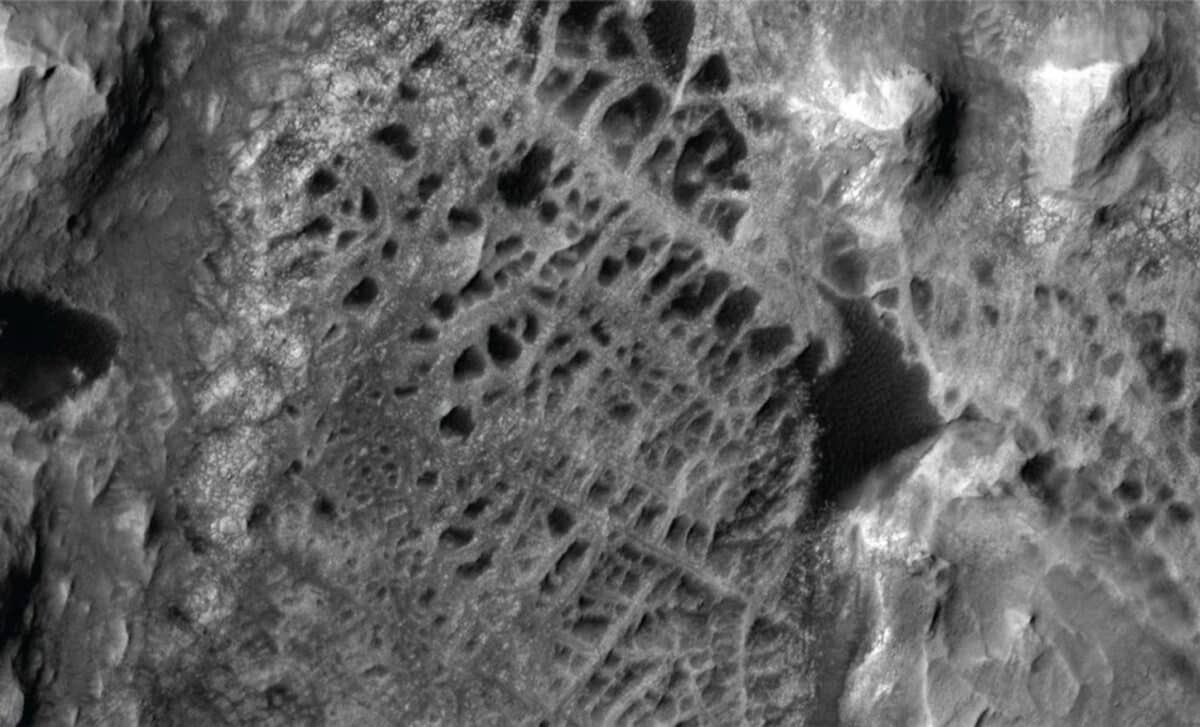 Researchers think these boxwork ridges were created by ancient groundwater, as captured in a Dec. 10, 2006 image taken by NASA’s Mars Reconnaissance Orbiter. ©NASA/JPL-Caltech/University of Arizona.
Chemistry from Drilled Samples Adds Clay, Carbonates, and a Targeted Search for Organics
Curiosity isn’t only photographing the terrain. It has drilled and analyzed samples from the boxwork area using onboard instruments that include X-ray measurements and heating experiments. According to the ZME Science report of rover operations and results, samples from different parts of the terrain showed clay minerals in ridge material and carbonate minerals in a hollow, a pairing used to help reconstruct how the boxwork formed.
The rover also carried out a more specialized procedure on a fourth sample: wet chemistry after heating powdered rock in Curiosity’s onboard oven. According to the account in the same report, the aim is to improve detection of certain organic compounds, carbon-based molecules linked to life’s chemistry but not proof of life by themselves.
A separate, more technical thread appears in an Astrobiology paper about long-chain alkanes detected in the Cumberland mudstone in Gale Crater. The study discusses measured concentrations of 30–50 ppb of C10–C12 alkanes, estimates how radiation exposure could imply much higher original abundances, and weighs abiotic and biological hypotheses. The findings are not presented as direct results from the boxwork ridges, but they highlight why Curiosity’s organic-detection analyses are limited in supply and used selectively on the most compelling targets.
Curiosity is expected to leave the boxwork area in March and continue traversing a sulfate-rich layer on Mount Sharp, where salty minerals point to environments formed as water dried out. The rover has been climbing Mount Sharp since 2014, building a layered record of drying punctuated by returns of water, and in the boxwork field, it has found a pattern that looks like a web, drives like a hazard course, and reads like a longer, messier groundwater story than the orbital view suggested.