
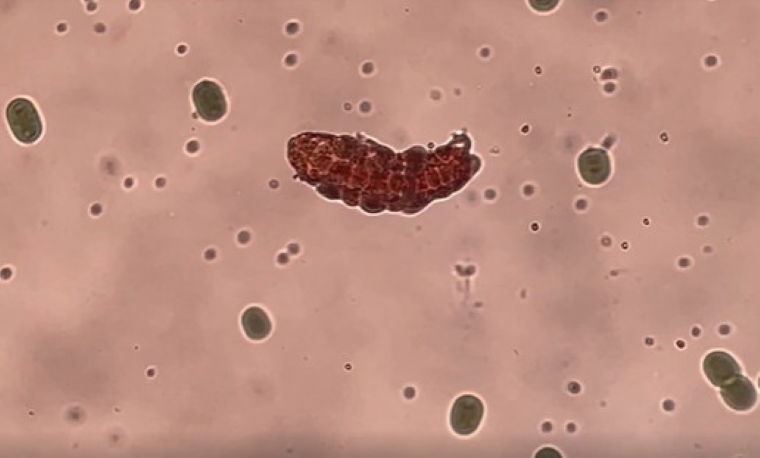
Penn State University scientists studying the potential habitability of Mars exposed microscopic animals called tardigrades to a batch of simulated Marian soil, causing the resilient creatures, which can survive in the vacuum of space, to slow down and eventually stop moving altogether.
After the scientists washed the simulated Marian soil with ordinary water, the tardigrades, more commonly known as Water Bears, moved more normally even after several days of exposure, suggesting the possible presence of an unidentified substance or property that makes the base material resistant to biological life.
The research team behind the study said their findings could offer new insights into how humans could adapt extraterrestrial resources to support space exploration. The study could also help scientists determine which, if any, of the red planet’s natural resources might offer protection against biological contaminants that future human colonists might shed.
Understanding Martian Soil Critical for Future Colonists
Since the dawn of the space age, scientists have employed complex processes and techniques to ensure that probes and rovers visiting other worlds don’t contaminate the local environment with potentially harmful Earth organisms. Many of these same measures are in place to protect astronauts and future human colonists from any harmful local biological or non-biological contaminants.
According to Penn State Altoona Professor of Microbiology Corien Bakermans, mission planners designing long-term expeditions to places like the Moon and Mars need to pay even closer attention to these preventive measures. They also need to understand the mechanisms behind a local material that may resist or aid human colonization, including its ability to support crop growth and other forms of life.
“When considering sending people to non-Earth environments, we need to understand two things: how the environment will impact the people and how the people will impact the environment,” the professor explained.
For example, if a planet already has naturally evolved protections against “extraterrestrial invaders” in its regolith, which is the planet’s base rock and dirt material, that may actually be beneficial to future human colonists. Still, Professor Bakermans noted, if the base soil of a planet that humans hope to colonize has a property that inhibits life, they will need to know how to counteract it or remove it altogether to support crops and potentially mitigate any threat to animals and humans.
“We know a lot about bacteria and fungi in simulated regolith, but very little about how they impact animals — even microscopic animals, like tardigrades,” the professor explained.
Tardigrades Can Survive in Space and at the Bottom of the Ocean
Because conducting experiments with regolith collected from Mars is impractical, the Penn State researchers used simulated Martian soil designed to precisely mimic the chemical and mineral composition of real Martian regolith. For these experiments, the team used two types of simulated regolith based on regolith collected by NASA’s Curiosity Rover from the Rocknest deposit within the Gale Crater.
According to a statement announcing the new experiments, the first simulant, MGS-1, was designed to mimic the overall regolith layer across the planet’s surface. The second simulated soil, OUCM-1, was designed to more closely approximate the local soil collected for the Rocknest deposit south of the planet’s equator. This included special attention to the simulant’s material and chemical compositions.
To test the effects on animals, the team selected a batch of tardigrades. When these hardy organisms are dehydrated or exposed to adverse conditions like the vacuum of space or the extreme pressures at the bottom of the ocean, they fall into a nearly lifeless, dormant state. However, when tardigrades are rehydrated, they become active. According to the research team, even in this more delicate state, they can remain active during periods of limited food availability or freezing temperatures, making them ideal test subjects for assessing survivability in Martian soil.
“We investigated the specific, isolated impact of the regolith on tardigrades,” Bakersmans said.
Experiments Reveal Presence of Mysterious Biological Inhibitor
After procuring the two regolith samples, Bakermans, who also coordinates Penn State Altoona’s biology program, mixed in the tardigrades. Next, the researcher periodically examined the two mixtures under a microscope over the next several days. This monitoring revealed that the tardigrades’ activity levels were different depending on the regolith in which they were immersed.
According to Bakermans, tardigrades mixed with the “broader” MGS-1 Martian soil indicated that the inhibitory effect was “very damaging” compared to the OUCM-1. Conversely, tardigrades mixed with that more localized version of simulated Marian soil moved more slowly, but the researcher said that the simulant’s inhibitory effect was “much less” than the MGS-1.
“We were a little surprised by how damaging MGS-1 was,” Bakermans said.
After theorizing that there may be a chemical or material component of the simulated Martian soil that could be “washed away,” the team rinsed off a batch of MGS-1 with ordinary water and mixed in some tardigrades and water. As suspected. The tardigrades exposed to the rinsed soil showed almost no reduced activity.
Bakermans said it appears that there is something “very damaging” in MGS-1 that can also be dissolved in water. He also theorized that this unidentified inhibiting material could be dissolved and removed using salts or “some other compound. Either way, the research team said that understanding the mechanism could impact future colonization plans.

“That was unexpected, but it’s good in a sense, because it means that the regolith’s defense mechanism could stop contaminants,” the professor explained. “At the same time, it can be washed to help support plant growth or prevent damage to humans who come in contact with it.”
‘Teasing Apart’ Components of the Overall System to Support Planetary Protection
Although the study revealed that washing Martian soil before using it may be necessary, the team noted that water is a scarce resource on space missions. Still, the professor noted, simply knowing that whatever is inhibiting tardigrade activity in simulated Mars regolith can be washed away is valuable for future missions to the red planet.
“With this research, we’re looking at a potential resource for being able to grow plants as part of establishing a healthy community,” Bakermans explained.
However, the professor said his team is also exploring whether this material could help scientific and colonization mission planners protect the planet’s ecosystem from Earth contaminants, “which is a goal of planetary protection.”
Moving forward, the team has begun experiments to factor in other conditions beyond chemical and material composition that may inhibit biological activity, including temperature and atmospheric pressure.
“Regolith isn’t the only component, of course,” Professor Bakermans explained. “But we’re beginning to tease apart components of this overall system where any single piece could be a drawback or benefit the larger understanding of planetary protection.”
The study “Short-term survival of tardigrades (Ramazzottius cf. varieornatus and Hypsibius exemplaris) in martian regolith simulants (MGS-1 and OUCM-1)” was published in the International Journal of Astrobiology.
Christopher Plain is a Science Fiction and Fantasy novelist and Head Science Writer at The Debrief. Follow and connect with him on X, learn about his books at plainfiction.com, or email him directly at christopher@thedebrief.org.