
Malta Vision 2050 was launched with a bang on Friday evening, but a closer look at the strategy’s final document reveals quiet and unannounced changes to the vision’s headline targets.
Arguably, the most significant changes have been to the metrics the government says it will use to measure the strategy’s overall success.
A GDP growth target has been revised downwards to annual growth of 4% – down from the 5% cited when the strategy was first opened to consultation.
In real terms, that means policymakers now expect Malta’s economy to generate roughly €400m less by 2035 than they previously did.
Social targets, however, have become more aggressive.
Previously, policymakers said they wanted Malta to make the EU’s top 10 for overall life satisfaction by 2035. Now, they are aiming for the top eight within the next decade, rising to Europe’s top five by 2050.
The original document’s target of achieving 135% of the EU’s median disposable income by 2050 remains in place, though policymakers now have an interim target of achieving 115% of that level by 2035.
Currently, Malta’s median disposable income lies at around 95% of the EU median.
Taken together, those shifts suggest the government believes that quality of life and distribution of wealth will improve faster than previously projected, even though total GDP growth will slow.
The changes are understood to have been introduced following consultation with stakeholders that include economic and social partners at the MCESD and the Opposition.
A closer look at the 220-page Vision 2050 document reveals some other changes to the original plan, too.
The final document explicitly notes that the 2050 vision applies to everyone who “lives in, works in, or studies in” Malta – and not just Maltese passport holders.
In a nod towards Malta’s reliance on a non-Maltese workforce, a pillar that was initially titled ‘Accessible citizen-centred services’ is now rebranded to ‘Accessible people-centred services’.
The final document explicitly notes that the 2050 vision applies to everyone who “lives in, works in, or studies in” Malta – and not just Maltese passport holders.
The plan now establishes a dedicated project management office responsible for coordinating the strategy, directly under the purview of the Office of the Prime Minister.
That office adds a further layer to an already crowded bureaucratic structure: Vision 2050 now has an administrative lead in permanent secretary Ronald Mizzi, a political coordinator in OPM chief of staff Mark Mallia, a steering committee that acts as a board of governors and a project management office focused on coordination.
Another new addition is the introduction of what the Vision 2050 strategy calls ‘Bus Stops’: periods throughout the strategy’s 25-year cycle when policymakers must evaluate progress and reassess the original targets.
However, the strategy does not explicitly state when such ‘bus stop’ evaluations will take place, and sceptics will argue that means the government will be in a position to ‘stop the bus’ whenever it is politically convenient to do so, because a target will not be met or has shifted.
Those targets, or Key Performance Indicators (KPIs), are varied and come with initial targets set for 2025.
They range from targets to increase long-haul connectivity routes, to pledges to dramatically reduce landfilled waste, boost the fertility rate and significantly cut waiting times for non-emergency medical procedures.
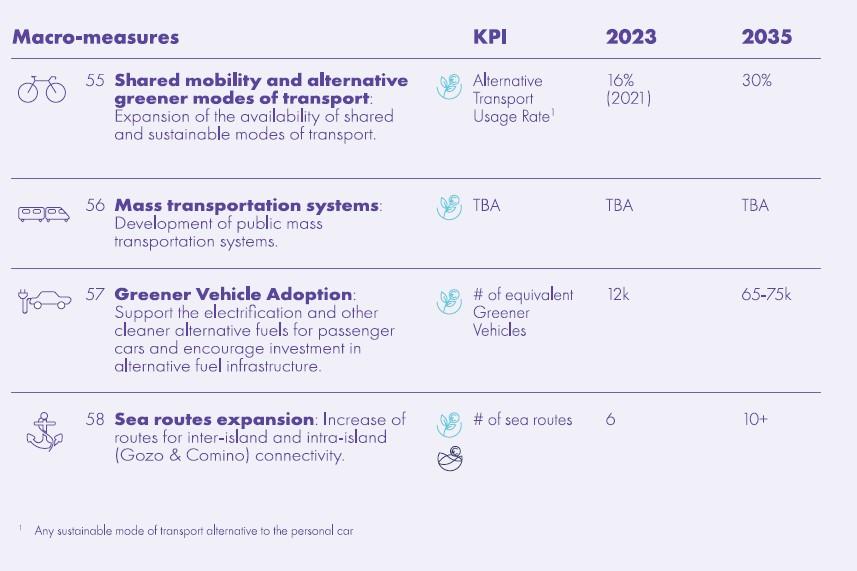 Targets, or Key Performance Indicators (KPIs) are varied and come with initial targets set for 2025.
What is measurable?
Progress in reaching these various KPIs can be tracked on the website maltavision.mt, designed to highlight the Vision 2050 strategy and its aims.
But not all of the government’s Vision 2050 promises are measurable.
The ‘flagship projects’ promised within the document, such as the Grand Harbour’s regeneration projects or an airstrip in Gozo, come with no defined KPIs or target dates.
Readers are given no indication of when those projects will begin, end or how much they are expected to cost. Arguably the biggest infrastructure pledge in Malta’s history – developing a mass transportation system, lists ‘TBA’ [To Be Announced] instead of its KPI.
Furthermore, an eye-catching pledge to introduce 150 “new or regenerated green open spaces” is also low on definition and could, in theory, allow the government to refurbish an existing pocket garden and call it a new green open space.
Despite those question marks, the strategy has been broadly well-received by various stakeholders.
Opposition leader Alex Borg, who attended Friday’s opening ceremony, wrote on social media that he wanted Malta by 2050 to be a country “built on courage, sustainability and social justice.”
And the Malta Chamber of SMEs said it welcomed the strategy and looked forward to being able to contribute to achieving it.