
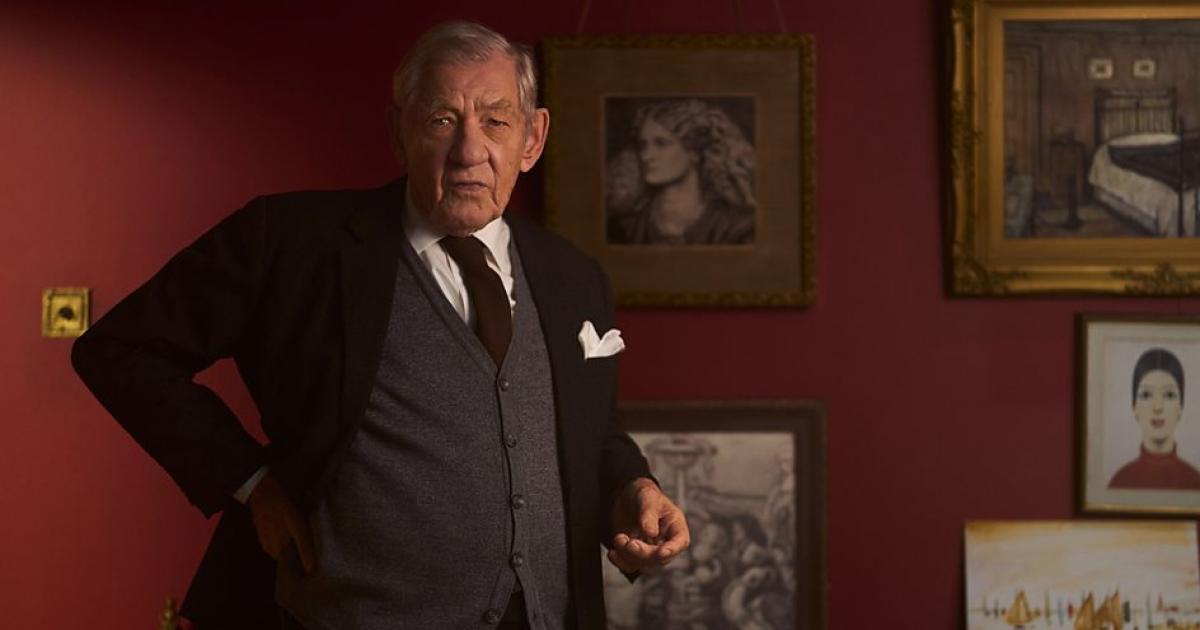
Ian McKellen stars as LS Lowry in a revealing new BBC show, using unheard tapes to shed light on the artist’s life.
The programme, LS Lowry: The Unheard Tapes, is a unique exploration into the life of the painter known for his distinctive ‘matchstick men’ style, capturing his private, often guarded, side.
A Cumbrian coastal scene by LS Lowry (Image: Supplied)
Many locals remember Lowry’s presence in the area from the late 1940s onwards, immortalising both coastal and town scenes in his own distinctive style.
It was a friendship with Geoffrey Bennett, a Cleator Moor bank manager and later an Anglican clergyman, that initially led Lowry to the area.
Venturing to Cleator Moor, he captured vivid scenes of everyday life, including the Westminster Bank, Market Square, the parish church, and Cowles Fish and Chip Shop.
These paintings were all influenced by actual streets, encapsulating the essence of the northern town during that time period.
Further afield in Maryport, Lowry created timeless pieces such as Senhouse Street, Maryport and Town Steps, Maryport, both echoing the town’s distinctive charm.
These pieces were deeply inspired by the harbour area and Shipping Brow, containing views that remain unmistakably recognisable in today’s Maryport.
Lowry’s impact stretched further than friends and picturesque scenes, notably shaping Cumbrian art culture.
He formed a strong bond with Sheila Fell, an acclaimed landscape artist from Aspatria, whom he championed as “the finest landscape artist of the mid-20th century”.
During his time in Cumbria, he would join Fell on sketching trips around West Cumbrian coasts and fells, hiring a car to explore and paint the landscapes.
Lowry’s artistic love affair with what was then known as Cumberland (now part of Cumbria) did not go unnoticed.
The Beacon Museum in Whitehaven hosted an exhibition dedicated to “L S Lowry in Cumberland”, while Maryport promotes a Lowry trail highlighting locations he immortalised in his art.
Lowry’s works still grace auction houses, with Cumbrian scenes fetching high prices, demonstrating the continued international interest in his connection with the area.
An oil painting of Senhouse Street, Maryport remains the most valuable publicly recorded West Cumbrian painting, auctioned for nearly £700,000 in October 2024, with pre-sale estimates ranging up to £1 million.
Lowry painting of Senhouse Street, Maryport (Image: Supplied)
Christie’s in London auctioned the Senhouse Street piece, reflecting on how rare and sought after a completed Cumbrian street scene by Lowry is.
In the same auction, two Lowry works collectively amassed more than £1.8 million.
Other West Cumbrian works, though not reaching the figures of the Senhouse Street oil, have also captured art markets’ attention.
A 1960 pencil sketch of Maryport – The Estuary secured £37,000 at Mitchells in Cockermouth in 2024, making it one of the more expensive West Cumbrian drawings.
Smaller Cumbrian scenes, including those of Maryport and Ulverston, have individually secured tens of thousands of pounds each at various auctions.
Cleator Moor also shares a similar narrative.
While pieces like The Broken Shop Window at Cleator Moor appear at auctions, their valuations are significantly lower compared to the Maryport oil.
Pastel and chalk works such as Church, Wath Brow, Cleator Moor have been sold at major London venues but did not reach the lofty sums commanded by the significant Maryport oil.
The tales and artistry of LS Lowry continue to paint a picturesque junction of art, culture, and friendship.
Despite his passing, his indelible mark in West Cumbrian arts and culture remains an evergreen testament to an artist who found and shared beauty in everyday life.
The legacy of West Cumbria’s immortalised scenes continues to thrive, capturing the fascination of both locals and international art lovers.
For now, the famous matchstick men continue to silently narrate enchanting tales from the streets and coastlines of West Cumbria, linking the present with the past through their silent, painted narratives.