
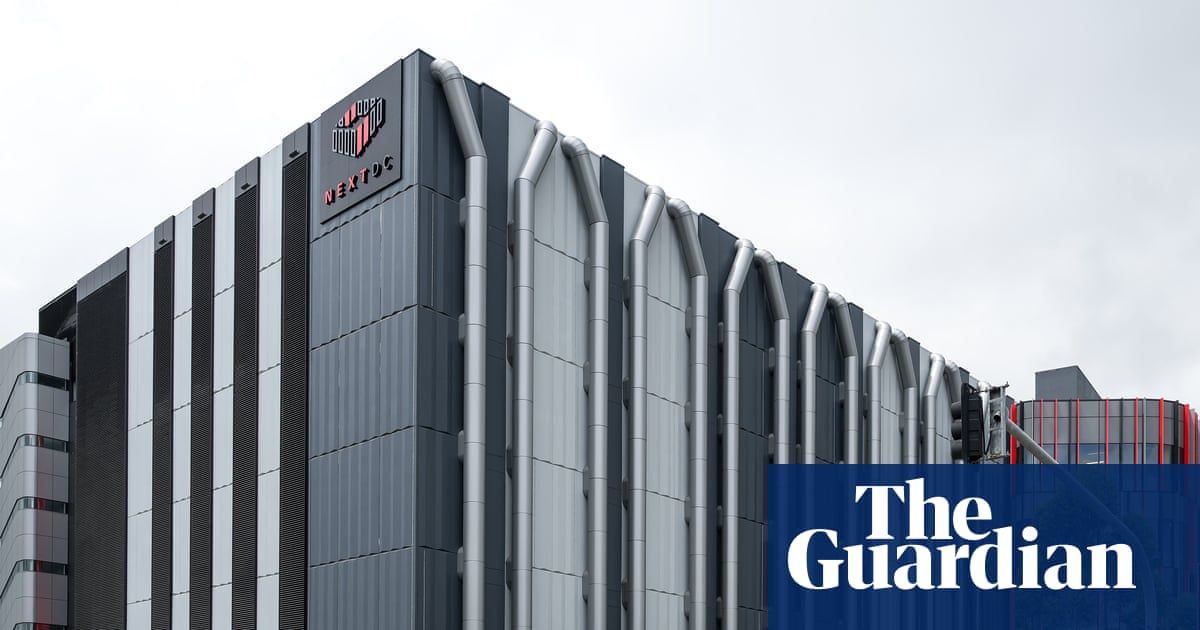
Our online lives are increasingly reliant on digital data, whether it’s asking an AI chatbot a question, generating a video or transcribing an online meeting.
Datacentres – giant warehouses stacked with servers to process and store all that data – have been around for decades. But what’s changing is the rapid pace and scale of industry growth, fuelled by the uptake of artificial intelligence.
Technology companies are pushing for Australia to become a hub for data processing and storage. But with 260 datacentres operating – mostly in Sydney and Melbourne – and dozens more in the offing, concerns about the impacts on power and water resources are also rising.
What has been said about datacentres – in the US and Australia – this week?
In the US, the president, Donald Trump, announced “ratepayer protection pledges” requiring tech companies to meet their own power needs.
“Many Americans are also concerned that energy demand from AI datacentres could unfairly drive up their electric utility bills,” he said. “They can build their own power plants as part of their factory, so that no one’s prices will go up.”
In Australia, the energy minister, Chris Bowen, acknowledged “datacentres are big energy users”, an issue he said would be addressed in a forthcoming AI and datacentre strategy.
“People who are building datacentres do need to build new energy to go with it, and that energy will be renewable. But we also want to ensure that energy use has flexibility and redundancy built in.”
A coalition of energy and environment groups, including the Clean Energy Council, Electrical Trades Union, Australian Conservation Foundation and Climate Energy Finance, proposed a set of “public interest principles for datacentres” that include investing in new renewable energy and using water responsibly.
Sign up: AU Breaking News email
“If you want to build a datacentre, you should have to build the renewables and water recycling to power it,” the ACF chief executive, Adam Bandt, said. “Big tech corporations should be forced to do their fair share so they don’t drain our resources.”
The Australian Energy Council says key policy questions still need answering: will datacentres need to be 100% renewable? And will that be based on total demand, or take into account when the electricity is being used?
Meanwhile, an inquiry in New South Wales will examine the social, environmental and economic effects of the datacentre boom.
Are datacentres a threat to Australia’s electricity supply for households and businesses?
Datacentres currently draw about 2% of electricity from the national grid but that share could triple within five years, according to the Australian Energy Market Operator (Aemo).
By 2030, Aemo forecasts that datacentre energy demands could exceed the power used by the nation’s fleet of electric vehicles. And by 2035, the industry could consume 21.4 terawatt hours of power, an amount just shy of the annual consumption of Australia’s four aluminium smelters.
AGL, one of Australia’s largest electricity companies, anticipates demand might even “outstrip AEMO’s forecasts”.
The industry’s energy and water demands are largely related to cooling – either by air conditioning or water – given servers, like other computing devices, convert electrical energy into heat.
The challenge of meeting these ballooning requirements is not unique to Australia. Globally, datacentre power demand is growing four times faster than all other sectors, according to the International Energy Agency. Centres are multiplying and increasing in size, with hyperscale facilities becoming more common.
According to the IEA: “A hyperscale, AI-focused datacentre can have a capacity of 100MW or more, consuming as much electricity annually as 100,000 households.”
Will datacentre growth affect electricity prices?
There will be an undeniable impact on the overall cost of electricity, which will flow through to power prices, says Dr Dylan McConnell, an energy systems researcher at the University of NSW. “You need to build a bigger system to serve this load, and that will mean more expensive resources are used.”
A report by Baringa consultants for the Clean Energy Finance Corporation (CEFC) finds that by 2035 datacentre growth could increase wholesale electricity prices by 26% in NSW and 23% in Victoria, primarily driven by a need for more expensive gas peaking generation.
“This reliance not only drives up prices but could also lead to a 14% increase in grid emissions across the [national electricity market],” the report says.
The CEFC’s head of infrastructure, Julia Hinwood, says Australia can “avoid these pitfalls”, by “investing early in renewable energy and storage capacity to power the sector”.
Industry group Data Centres Australia says power purchase agreements and onsite solar account for about 70% of the industry’s energy consumption.
The group’s CEO, Belinda Dennett, says “the datacentre industry is one of the largest investors in renewable energy”.
What about Australia’s ability to cut emissions and meet climate targets?
But McConnell says while renewable energy is growing in Australia, the pace isn’t yet fast enough to meet renewable energy and emissions targets. Datacentre growth could add to the challenge, he says.
“If we are in a situation where demand is growing much faster than anticipated and renewables don’t keep up, then actually what we end up doing is just powering that new demand and not displacing coal.”
Australia’s emissions projections indicate that additional demand on the grid from datacentres contributes to a slowdown in emissions reductions from the power sector after 2035.
Are they a threat to the water supply?
Data Centres Australia describes the industry as “modest water users” and highlights major opportunities to reduce reliance on drinking water with closed-loop cooling systems and recycled water.
But water authorities are anticipating the demand on drinking water supplies will be significant. Datacentre demand in Sydney alone is forecast to be 250 megalitres a day by 2035, roughly equivalent to Canberra’s total drinking water, while Melbourne Water says development applications for new hyperscale datacentres already exceed the water demand for nearly all of the state’s top 30 business customers combined.