
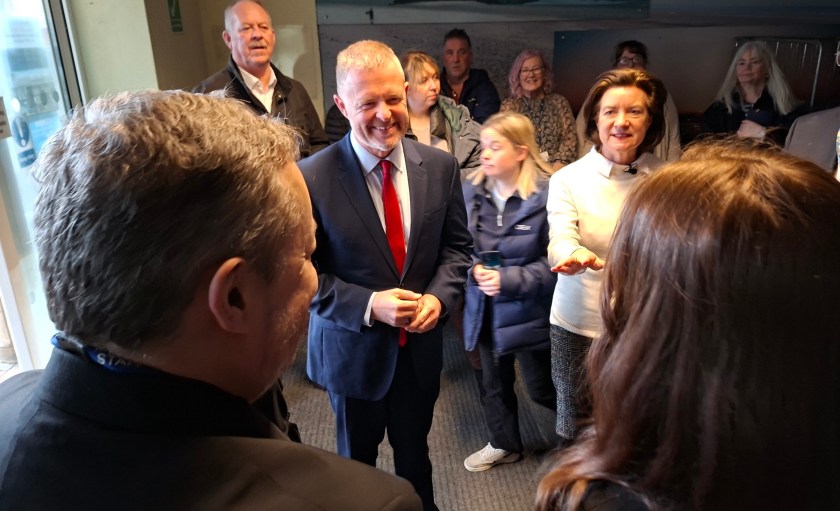
The announcement that the Royal Alexandra Hospital will be turned into a new health facility as part of a £33m redevelopment was a genuine piece of news, significant enough to ensure the visit of First Minister Eluned Morgan and Health Secretary Jeremy Miles to North Wales.
Most will have welcomed the funding commitment which should see the site completed by next year, albeit some critics believe the long delayed plans have been “watered down”.
Local Democracy Reporting Service (LDRS) reporter Richard Evans took the opportunity of yesterday’s announcement to ask Mr Miles, the Cabinet Secretary for Health and Social Care, about healthcare in North Wales.
In a wide-ranging interview Mr Miles admitted the families of patients who died of a preventable cause in North Wales hospitals are “entitled to expect better”.
He also addressed claims made by a North Wales council leader that he failed to respond to her letter raising the alarm over “third-world” health care.
Mr Miles also responded to the declaration of a “health emergency” by several North Wales councils; the growth of “corridor care” in Emergency Departments (A&E) and why the Betsi Cadwaladr University Health Board has been in “special measures” for much of the last decade.
LDRS Have you been to Ysbyty Glan Clwyd to the A&E department?
Mr Miles: I was in Glan Clwyd this morning, and I’ve been to the A&E department there. And we were announcing this morning £10m of investment, which has been spent since last year for two new cutting-edge radiotherapy machines, which will be coming onstream at Glan Clwyd over the next few months. Again, it will make a real difference to cancer treatment in North Wales.
LDRS: In Glan Clwyd A&E department people are literally dying in the corridors. I get phone calls on a weekly basis. After 10 years of special measures, if Labour gets in power again, what’s going to change in the next couple of years? Are you going to fix it? And what is your timescale for fixing it?
Mr Miles: Look, A&E performance in North Wales is not good enough. There is no two ways about that. We need to see it improving. We are working hard as a government. We put extra money into the health board.
We put a team of extra support in there to help the health board with their A&E pressures, but also the planned care, so that’s the surgery people are waiting for. We are seeing those long waits coming down a lot, not anyway near where they need to be, but if you look over the last year, they’ve come down by thousands in North Wales, as in other parts of Wales, so there is progress.
It’s not gone far enough, and I’m working with the health board, pressing them hard, giving them the support they need so we can get the services patients in North Wales deserve.
LDRS: The demographic in North Wales is quite different. There is quite an elderly population. People tend to come to counties like Conwy, in particular, to retire, and a lot of people in this area feel they are not getting the money from Welsh Government, in regard to the way the government funds the NHS and councils for social care.
People feel it’s wrong. That’s what councillors are saying. I know Conwy County Council’s leader Julie Fallon wrote to you and she said you ignored her letter a few months ago when she declared a health emergency. Is that right?
Mr Miles: I didn’t ignore the letter. Nobody ignored the letter. Look, it is easy enough just to use slogans.
At the end of the day, my job as a health minister is to make sure on behalf of the people of Wales that we deliver the best possible health service and set clear expectations for the health service to deliver.
In terms of investment in North Wales, I’ve come this morning from Glan Clwyd where we announced £10m last year of two cutting-edge radiotherapy machines, which will be coming on stream in the next few weeks; a £60m investment here in Rhyl, a new orthopaedic centre opening in Llandudno, 1,900 extra operations a year for people’s hips and knees.
It is a huge level of investment in the health services in North Wales, which people in North Wales need and deserve, and we are very happy to make that investment.
LDRS: So what will change then if Labour get back in power? How are you going to do it? How are you going to fix Betsi Cadwaladr University Health Board? We’ve had 10 years of special measures. What are you going to do to fix it?
Mr Miles: We are already seeing improvement. It’s not fast enough. If you are waiting for your knee to be done or your shoulder or your hip to be done, because of Welsh Labour investment into the health service in North Wales, you’ll be getting that done faster when the Llandudno unit opens in the next few weeks.
If you want to come to a minor injuries unit, if you want to be in a community bed waiting to go home, by the time this facility here at the Royal Alex opens next year, that will be easier.
If you are waiting for cancer treatment, later this year you are more likely to get seen quickly at Glan Clwyd because of those radiotherapy machines. So we are seeing big investment and changes coming. I want to see it happening faster. But we are seeing that change, and that’s what we need to see.
LDRS: On a weekly basis, I’m getting phone calls from families of people dying or being sent home to die from North Wales A&E departments. And I don’t know whether the Welsh Government realises this. Do you realise that is going on in North Wales daily, and people here feel that South Wales gets a lot more of the investment than North Wales?
Mr Miles: Well, our job, as a journalist in your case and a public figure in my case, is to represent the truth to people, isn’t it? And so I’m explaining to you three massive investments we are making, which will change people’s experience of health care over the coming weeks. So that’s not me making things up. We are sitting here…
LDRS: But I’m not making it up. North Wales has had the most preventable deaths in the whole of Wales. Many people feel the NHS in North Wales is in an awful state. This is how people feel. I’m here telling you how people feel, and North Wales has had more preventable deaths than anywhere else in Wales, and that’s in the health board’s report. That’s in the coroner’s report. What do you say to those families (of those people who have passed away)?
Mr Miles: I say that’s not good enough, and they are entitled to expect better service. And the point I’m making to you, and I hope I’m explaining what we are doing, not just what we want to do. We are investing more money in supporting Betsi to turn things around than other health boards.
We are putting in teams of people to support the health board to do that. You talked about urgent and emergency care. We had people go in just before Christmas who are working with the health board to support them to do better and improve those services in the way that they absolutely need to be improved.
And I’m also saying, whether it’s cancer care, whether it’s community-based provision, whether it’s minor injuries, whether it’s orthopaedics, all the things that your readers care a lot about, absolutely rightly.
In each of those areas, there is a plan, and we are putting money in, and over the course of this year and next year, we are going to see significant change as a result of that investment already.
And what I want to see is the health board improving things more quickly, but there have been signs of progress over the last year. I think that’s positive. It needs to go further, and it needs to go faster.
By Richard Evans – Local Democracy Reporter
Spotted something? Got a story? email us at news@wrexham.com

Add Wrexham.com as a preferred source on Google to see more of our trusted coverage when you search.