
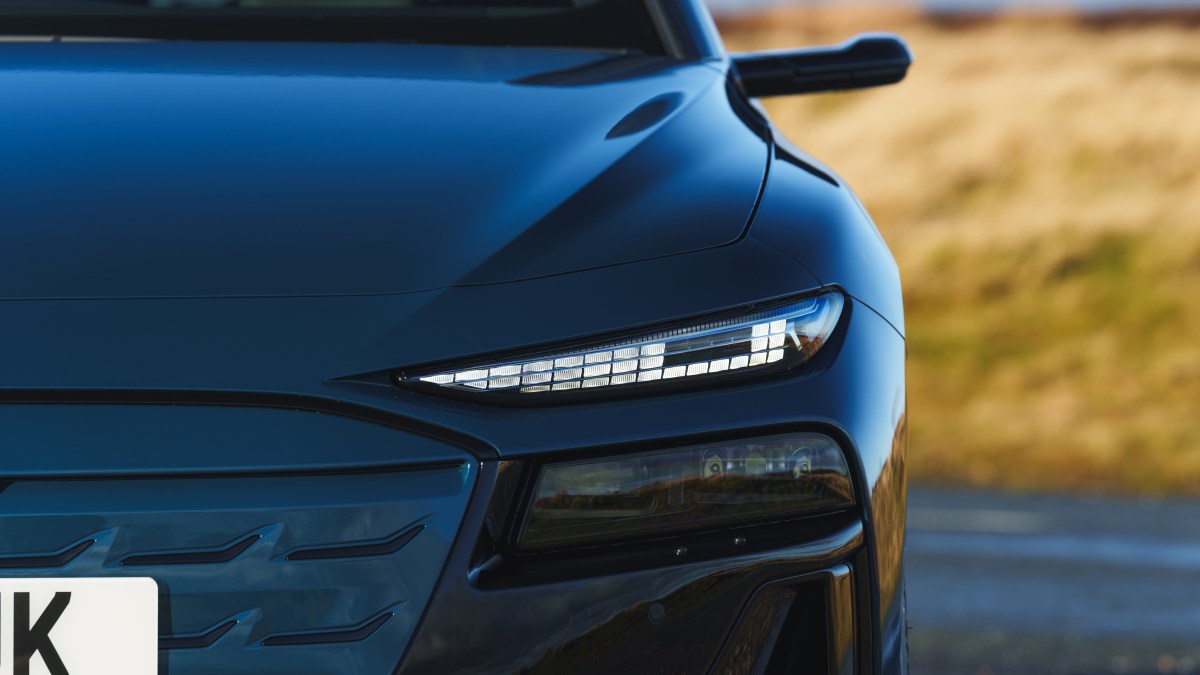
Features in Audi’s new headlight system could inadvertently increase the risk of accidents by distracting other drivers, campaigners have warned.
Last year, the German manufacturer unveiled its new digital matrix LED headlights, which are being used in models including the A6 and the Q3.
The “intelligent lighting” contains 25,600 individually controlled micro-LEDs enabling the system to project patterns and journey information onto the road surface as the car moves forward.
• Drivers lose faith in EVs’ savings as pay-per-mile road tax looms
This includes projecting a snowflake onto the road ahead when the temperature drops below 4C to warn of slippery conditions, and projecting a triangle with an exclamation mark if there are reports of an accident ahead.
If the vehicle spots someone in the road a “light cone”, separate from the main headlights, will flash up to highlight the person’s presence.
John Kushnick, the legal director at National Accident Helpline, said: “Features such as snowflake and cone projections were designed to improve safety, but these excessively intense lights can have the opposite effect.
“Even momentary glare can significantly reduce reaction times, obscure pedestrians, cyclists and road markings, and overall increase the likelihood of avoidable collisions.”
The technology also includes an “orientation light’, which projects two parallel lines on to the road ahead while driving on a carriageway to help the driver maintain lane position.
If a lane boundary is unintentionally crossed one of these lines on the road turns into an arrow telling the driver to return back. If the Audi is being overtaken the light will move slightly to inform the driver of being approached from behind.
When changing lanes the headlights adjust to be spread over both the lane that is being left and the one in to which the car is moving.
Although many of these functions can be deactivated by drivers, Steve Gooding, director of the RAC Foundation, said lighting was becoming too complex.
• Britain’s cars are older than ever — but is that a bad thing?
“Designers need to focus on the basics: the lights on cars are there to perform two functions – help the driver see the way ahead and send alerts to other drivers, making the car more visible and indicating that it is braking or about to turn.
“It is welcome to see auto companies taking action to address the intense glare of LED headlights but projecting symbols on to the road could prove distracting for other drivers, and using LED clusters to send patterns dancing across the car like a glitterball definitely feels like a step too far.”
In an interview in October, Michael Kruppa, Audi’s head of front lighting development, said the modern digital lighting system could take “safety to a new level”.
“We have developed a light source in such a way that we can almost use it like a video projector,” he said. “It combines safety and comfort while also improving driver concentration. Good lighting means that I can see more, I am more visible, and I can react faster to any situation.”
The Department for Transport is investigating headlamp glare from modern lights as part of the road safety strategy. It is also pressing for improvements to international lighting regulations.
At present, international standards on headlights are discussed and agreed at the United Nations Economic Commission for Europe, also known as UNECE.
An Audi spokesperson said: “All Audis undergo a very extensive development programme that ensures the end product is built to the exacting standards, including safety, any customer would expect. All safety systems on our cars comply with all UK and EU legislation.”