
Astronomers using the MeerKAT radio telescope in South Africa have detected the most distant hydroxyl megamaser ever observed, a cosmic “laser” emitted from a galaxy more than 8 billion light-years away. The discovery was detailed in a paper accepted for publication in Monthly Notices of the Royal Astronomical Society Letters, with a pre-print version available on arXiv. This remarkable find not only pushes the boundaries of space exploration but also highlights the power of advanced computational techniques in uncovering the mysteries of the universe.
A Cosmic Laser Across 8 Billion Light-Years
Hydroxyl megamasers are natural phenomena that emit exceptionally bright radio waves when hydroxyl molecules in the gas-rich regions of merging galaxies collide. These collisions compress the gas and trigger the molecules to amplify radio emissions in a way similar to how lasers are produced on Earth, but at much longer wavelengths. The newfound system, located in a galaxy that is 8 billion light-years away, is the most distant hydroxyl megamaser ever detected, and its intensity qualifies it as a “gigamaser”, a term used to describe the brightest and most powerful space lasers.
“This system is truly extraordinary,” said Dr. Thato Manamela, the lead author of the study and a postdoctoral researcher at the University of Pretoria.
“We are seeing the radio equivalent of a laser halfway across the universe. Not only that, during its journey to Earth, the radio waves are further amplified by a perfectly aligned, yet unrelated foreground galaxy. This galaxy acts as a lens, the way a water droplet on a windowpane would, because its mass curves the local space-time. So we have a radio laser passing through a cosmic telescope before being detected by the powerful MeerKAT radio telescope, all together enabling a wonderfully serendipitous discovery.”
The concept of gravitational lensing, where light is magnified by the mass of a galaxy, has been theorized by Einstein and observed many times in optical astronomy. However, this discovery represents the first time gravitational lensing has played a significant role in amplifying a radio signal over such a vast distance, offering a rare and unique perspective on cosmic phenomena.
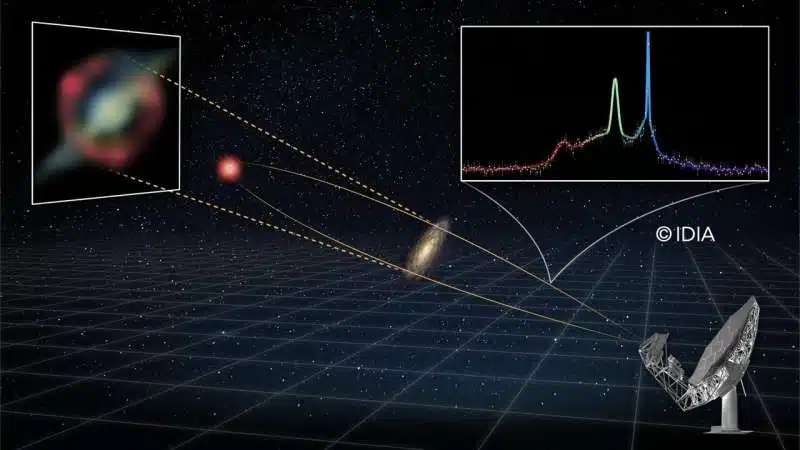 Illustration of the distant galaxy 8 billion light-years away (red), magnified by an unrelated foreground disk galaxy, resulting in a red ring. Splitting up the radio light into different colors, as a prism does, reveals the hydroxyl gigamaser (top-right rainbow-colored line). Credit: Inter-University Institute for Data-Intensive Astronomy (IDIA)
MeerKAT’s Cutting-Edge Capabilities and Data Processing
The MeerKAT radio telescope, located in the Karoo region of South Africa, is known for its exceptional ability to detect faint radio emissions. The telescope’s design allows it to capture signals at centimeter wavelengths, which are crucial for studying distant cosmic objects. However, collecting the data is just the first step in making such discoveries. An enormous amount of computational power and sophisticated algorithms are required to process the terabytes of data that MeerKAT generates, which is where advanced infrastructure and highly trained software support personnel come into play.
“This result is a powerful demonstration of what MeerKAT can do when paired with advanced computational infrastructure, fit-for-purpose data processing pipelines, and highly trained software support personnel,” said Prof. Roger Deane, co-author of the study and Director of the Inter-University Institute for Data Intensive Astronomy (IDIA). Prof. Deane, also a professor at the Universities of Cape Town and Pretoria, emphasized how this combination of technology and expertise empowers young South African scientists, like Dr. Manamela, to lead the way in global scientific endeavors.
MeerKAT’s capabilities have already transformed the landscape of radio astronomy, allowing for deeper exploration of cosmic phenomena that were previously difficult to observe. The role of young scientists in driving these advancements underscores the growing importance of South Africa’s contributions to cutting-edge science.
The Promise of Future Discoveries
The discovery of this distant hydroxyl gigamaser is just the beginning. Dr. Manamela expressed excitement about the potential to find many more such systems in the future.
“This is just the beginning,” he said. “We don’t want to find just one system—we want to find hundreds to thousands. Here at the University of Pretoria, we are carrying out systematic surveys of the universe, building the required computational pipelines and algorithms to open this observational frontier ahead of, and ultimately with, the Square Kilometer Array.”
The Square Kilometer Array (SKA) is a next-generation radio telescope that promises to revolutionize our understanding of the universe. As MeerKAT continues to pave the way for future discoveries, it will work in tandem with the SKA, further enhancing our ability to study distant galaxies and uncover the secrets of the cosmos.
This discovery available on arXiv, highlights the significant strides made in radio astronomy, as well as the potential for future breakthroughs. With systematic surveys and advanced computational techniques, scientists are set to expand the frontiers of space exploration and gain deeper insights into the universe’s origins and evolution.