
Iranians to bid farewell to late Supreme Leader Khamenei in Tehran
Iranians are to bid farewell to late Supreme Leader Ayatollah Ali Khamenei in a ceremony on Wednesday at 10pm (1830 GMT) at Tehran’s Imam Khomeini prayer ground, state media reported.
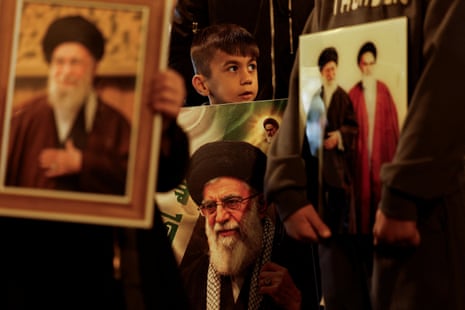 A boy carries a portrait of Iranian Supreme Leader Ayatollah Ali Khamenei during a symbolic funeral procession, following his death in Israeli and US airstrikes, amid the US-Israeli conflict with Iran, in Najaf, Iraq 3 March 2026. Photograph: Alaa Al-Marjani/Reuters
The ceremony will last for three days and the funeral procession will be announced when it is finalised, it said.
Updated at 01.39 EST
Key events
Show key events only
Please turn on JavaScript to use this feature
Loud explosion in Tehran – report
News agencies are reporting a loud blast in eastern Tehran.
We will bring you more details as we get them.
ShareDozens rescued from sinking Iranian warship near Sri Lanka
Reuters reported that the Sri Lankan military rescued at least 30 people on board a sinking Iranian ship today near Sri Lankan waters, according to officials.
The Sri Lankan navy dispatched a rescue mission after a distress call from the Iranian ship, a defence ministry spokesperson said.
Sri Lankan foreign minister Vijitha Herath told parliament that the injured sailors from the 180-crew vessel were taken to a hospital in the south of the country. He did not give further details, including what caused the ship to sink, but said Sri Lanka would take appropriate action.
According to local reports, the ship was the Iris Dena, a frigate in the Iranian navy. It had reportedly sent out a distress call off the coast of Galle in the southern part of the country.
ShareIsrael threatens to assassinate Ali Khamenei’s replacement
Israel’s defence minister Israel Katz threatened on X on Wednesday to assassinate any Iranian leader picked to succeed supreme leader Ayatollah Ali Khamenei, who was killed in US-Israeli strikes on Tehran.
double quotation markAny leader selected by the Iranian terror regime to continue leading the plan for Israel’s destruction, threatening the United States, the free world and countries in the region, and suppressing the Iranian people, will be a certain target for assassination, no matter his name or where he hides.”
Share Hannah Ellis-Petersen
India is facing a highly precarious situation for its energy security if the Strait of Hormuz – the world’s most critical oil shipping chokepoint – remains closed amidst the escalating Middle East crisis.
India, a country of more than 1.4bn people, imports about 88% of its required crude oil to meet its vast energy requirements. Around 40% of that comes from the Middle East, through the Strait of Hormuz, a narrow but vital maritime corridor linking the Persian Gulf with the Gulf of Oman.
Oil traffic through the Strait of Hormuz halted since the US and Israel launched strikes on Iran last week. In retaliation, Iran’s Islamic Revolution Guards Corps claimed control of the shipping corridor and warned that any vessel attempting to transit the passage could face missiles or drone strikes.
According to industry analyst Kpler, India currently has around 100 million barrels of commercial crude oil stocks left, covering roughly 40 to 45 days of its requirements.
Over the past few months, punitive tariffs and sanctions from US president Trump had pushed India to move away from its reliance on discounted Russian oil, over accusations it was funding Putin’s aggressions in Ukraine. However the ongoing turbulence in the Middle East, which is driving up crude oil prices, could send India back to Moscow to ensure its energy security needs are met.
On Tuesday, Russian Deputy Prime Minister Alexander Novak told a state-run tv channel that India had signalled “renewed interest” in importing larger volumes of Russian crude oil following the closure of the Strait of Hormuz.
Indian officials have not officially commented but government sources told Reuters that India was “scouting for alternatives” of both crude oil and natural gas and that they were “reasonably confident that if one source closes, another window will open”.
The situation is even tricker for India’s natural gas needs, which are largely reliant on Abu Dhabi and Qatar. Facing strikes from Iran, both countries have halted production and exports. This week, Indian companies began reducing gas supplies to some industrial customers as they face an impending shortfall.
Here are some early images from the newswires of the Israeli airstrikes in Dahiyeh, a southern suburb of Beirut, seen as a support base for the militant group Hezbollah.
Smoke rises following an Israeli airstrike in Dahiyeh, Beirut’s southern suburb, Lebanon. Photograph: Bilal Hussein/AP Photograph: Bilal Hussein/AP Photograph: Bilal Hussein/AP Photograph: Mohamed Azakir/ReutersShare
The US Senate is headed towards a vote Wednesday on president Donald Trump’s decision to embark on a war against Iran, an extraordinary test in Congress for a conflict that has rapidly spread across the Middle East with no clear US exit strategy.
The legislation, known as a war powers resolution, gives lawmakers an opportunity to demand congressional approval before any further attacks are carried out. The Senate resolution and a similar bill being voted on in the House later this week face unlikely paths through the Republican-controlled Congress and would almost certainly be vetoed by Trump even if they were to pass.
ShareIran Guards say launched more than 40 missiles at US, Israeli targets
Iran’s Revolutionary Guards said Wednesday they had launched about 40 missiles at US and Israeli targets on the fifth day of war in the Middle East.
“Several hours ago, the 17th wave of operation Honest Promise 4 was conducted with the launch of 40 missiles by the Islamic Revolutionary Guard Corps’ aerospace forces, towards American and Zionist targets,” a statement read on state TV said, without giving further details.
ShareIranians to bid farewell to late Supreme Leader Khamenei in Tehran
Iranians are to bid farewell to late Supreme Leader Ayatollah Ali Khamenei in a ceremony on Wednesday at 10pm (1830 GMT) at Tehran’s Imam Khomeini prayer ground, state media reported.
A boy carries a portrait of Iranian Supreme Leader Ayatollah Ali Khamenei during a symbolic funeral procession, following his death in Israeli and US airstrikes, amid the US-Israeli conflict with Iran, in Najaf, Iraq 3 March 2026. Photograph: Alaa Al-Marjani/Reuters
The ceremony will last for three days and the funeral procession will be announced when it is finalised, it said.
Updated at 01.39 EST
Differences are emerging between the governments of Israel and the US, even as they conduct a joint war against Iran.
At the outset of the bombing campaign on Saturday, both Trump and Netanyahu said regime change was the goal. But in remarks at the White House on Monday, two days after Israeli air strikes killed Iran’s Supreme Leader Ayatollah Ali Khamenei and much of his leadership, Trump did not mention overthrowing Iran’s government as his top priority, Reuters points out.
The US goal, he said, was to destroy Iran’s missiles and navy, and to stop it from obtaining a nuclear weapon. His Pentagon chief Pete Hegseth said at a press conference that same day that the operation was not a “so-called regime-change war.”
President Donald Trump shakes hands with Israel’s prime minister Benjamin Netanyahu during a news conference at Mar-a-Lago, Dec. 29, 2025, in Palm Beach, Fla. Photograph: Alex Brandon/AP
Netanyahu, by contrast, has called on Iran’s citizens to take to the streets and overthrow their rulers as recently as Monday night. “We’re going to create the conditions, first, for the Iranian people to get control of their destiny,” he told Fox News.
The US and Israel’s joint war in Iran has already upended travel across the Middle East, stranding tens of thousands of people. And the future is anything but certain.
Experts stress that flights scheduled in the coming days and weeks could continue to see disruptions, causing ripple effects globally. Many carriers have been forced to either cancel flights or shift to longer routes. That’s straining operating costs and ticket prices, both of which could become more expensive if airlines have to pay more for fuel the longer the war drags on.
FlyDubai airline planes are parked on the tarmac at Dubai International Airport in Dubai on 2 March 2026. Photograph: Fadel Senna/AFP/Getty Images
Experts recommend postponing unnecessary travel if possible, checking refund or insurance policies and, most importantly, monitoring safety advisories.
ShareUK government charter flight for British nationals in Oman
A government charter flight will be available on Wednesday evening for British nationals wanting to leave Oman amid the conflict in the region.
The Foreign Office said the flight will depart the country’s capital, Muscat, at 7pm and is available for British nationals, their partners and children under 18 with a valid travel document.
Buildings surround Mohammed Al Ameen Mosque, amid the US-Israeli conflict with Iran, in Muscat, Oman 3 March 2026. Photograph: Benoît Tessier/Reuters
According to the Foreign Office, priority for the evacuation flight will be given to the most vulnerable and they will contact British nationals in Oman. The department asked people not to travel to Muscat International Airport in Oman unless they are contacted by officials, while dependents who are not British nationals will require a valid visa or permission to enter or remain granted for more than three months.
The US state department has given its non-emergency personnel and their families in Saudi Arabia and Oman permission to leave, the US embassies in both Gulf states said Tuesday, as Iran launches retaliatory strikes in response to US-Israeli air raid.
Updated at 00.56 EST
Missiles launched from Iran early Wednesday triggered air raid sirens across large parts of Israel, with the military saying it was “operating to intercept the threat”.
The order to seek shelter covered Jerusalem, Tel Aviv and other areas across the country. It was lifted after several minutes, with no immediate reports of any direct impact.
Israel’s emergency medical service Magen David Adom said it had received no reports of casualties.
ShareConflicting claims over the strait of Hormuz
Iran’s Revolutionary Guards said Wednesday they control the Strait of Hormuz, a vital shipping route for oil and gas, and any vessels seeking to pass through the waterway risk damage from missiles or stray drones, Agence France-Presse reports.
“Currently, the Strait of Hormuz is under the complete control of the Islamic Republic’s Navy,” said Guards Navy official Mohammad Akbarzadeh in a statement issued on Fars news agency.
Birds fly near a boat in the Strait of Hormuz amid the US-Israeli conflict with Iran, as seen from Musandam, Oman, 2 March, 2026. Photograph: Amr Alfiky/Reuters
However, Admiral Brad Cooper of US Central Command contradicted Iran’s claim, saying just hours earlier that the US was sinking “all of the Iranian navy” and had already destroyed 17 Iranian ships.
“For decades the Iranian regime has harassed international shipping. Today there is not a single Iranian ship underway in the Arabian gulf, Strait of Hormuz or Gulf of Oman,” he said.
The US navy could begin escorting oil tankers through the strait of Hormuz if necessary, President Donald Trump said on Tuesday, in one of the administration’s most aggressive steps yet to attempt to contain soaring energy prices sparked by the war.
In his briefing, Admiral Cooper also said that the number of strikes carried out on Saturday in the first 24 hours of its war on Iran was nearly double that of the “shock-and-awe” strikes on Iraq in 2003, and that nearly 2,000 targets had been hit so far in Iran.
Updated at 00.56 EST
Global markets roiled by conflict
Global markets tumbled further on Wednesday despite Donald Trump’s offer to have the US navy escort tankers through the strait of Hormuz and the US military’s claim that there is “not a single Iranian ship underway” in the crucial waterway.
The Middle East conflict has crippled the strait which was in effect closed by Iran after strikes by the US and Israel this weekend, raising fears of a sustained energy supply crisis that reverberated around the world.
As Asian stock markets came under fresh pressure on Wednesday, trading in Seoul was suspended as South Korea’s benchmark Kospi share index fell by as much as 11.3%, before pulling back to trade down 7.7%. Japan’s Nikkei 225 fell 3.9% in Tokyo.
The Guardian’s Callum Jones looks at how the markets have been roiled.
Updated at 00.57 EST