
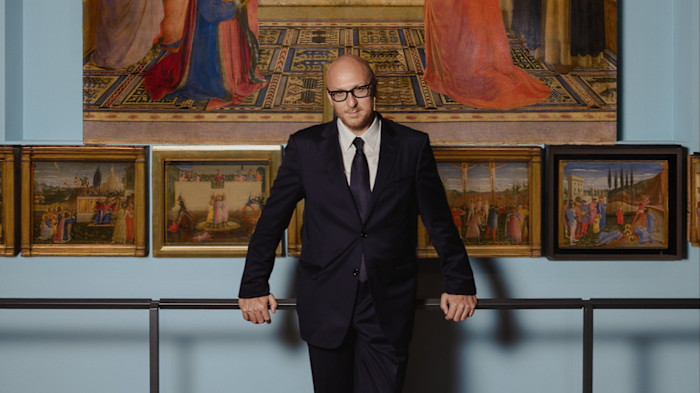
Arturo Galansino, director of Florence’s Fondazione Palazzo Strozzi, has the opposite problem to many of the world’s museum directors. “In Italy, exhibitions of contemporary and Modern art are not popular, as they are in London or Berlin or Paris. But a lot of people travel from here to see contemporary art around the world. So why not bring what they are seeing here?” he says.
A show jumper since he was a child, overcoming obstacles seems to come naturally. Galansino became director of the museum, housed in the lofty Renaissance palace of the Strozzi family — rivals to the Medicis — from London’s Royal Academy of Arts in 2015. Since then, living artists whose work he has brought to the medieval city include Tracey Emin, Ai Weiwei, Marina Abramović, the conceptual artists Tomás Saraceno and Carsten Höller, and even the social media sensation Kaws.
In all, Galansino says, the aim is to bring out the connections between their work and what he describes as “the modernity of the Renaissance”. Examples include the 2020 Saraceno exhibition Aria, for which the artist explored ways to escape the current Anthropocene epoch including through air-filled floating sculptures, in the mould, Galansino says, of Leonardo da Vinci, “who dreamt of flying”.
 Fra Angelico’s ‘Mocking of Christ, the Virgin and Saint Dominic’ (c1438-39)
  ‘Interior’ (1936) by Mark Rothko
The links are more obvious when it comes to the Strozzi’s next show — a much-anticipated retrospective of Mark Rothko, which opens next week. The American painter “had a life-long passion and engagement with the Italian Renaissance,” says his son, Christopher Rothko, who is co-curating the exhibition alongside independent curator Elena Guena.
Mark Rothko first visited Florence in 1950, “just as he was moving into his signature style, with a new sense of space and architecture,” Christopher Rothko says. Fra Angelico’s frescoes in the Convent of San Marco and Michelangelo’s architecture in the nearby Medicea Laurenziana library inspired works such as the Seagram Murals (nine of which are now in London’s Tate Modern) and the octagonal Rothko Chapel in Houston, he explains.
The last room of the Strozzi exhibition will emphasise the influence, Galansino says. While most chronological exhibitions of Rothko end with the artist’s late, dark paintings, the Strozzi show concludes with light, large works on paper, “painted with delicate colours, sienna, blue, pink,” he says, describing these as “the colours of the early Renaissance”.
 Carsten Höller’s installation at the Palazzo Strozzi
Galansino’s most recent hit was distinctly not for contemporary art. The Strozzi has just closed the most visited show in its 20-year history, of the early Renaissance painter Fra Angelico. Galansino confirms this had more than 250,000 visitors in its four-month run, while also supporting the restoration of 28 of the 150 works on show.
Yet for an Old Masters blockbuster, it was an outlier. “The numbers are important, but more so that it changed the perception of an artist for scholars and the public. People understand the ambition and stature of, say, Caravaggio or Leonardo, but they didn’t for Fra Angelico,” he says.
There was also a very visible contemporary art addition in the museum’s free-to-see, arched and open courtyard: a sculpture by Kaws that updated the familiar positioning of the annunciation with the Angel Gabriel and Virgin Mary supersized into cartoon-like figures in the thrall of their mobile phones.
 Kaws’s sculpture ‘The Message’ modernises the Angel Gabriel and Virgin Mary © Ela Bialkowska, OKNO studio; KAWS
 French artist JR’s installation ‘The Wound’ on the outside of Palazzo Strozzi © Ela Bialkowska, OKNOstudio
Galansino seems pleased to hear that I found the sculpture surprisingly effective. “There are many art historians with some prejudices. I think Brian [Donnelly, Kaws’s real name] is very smart. We talked about how to find the right way, and I thought the craziest is the best.” He sent the artist books about the Renaissance, he says, and showed him around Florence so “he could see with his eyes, from the point of view of his own culture”. Kaws has, Galansino notes, more than 4mn Instagram followers.
Such initiatives are helping to bring in a younger crowd — Galansino says that more than a third of the Strozzi’s visitors are under 30 — but this isn’t his only ambition. “I want to encourage sustainable tourism, for Italians,” he says, in a city that is notably overrun by overseas visitors.
He gives the example of extending the Fra Angelico exhibition to a second venue, the nearby Convent of San Marco, which houses the artist’s in situ frescoes, including those made for the cells of his fellow monks. “They have always been there, but the convent is almost totally unknown. With our exhibition, they received four times their annual visitors in four months, and a lot of social media attention,” Galansino says.
 Tomás Saraceno’s ‘Thermodynamic Constellation’ (2020) © Ela Bialkowska, OKNO Studio
It is a marked difference from what he calls the “mass tourism” of “people coming in a big bus to spend one day in Florence and just see [Michelangelo’s] “David” or the Uffizi. That doesn’t help the local economy much. With the two venues, we create an alternative map. People walk between them, find new places, stop for a coffee,” he says.
The institution’s direct and indirect economic impact is significant. On a projected income of about €10mn last year, Galansino cites independent research that puts its wider economic contribution close above €100mn, driven by so-called “exclusive visitors”, an estimated 200,000 who travel to Florence primarily to visit the Palazzo Strozzi’s exhibitions.
The Rothko exhibition brings in two additional venues — the San Marco convent again, where five of Rothko’s paintings will be hung alongside Fra Angelico frescoes, and the Medicea Laurenziana library, which sits between the convent and the Palazzo Strozzi, and will have two Rothko works in its vestibule.
 ‘Untitled’ (1952-53) by Mark Rothko © FMGB Guggenheim; Bilbao Museoa, photo Erika Barahona
Galansino’s inventive spirit is partly dictated by the Strozzi’s unusual funding mix. “In Italy there are normally two models. Either you are 100 per cent funded by the state, so you are reliant on politics, or you are 100 per cent funded privately, so you are reliant on one very rich person or corporation. We are in the middle,” he says.
His institution gets about 15 per cent of its income from public funds, 40 per cent from its own activity (mostly ticket sales) and 45 per cent from private support, he says. The latter comes from corporations, including the foundations of the Italian banks CR Firenze and Intesa Sanpaolo as well as private individuals, many with ties to Florence, such as the collectors Maria Manetti Shrem and Christian Levett.
It is no mean feat. Galansino underlines that “in Italy, there isn’t a culture of philanthropy. We are among the highest taxpayers in the world, so people think they have done enough.” How does the show jumper overcome this particular hurdle? “Logically, you should have super-commercial exhibitions, but we always have the opposite, super-scholarly shows. We start with this and find ways to bring in the public, the politicians, the city, the support. It’s not easy, but it is what we do.”
‘Rothko in Florence’ at Palazzo Strozzi, March 14-August 23, palazzostrozzi.org