
The FTSE 100 was up in afternoon trading while US markets also recovered from yesterday’s sharp downturns, providing some hope for global investors after Asian markets fell sharply overnight.
The UK’s premier stock market index, which fell at the start of trading in London, had gained 83 points, or 0.8 per cent, to 10,568.10 by mid-afternoon on Wednesday. Markets in Germany and France gained 1.7 per cent and 1.5 per cent respectively as investors moved into defensive stocks as well as defence and energy shares.
US markets, too, shrugged off their previous concerns over the possible prolonged nature of military action in the Middle East with the main stock market indices all rising in early trading today. The S&P 500 was up 0.6 per cent to 6,862.66, the Dow Jones industrial was up 0.5 per cent at 48,761.38 and the tech-heavy Nasdaq Composite was up 1.2 per cent at 22,792.08.
Investor sentiment was buoyed after President Trump said last night that America would provide insurance and guarantees to shipping passing through the Gulf, escorted by the US navy if necessary. The cost of transporting crude has nevertheless soared, according to Argus Media, the London-based provider of energy and commodity market intelligence.
The US reaction was in stark contrast to Asia where the region’s dependence on imported oil hit markets hard. Investors in major Asian crude importers — South Korea, Japan and Taiwan — dumped high-flying AI stocks for safe havens on concerns that the Middle East conflict could result in an oil price shock.
It follows four days of military action, with US and Israeli forces striking targets inside Iran. Tehran retaliated with attacks on Gulf oil and gas plants and claimed the Strait of Hormuz was closed.
Threats to the strait, through which 25 per cent of global seaborne oil and nearly all Middle Eastern liquefied natural gas (LNG) must pass, sent Brent crude above $84 a barrel on Wednesday, before the price eased back slightly.
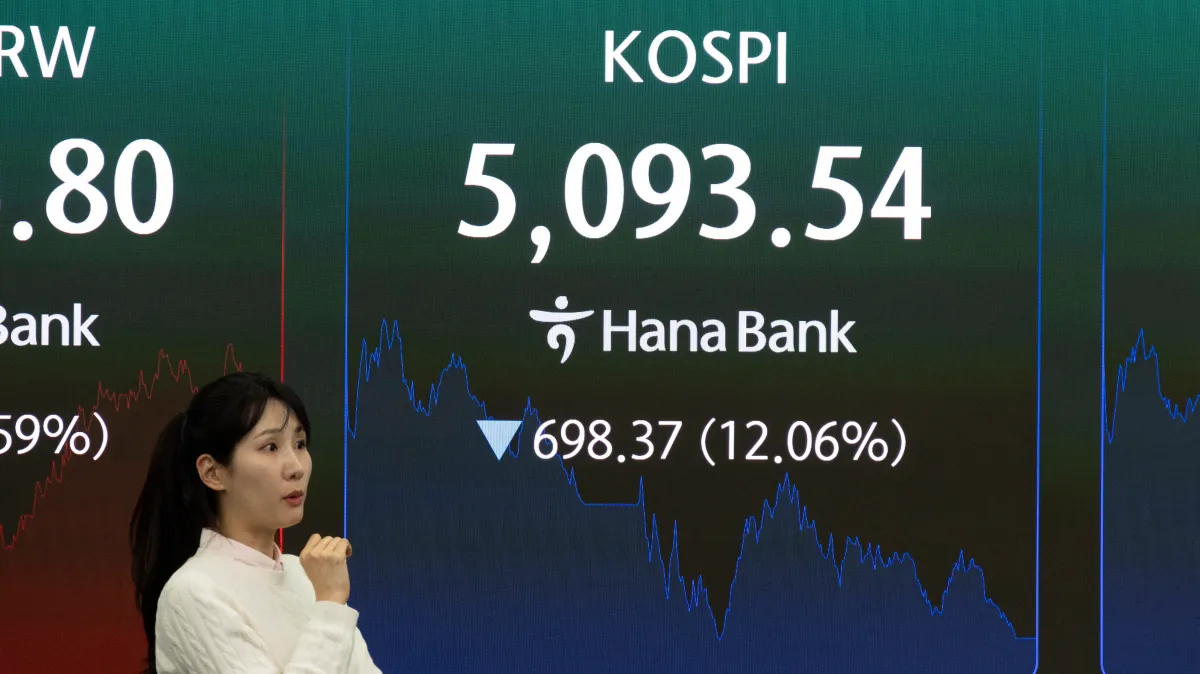
Asian economies are seen as particularly vulnerable to rising oil and liquefied natural gas prices. South Korea is the world’s fourth-largest oil importer, with 70 per cent of its oil sourced from the Middle East. A massive unwinding of stock market positions in South Korea triggered a circuit breaker as the Kospi share index shed 12 per cent, with two-day losses the heaviest since the financial crisis.
Heavyweight technology stocks that powered the Kospi’s 50 per cent rise earlier this year were the hardest hit as global funds de-risked. Samsung and SK Hynix — down 9.7 per cent and 7.2 per cent respectively — led the losses as cash and energy security replaced “AI growth” as the market’s priority.
In Japan, the Nikkei fell 3.7 per cent and shares in Taiwan dropped 4.3 per cent as investors moved out of semiconductor makers, which have been one of the biggest bets of the past few months.
A wave of contagion swept through most Asian exchanges, with markets in China, Hong Kong and Australia down between 1 per cent and 2.6 per cent. Safe-haven buying lifted the dollar against a basket of currencies, while gold rose 1.8 per cent to $5,181.74 an ounce.
Business newsletter
The business editor’s exclusive analysis of all the latest financial and economic news.
Sign up with one click
Charu Chanana, chief investment strategist at Saxo in Singapore, said: “Asia’s sell-off is turning disorderly because markets are no longer treating this as a ‘one-week headline shock’.”