
ⓘ Apple
The Apple M5 Pro and M5 Max offer notable upgrades over their predecessors
A new leak has revealed the Apple M5 Pro and M5 Max in full. Both chips use Apple’s new Super and Medium cores, with the former boosting up to 4.61 GHz.
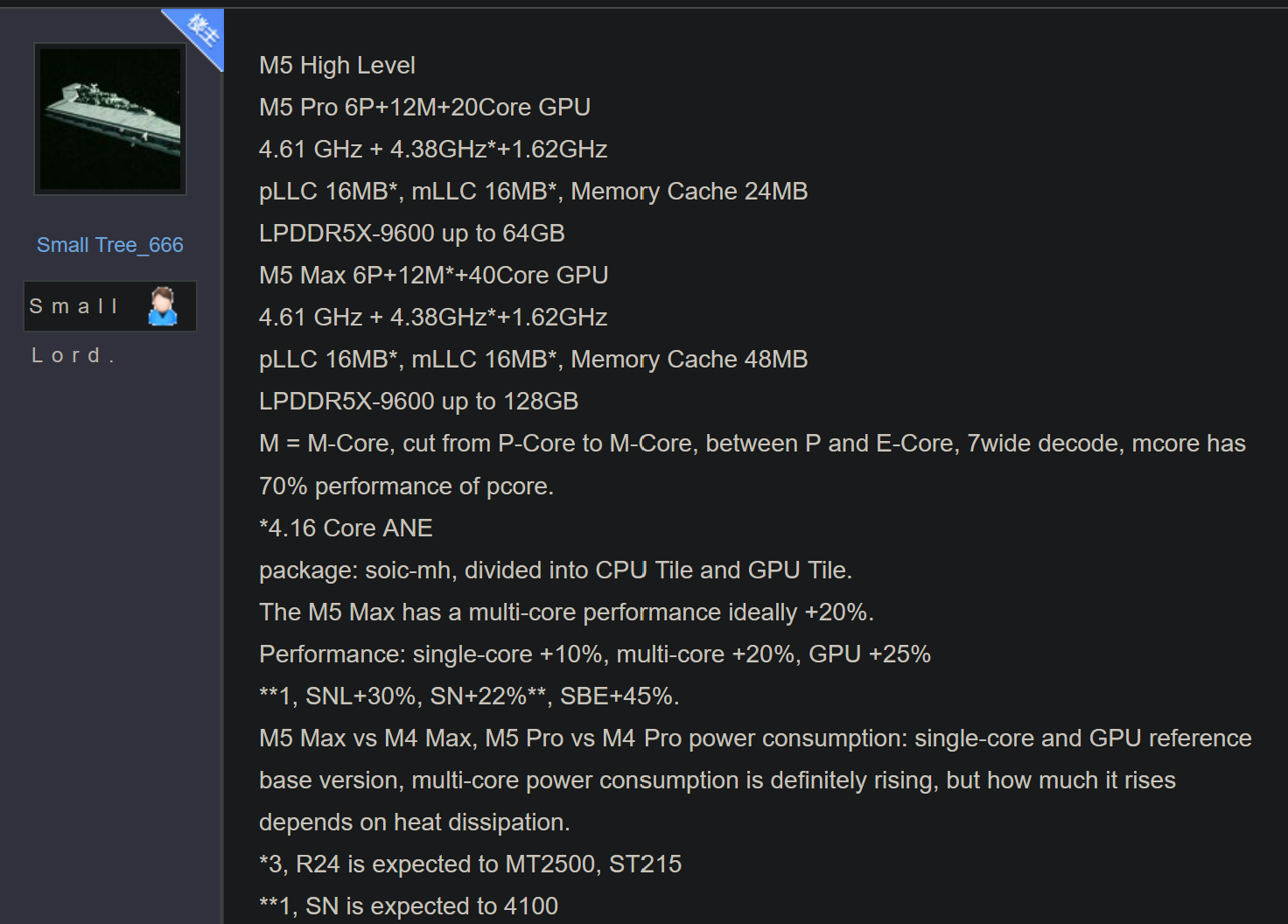
Even though Apple officially showed off the M5 Pro and M5 Max yesterday alongside its new MacBook Pro models, only some of their specifications were revealed. These are usually confirmed by listings on Geekbench and other benchmarking platforms. However, a leak from Baidu has now shed light on both chips’ innards.
Apple M5 Pro6 Super CPU cores with 4.61 GHz boost clock, 16 MB L3 cache12 Medium CPU cores with 4.38 GHz boost clock, 16 MB L3 cacheGPU boost clock: 1.62 GHz. 24 MB memory cacheUp to 64 GB LPDDR5x-9600 RAM supportedApple M5 Max6 Super CPU cores with 4.61 GHz boost clock, 16 MB L3 cache12 Medium CPU cores with 4.38 GHz boost clock, 16 MB L3 cacheGPU boost clock: 1.62 GHz. 48 MB memory cacheUp to 128 GB LPDDR5x-9600 RAM supported
Apple confirmed the M5 Pro and M5 Max use what it calls Fusion architecture. It is essentially TSMC’s SoIC-MH 2.5D packaging tech that connects a CPU tile and a GPU tile with a high-speed interconnects. Performance-wise the M5 Pro and M5 Max are tipped to offer up to a 10% increase in single-threaded workloads, 20% in multi-threaded applications, and the GPU will be about 25% faster.
Power consumption is expected to stay more or less the same across generation in single-threaded workloads. The extra CPU cores will, however, result in the M5 Pro and M5 Max guzzling more power when all cores are stressed.
ⓘ Baidu
Apple M5 Pro and M5 Max specifications
 Anil Ganti – Senior Tech Writer – 2859 articles published on Notebookcheck since 2019
I’ve been an avid PC gamer since the age of 8. My passion for gaming eventually pushed me towards general tech, and I got my first writing gig at the age of 19. I have a degree in mechanical engineering and have worked in the manufacturing industry and a few other publications like Wccftech before joining Notebookcheck in November 2019. I cover a variety of topics including smartphones, gaming, and computer hardware.