
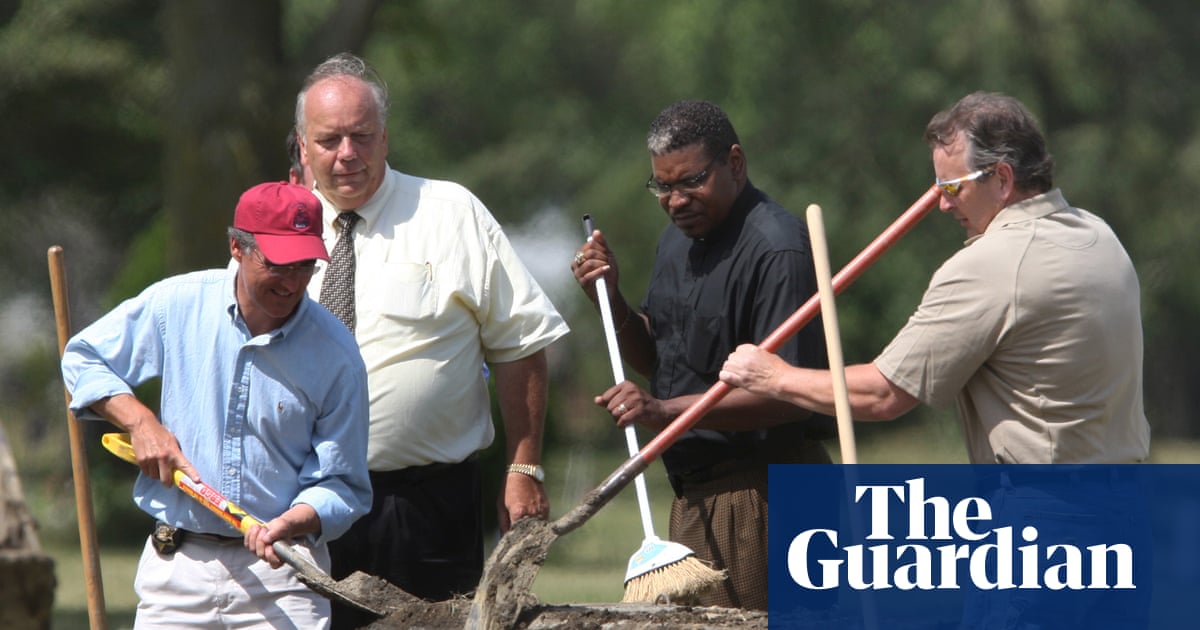
It was a particularly heinous crime. Four workers at a cemetery near Chicago dug up more than 100 bodies and dumped the remains elsewhere in the grounds, in order to resell the burial plots for profit.
Now, nearly two decades after the scandal broke at Burr Oak cemetery in Alsip, Illinois, scientists have released details of how a tiny clump of moss became crucial forensic evidence that helped convict the grave robbers.
Dr Matt von Konrat, head of botanical collections at the Field Museum in Chicago, was drawn into the case in 2009 when he received a phone call from the FBI. “They asked if I knew about moss and brought the evidence to the museum,” he said.
An investigation by local police had found human remains buried under inches of earth at the cemetery, a site of enormous historical importance. Several prominent African Americans are buried at the cemetery, including Emmett Till, whose murder in 1955 became a catalyst for the civil rights movement, and the blues singer Dinah Washington.
Alongside the re-buried remains, forensic specialists spotted various plants, including a piece of moss about the size of a fingertip. Hoping that it would help them crack the case, the FBI asked von Konrat to work out where the moss came from and how long it had been there.
After examining the moss under a microscope and comparing it with dried specimens in the museum’s collection, the scientists identified it as common pocket moss, or Fissidens taxifolius. A survey at the cemetery found that the species did not grow where the corpses were discovered, but was abundant in a lightly shaded area beneath some trees where police suspected the bodies had been dug up. The moss had evidently been moved with the bodies.
But when was the crime committed? The answer lay in a quirk of moss biology. “This is the cool thing about moss,” von Konrat said. “When we’re dead, we’re dead, but with mosses, it’s bizarre. Even when we might think they’re dead, they can still have an active metabolism.” The metabolism drops slowly over time as cells gradually die off.
Emmett Till is among those whose remains are buried in the cemetery. Photograph: Charles Rex Arbogast/AP
One way to measure moss metabolism is to bathe it in light and see how much is absorbed by the chlorophyll used to make food through photosynthesis, and how much light is re-emitted. The scientists ran tests on the moss found with the bodies, on a fresh clump from the cemetery, and other specimens from the museum’s collection.
“We concluded that the moss had been buried for less than 12 months and that was important because the accused’s whole line of defence was that the crime took place before their employment. They were arguing that it happened years and years earlier,” said von Konrat. Details are published in Forensic Sciences Research.
Doug Seccombe, a former FBI agent who worked on the case and a co-author of the study, said the plant material from the cemetery was “key” to securing the convictions when the case went to trial.
Von Konrat, who is a fan of the BBC forensic science drama Silent Witness, never expected to be working on a criminal case, but now wants to highlight how important mosses might be for forensic investigations. “I had no idea we’d be using our science, our collections, in this manner,” he said. “It underscores how important natural history collections are. We never know how we might apply them in the future.”