
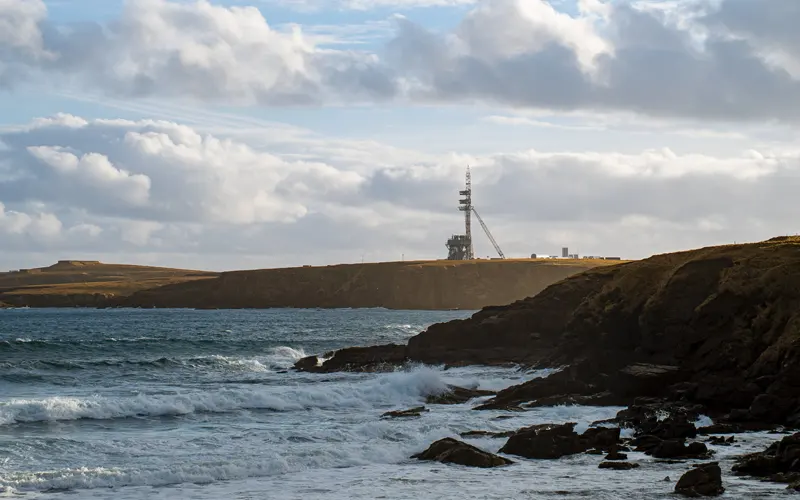
 Credit: RFA
The United Kingdom has announced a new £500 million spending package to support its space sector, including £20 million to support the development of spaceport infrastructure in Scotland.
During a 4 March address at Space-Comm Expo 2026, Liz Lloyd, the country’s Minister for the Digital Economy, announced the new spending package. The largest commitments included in the package were £105 million to develop civil capabilities for in-orbit servicing and manufacturing, £85 million to develop the National Space Operations Centre, and £80 million to deliver the Connectivity in Low Earth Orbit programme.
On its investment in launch, Lloyd explained that in the country’s pursuit of “assured access to space,” it planned to focus on “accelerating launch from Scotland.”
“I want to make funding available for the capabilities, skills, and infrastructure that enable the launch sector to thrive, and so I can announce £20 million to accelerate spaceport infrastructure development in Scotland,” said Lloyd.
Scotland is home to two spaceport projects, the most prominent of which is SaxaVord Spaceport on the island of Unst off the country’s northern coast. The spaceport already features a completed launch pad, the infrastructure to support a launch, and a spaceport licence from the country’s Civil Aviation Authority. Germany’s Rocket Factory Augsburg is currently in the process of preparing to launch the inaugural flight of its RFA ONE rocket from the spaceport later this year.
SaxaVord has previously received financial support from the government, which committed £10 million as part of its Spring Budget in 2024. According to the budget, the funding was to support the goal of becoming the first to launch a satellite into orbit from the European mainland and become a “leading small satellite launch destination by 2030.”
The other, less well-developed spaceport project is Sutherland, located on the northern tip of Scotland. The spaceport was expected to be the home base of Orbex, but its construction was “paused” in December 2024, with the company redirecting funding to the development of its Proxima rocket. With the company appointing administrators and laying off its workforce, the pause has become an abandonment.
On Orbex, Lloyd explained that while the government is “disappointed,” the company’s failure did not end its “ambitions for launch.”
In late February, the Melness Crofters Estate, the organisation that owns the land leased to Orbex for the construction of the spaceport, announced that it was seeking new partners to deliver the spaceport, with UK-based launch startup Skyrora expressing interest in taking over the lease earlier that same month.
The Sutherland project has also previously received funding from the UK government, receiving £2.5 million in 2018. It also received £3 million from the Nuclear Decommissioning Authority in 2023 and a combined £9 million from Highlands and Islands Enterprise and the Scottish Government.
In addition to the £20 million to support the development of spaceport infrastructure in Scotland, the UK still has €112.30 million in unallocated funding under the European Launcher Challenge. With Orbex now gone, the most likely recipient of the remaining funding is Germany’s Rocket Factory Augsburg (RFA), to which the country committed an initial €10 million as part of the challenge. However, it’s unlikely that the country would be willing to commit the full €112.30 million to RFA without assurances of a significant increase in the company’s footprint in the UK.
Keep European Spaceflight Independent
Your donation will help European Spaceflight to continue digging into the stories others miss. Every euro keeps our reporting alive.