
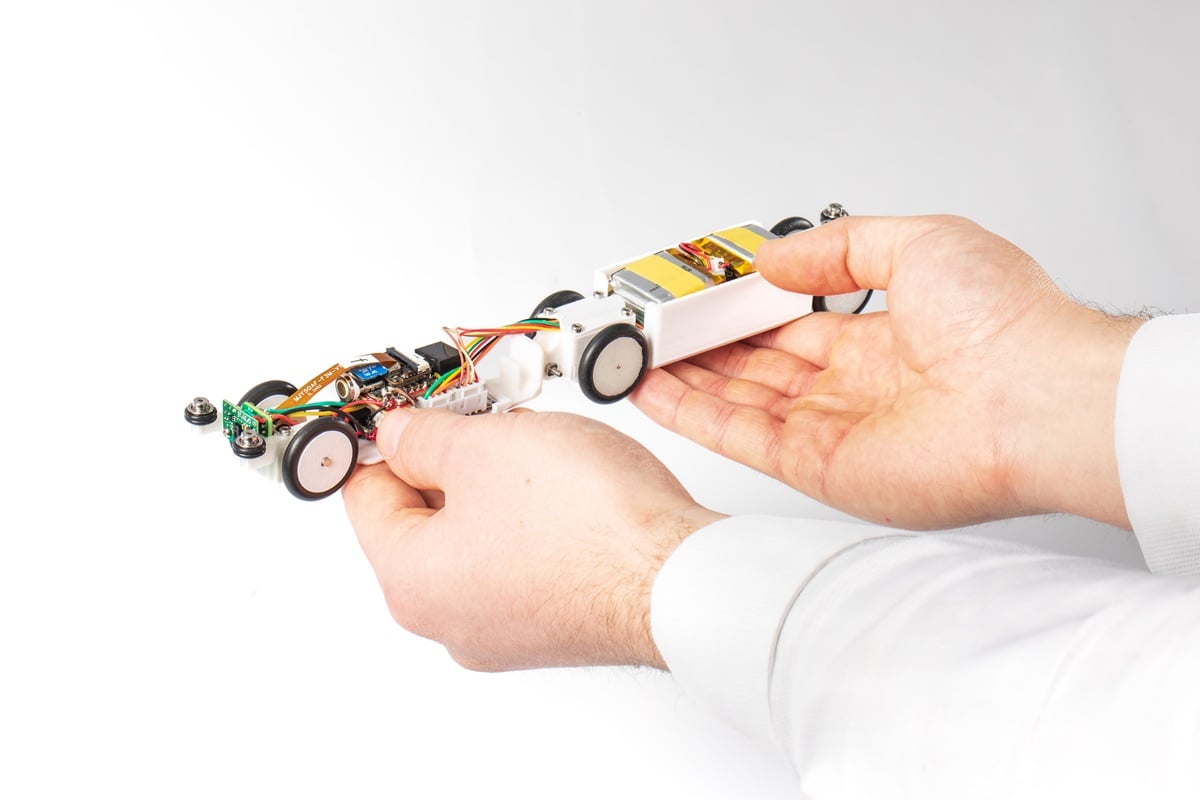
The UK Atomic Energy Authority (UKAEA) and CERN have jointly developed a “mouse-sized robot” to inspect parts of the Large Hadron Collider (LHC) that are out of reach to humans.
Named “PipeINEER,” from “pipe” and “pioneer,” the 3.7 cm wide (about 1.5 in) robot sadly looks nothing like a mouse, though it was designed to trundle autonomously through long, narrow pipes, which perhaps made the designers think of a rodent.
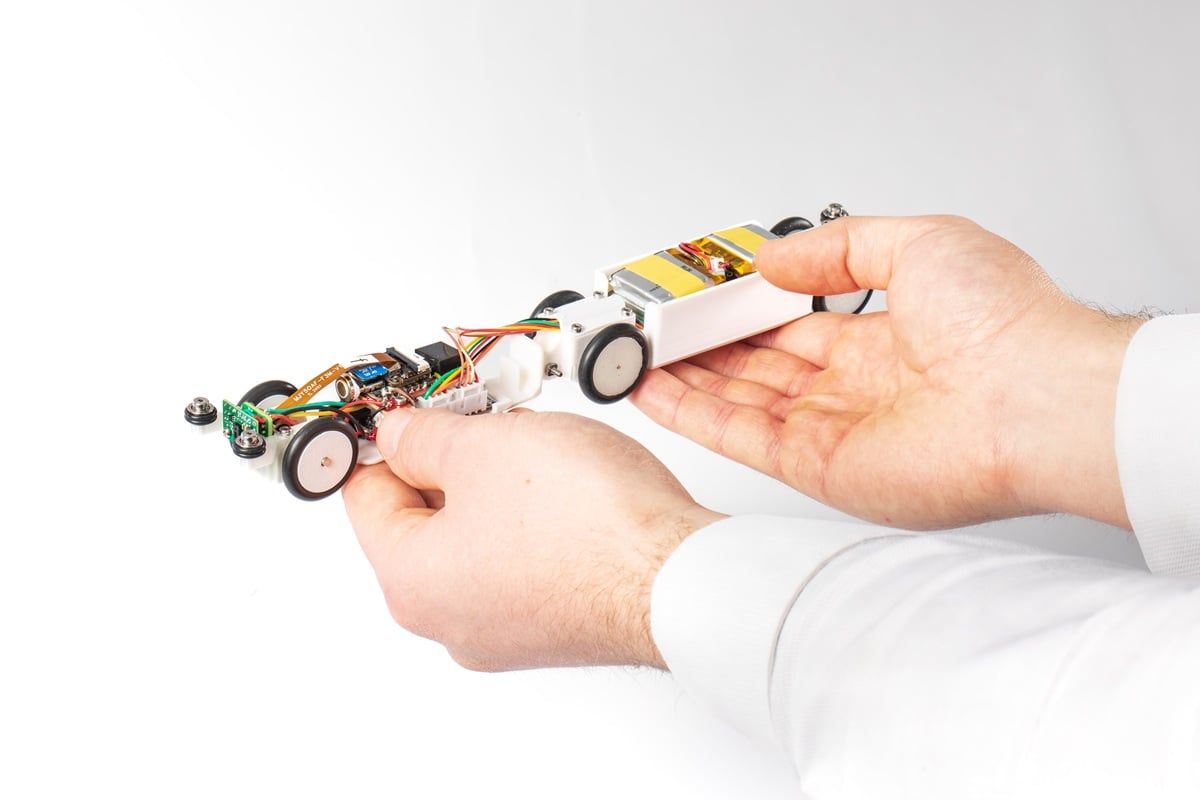
PipeINEER (image courtesy of United Kingdom Atomic Energy Authority)
The pipes in this case run the 27 km (approximately 16.8 miles) circumference of the LHC, which straddles the border between France and Switzerland, near Geneva.
These are the pipes that carry the actual particle beams that are surrounded by superconducting magnets at -271°C (-455°F) while also operating under high vacuum conditions. Add in their position deep within the infrastructure, and this makes human access and inspection extremely challenging.
The inspections are needed as the LHC contains about 2,000 plug-in modules (PIMs) to handle the expansion and contraction caused by the extremes of temperature and pressure. However, small components within the modules – thin radio frequency “fingers” designed to maintain electrical contact – can become deformed and cause obstructions inside the beamline.
PipeINEER can travel for up to six kilometers on battery power while capturing detailed images of each PIM, and uses an AI model trained to detect any abnormalities. If the robot detects an issue, it returns to its starting point and reports the exact location of the problem.
This approach allows engineers to address specific points along the 27 km collider, UKAEA says, without having to disassemble sections of pipe and use a manual endoscope to inspect for defects.
The robot was developed for CERN, the European Organization for Nuclear Research, by UKAEA’s Remote Applications in Challenging Environments (RACE) robotics center.
We would love to tell you that the PipeINEER is based on a Raspberry Pi module or something similar, but the UKAEA had not responded to our requests for further information at the time of publication.
Instead, RACE director Nick Sykes said in a statement: “We’re proud to apply our robotics expertise from fusion energy to support CERN’s world leading experiments. By combining our remote handling experience with CERN’s scientific excellence, we’re helping ensure the Large Hadron Collider operates safely and efficiently for years to come.”
But it isn’t the only robot being tasked with going where humans cannot. The famous Boston Dynamics robot dogs are set to help with the ongoing cleanup and decommissioning of the UK’s Sellafield nuclear site. ®