
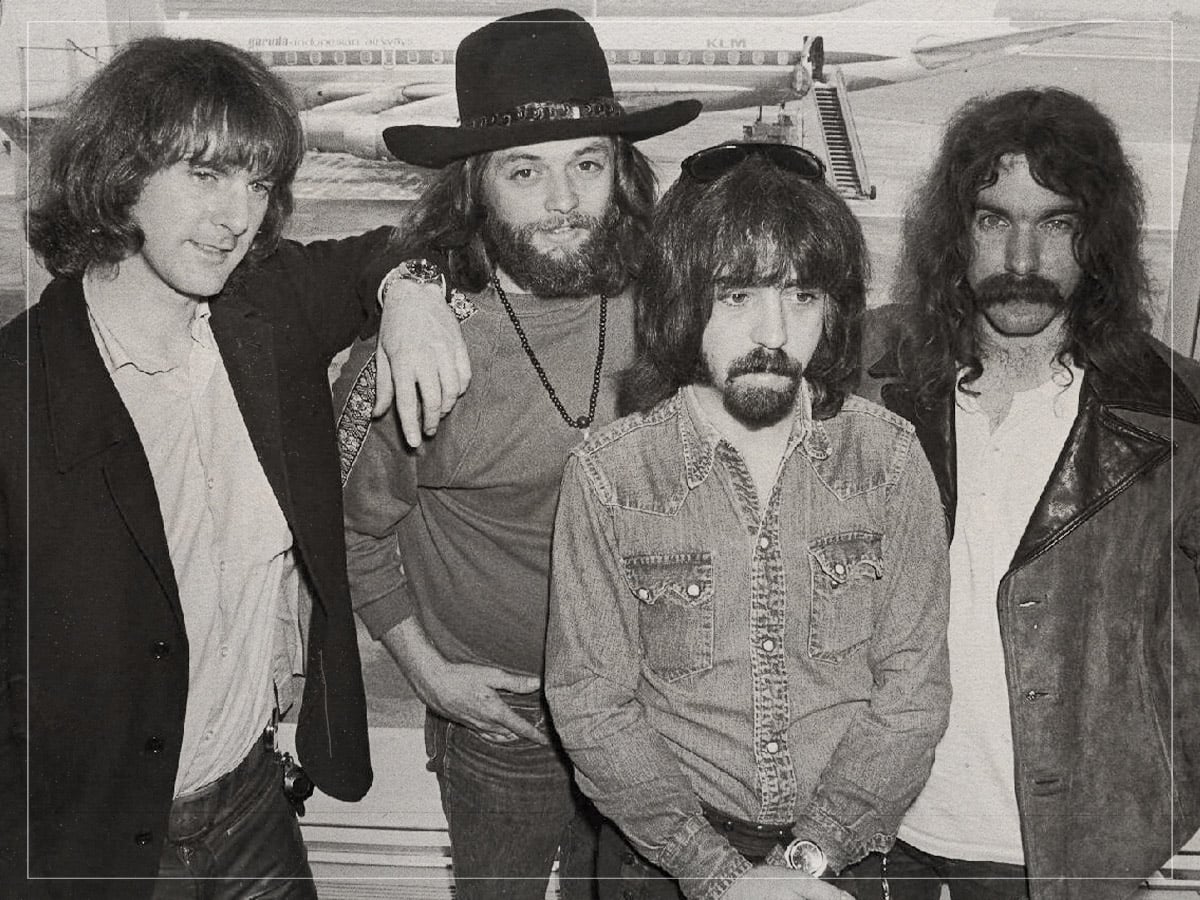
(Credits: Far Out / Joost Evers / Anefo / Dutch National Archives)
Thu 5 March 2026 22:00, UK
Roger McGuinn certainly didn’t rule The Byrds with an iron fist. Arthritic butterflies have had a firmer grip.
This soft-touch approach carried through to the sound of their music, too. And the culmination of this laidback and breezy slow-train of thought may well have made them the most influential American band in history to ever be confused for being British.
Their unique sound – a sound so seminal it seems solely responsible for the overuse of the word jangly to describe modern indie guitar playing in 90% of reviews – was as devoid of American certainty as their wishy-washy business approach.
While they changed the world by casually inspiring Bob Dylan to go electric, bringing the mythical past to the counterculture movement by hitting number one with a 2,000-year-old song, and pioneering the dissolution of genre boundaries, they were so blasé – dressed like every student band around in 2026 – that McGuinn accidentally undermined his genius by making this all seem largely inadvertent.
Although maybe it was inadvertent, because when they ventured into country-rock – a truly trailblazing moment – they did so because McGuinn was feeling a little bit “tired”. Formed in 1964, they had relentlessly toured, always teetering on the brink of commercial comfort but never quite nailing it down enough to rest.
With that in mind, David Crosby decided to depart in ‘67, and Michael Clarke was hot on his heels. That left just McGuinn and Chris Hillman as founding members of the only British Invasion band born in Los Angeles. Maybe it was the initial Transatlantic nature of their sound that sent Hillman under the sea, looking for a fresh, authentic sound as part of the short-lived International Submarine Band, when it looked like The Byrds’ flight had flown.
 Credit: Alamy
But he soon came back to McGuinn with some kid called Gram Parsons in tow. Parsons might have come from a country background, but his songwriting instantly impressed the pair. A new era of The Byrds was given the nonchalant nod by their weary leader. Clarence White soon joined the fold, and country-rock was born.
“I guess I was kind of tired by then,” McGuinn rather simply puts it. “Gram was a strong musical force. I just let him go and went along with it because it was fun. I was having a good time with the country thing,” he told Guitar Player. After years of doing the rock ‘n’ roll schtick nightly, it seemed refreshing to cosplay as a country star.
“I started listening to country radio and talking with a southern accent [laughs]. It was like Halloween for a long, extended period, McGuinn recalled. But he knew this was, at best, a fleeting art project (and at worst a daft fad indulged in by a fellow growing a little bored with his passion).
His bandmates weren’t on the same page. “Sweetheart of the Rodeo was a one-time adventure. I didn’t intend to permanently get into country music. After the album was finished, Chris [Hillman] and Gram wanted to do another country record, and I said, ‘No, no! Wait a minute. That’s enough’,” for McGuinn, the idea had run its course, and it was time to get back to what he truly loved.
But Parsons felt he had hit upon something truly vital. With the British Invasion bands ruling the waves, he felt the new Byrds sound was resplendent with authenticity and American spirit; he even crowned it: “Cosmic American Music”. To turn back on that discovery would mean turning back on three things he loved: America, Music, and, well, cosmic may well be code for getting stoned.
So, when McGuinn said he wanted to revert to something closer to the Beatlesque sound The Byrds had been known for, Parson and Hillman left without a second thought. “They were so upset about it that they started the Flying Burrito Brothers,” McGuinn recalled in his typically casual fashion (does anything faze this fella?). “I really liked the Flying Burrito Brothers, but it wasn’t the direction I wanted to go in. I wanted to play rock and roll.” So it goes.