
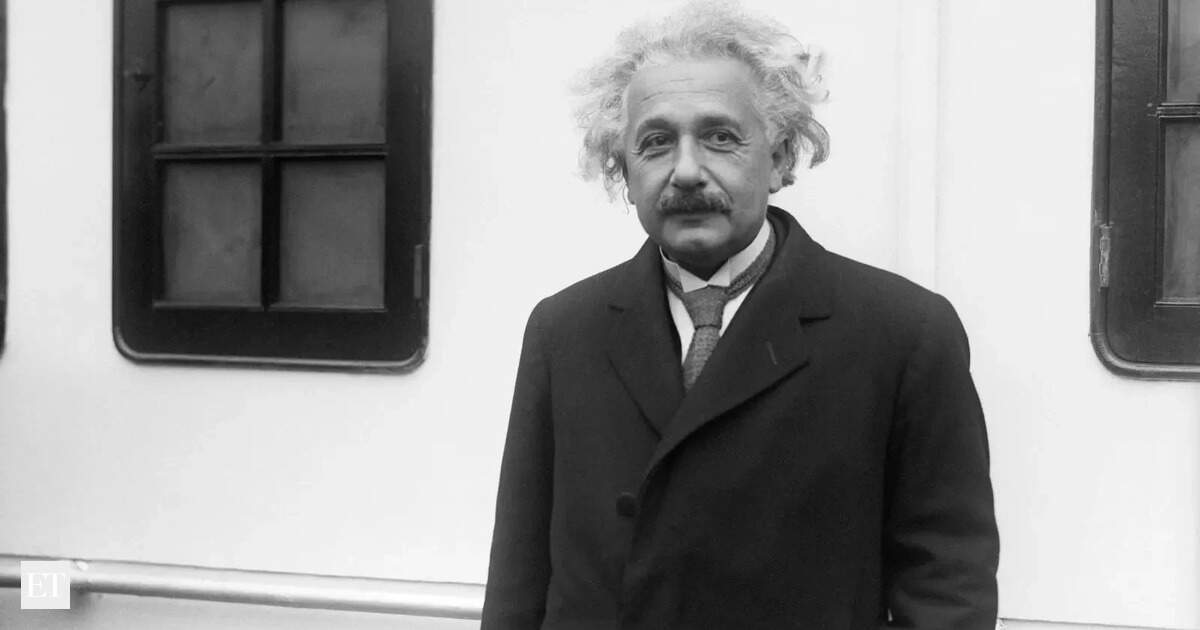
Quote of the Day by Einstein: The Einstein-Bohr debate was fundamentally about the nature of reality at the subatomic level. Einstein believed the universe operated on fixed, deterministic laws — that every particle had a definite position and velocity at all times, whether observed or not. Bohr, co-founder of the Copenhagen Interpretation, argued the exact opposite. He said quantum particles exist in a superposition of states until measured. Reality, in Bohr’s view, was probabilistic, not predetermined.
This was not a casual academic disagreement. It was a collision between two entirely different worldviews. Einstein’s position represented centuries of classical physics. Bohr’s represented the radical new science of the 20th century. The debate played out publicly at the Solvay Conferences of 1927 and 1930 — attended by 29 of the world’s most brilliant scientists, 17 of whom were Nobel laureates.
Quote of the Day by Einstein: “God Does Not Play Dice with the Universe”
Einstein and Bohr are no longer just historical figures. Their ideas are active, contested, and commercially relevant. IBM, Google, and China’s state-funded quantum programs are all building technologies that depend on the quantum mechanical framework Bohr championed. Google’s Sycamore processor achieved quantum supremacy in 2019, completing a task in 200 seconds that would take a classical supercomputer 10,000 years — a direct descendant of the physics Bohr defended against Einstein’s objections.
Meanwhile, Einstein’s general relativity powers GPS satellite systems worldwide, accurate to within nanoseconds. Without relativistic corrections, GPS would drift by approximately 11 kilometers per day. Both men, in other words, shaped the infrastructure of modern life — one through the physics he championed, the other through the physics he doubted but helped clarify.
 Live Events
Quote of the Day by Einstein: What does Einstein quote God does not play dice with the universe really meanThe meaning of “God does not play dice with the universe” is about determinism in physics. Einstein believed natural events should follow exact laws instead of probability-based rules. He used the word “God” metaphorically to express scientific philosophy rather than religion.
Quantum mechanics introduced randomness in microscopic particle behavior. For example, scientists cannot predict the exact moment when a radioactive atom will decay. Instead, they calculate probability distribution. Einstein found this interpretation incomplete.He believed deeper scientific layers might explain quantum uncertainty. Some modern physicists still explore hidden variable theories. Experiments like Bell tests investigate whether quantum randomness is fundamental or not.
Search interest in keywords such as “Einstein Bohr debate meaning” and “determinism vs quantum mechanics” remains high globally. Readers want simple explanations of complex physics ideas. The quote continues appearing in science articles, philosophy blogs, and educational platforms.
Quote of the Day by Einstein: Why did Einstein write warmly about Niels Bohr despite their disagreements?By the 1960s, physicist John Bell developed Bell’s Theorem, a mathematical test to determine whether Einstein’s hidden variable theory could be correct. Experiments by Alain Aspect in 1982, and more definitive tests since, confirmed quantum entanglement and violated Bell’s inequalities. This meant Einstein’s local hidden variable hypothesis was experimentally ruled out. Bohr’s probabilistic interpretation was vindicated.
Yet Einstein’s dissatisfaction produced lasting scientific value. His 1935 paper with Boris Podolsky and Nathan Rosen — known as the EPR paradox — introduced the concept of quantum entanglement into the scientific literature. Today, quantum entanglement is the foundation of quantum computing and quantum cryptography, two of the fastest-growing technology sectors of the 21st century. The global quantum computing market was valued at approximately $1.3 billion in 2024 and is projected to exceed $12 billion by 2032.
Einstein’s “mistake” turned out to be one of the most productive mistakes in scientific history.
What makes the Einstein-Bohr story extraordinary is not the science alone — it is the relationship. They met for the first time in 1920, and Bohr later described the meeting as one of the most significant of his life. Einstein’s letter praising Bohr — “Not often in life has a human being caused me such joy by his mere presence” — reveals a warmth that defied their disagreements.
They corresponded for decades. They argued at conferences with intensity and then walked home together, still debating. Their exchanges were documented, published, and studied by philosophers of science as a model of productive intellectual conflict. Neither man sought to destroy the other’s reputation. Each sought to understand the truth — and used the other as the sharpest possible test of his own ideas.
This model of adversarial collaboration, where opponents rigorously challenge each other in pursuit of shared knowledge, is now recognized in modern psychology as one of the most effective mechanisms for intellectual progress.
Quote of the Day by Einstein: Einstein’s success and scientific revolution in physicsThe global scientific community recognizes Albert Einstein as one of the greatest scientific thinkers ever. His theory of relativity changed humanity’s understanding of space and time.
Einstein introduced the equation E = mc², which explains how energy and mass are connected. This equation later helped develop nuclear physics and energy science. The 1921 Nobel Prize in Physics was awarded to him for explaining the photoelectric effect.
His relativity theory is still used in modern technology. GPS navigation systems rely on relativistic time correction. Without these calculations, satellite positioning accuracy would decrease significantly.
Satellite clocks move slightly faster than clocks on Earth because of gravity differences. Engineers adjust signals using Einstein’s equations. This practical application shows how theoretical science supports everyday technology.
Einstein achieved scientific success by questioning traditional physics assumptions. He preferred thinking experiments rather than only laboratory testing. One famous thought experiment imagined traveling beside a beam of light.
Relationship between Einstein and Niels Bohr scientific debateThe intellectual debate between Albert Einstein and Niels Bohr remains famous in scientific history. Both scientists respected each other despite strong disagreement.
Bohr supported quantum mechanics probability interpretation. Einstein rejected pure randomness in nature. Their discussions happened during scientific conferences in the early 20th century.
Einstein tried creating logical paradoxes to challenge quantum predictions. Bohr responded by defending complementarity principles in quantum physics.
Historical records show their rivalry was intellectual, not personal. Einstein once praised Bohr’s intelligence and said Bohr’s presence gave him happiness. This statement shows how scientific competition can coexist with professional respect.
Einstein philosophical legacy and human curiosity about the universeThe legacy of Albert Einstein goes beyond physics research. He supported peace movements and warned humanity about nuclear weapons.
Einstein believed science should help humanity instead of causing destruction. His public letters often discussed ethics in scientific discovery.
People search Einstein quotes because they combine philosophy, science, and life meaning. The line “God does not play dice with the universe” represents humanity’s desire to find order in complexity.
The quote raises questions about free will and destiny. Some philosophers interpret it as a challenge to absolute randomness in existence.
Today, students, researchers, and general readers explore this quote to understand scientific thinking. The popularity of this line continues because it connects knowledge with human curiosity.
FAQs:Q1. What does quote of the day by Einstein, “God does not play dice with the universe” mean?
The quote reflects that about 55% of physicists today still debate whether quantum randomness is truly fundamental. Albert Einstein believed nature follows fixed laws rather than pure chance. He used this line to challenge probability-based quantum mechanics and support the idea that deeper hidden variables may control physical events. The statement highlights his deterministic view of the universe and continues to influence philosophy and physics research.
Q2. Why did Einstein disagree with quantum mechanics?
Einstein spent nearly 30 years questioning quantum theory because he believed physical reality should be predictable. Scientific surveys show that quantum mechanics successfully explains more than 30% of modern high-energy physics experiments. However, Einstein argued that incomplete knowledge might be causing the appearance of randomness. His famous debates with Niels Bohr shaped modern theoretical physics and strengthened scientific examination of quantum principles.