
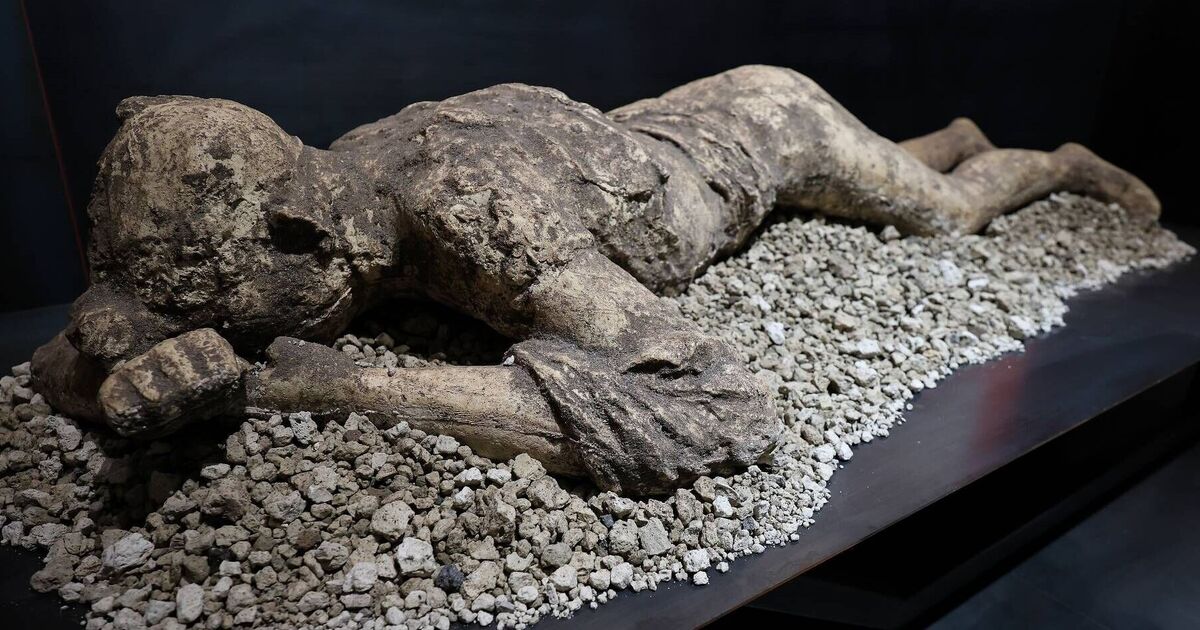
In a ground-breaking archaeological excavation, researchers uncovered a grand staircase leading to a “lost Pompeii” where the Roman elite lived.
It was previously believed the staircase inside Pompeii’s House of Thiasus villa led nowhere – now it appears it served as the entrance to an urban metropolis that paved the way for today’s high-rise luxury apartments.
“Lost Pompei consists of the upper floors of buildings which are essential to understanding life in the ancient city,” Gabriel Zuchtriegal, director of the Archaeological Park of Pompeii, said.
A research team used digital archaeology to create models of the super-rich’s villas, demonstrating that Pompeii’s largest villas likely once featured towers, genuine symbols of power and wealth, reports the Mirror.
Zuchtriegal added: “Archaeological research at Pompeii is highly complex. In addition to fieldwork, with excavations that reveal intact contexts of life in the ancient world and new stories to tell about the tragedy of the eruption.
“There is also non-invasive research, consisting of study and reconstructive hypotheses of what has not been preserved, but which completes our knowledge of the site.”
The researchers from Berlin’s Humboldt University produced reconstructions of the tower of the House of Thiasus, which were published in the E-journal Scavi di Pompei. Utilising state-of-the-art technology, researchers have digitally reconstructed the lost city of Pompeii, revealing previously unknown areas before its destruction by the Mount Vesuvius volcano in 79 C.E..
The team believes that while the volcanic ash preserved the buildings’ lower levels, the upper floors were obliterated.
Drawing on clues such as disconnected staircases and severed support beams, the researchers digitally crafted a fresh image of the city. They deduced that one particular staircase led to a tower, providing the affluent with panoramic views of the city and the Bay of Naples.
The tower is thought to have stood up to 40 feet high, suggesting that the House of Thiasus was actually a multi-storey building.
The researchers wrote: “The interior of the lower part was simple in its furnishing. This contrasted by the monumental external staircase that leads to the upper floor, suggesting a living space of a more elegant and representative character.
“By putting together the data in the form of a 3D digital model, we can develop hypothetical reconstructions that help us to understand the experience, the spaces, and the society of the time.”