

They might seem like ordinary household items, but many households are still throwing away objects which can cause fires, explosions and even put people in danger.
This year’s Simpler Recycling rules mean that most households now have up to four bins to deal with – but some items are dangerous regardless of whether they go in the main bin or the recycling.
Even items which you might not expect to be dangerous, such as greeting cards which play music, can cause fires or explosions when put in the bin.
Yahoo News spoke to Nicola Henshaw, Managing Director of Veolia UK’s Hazardous Waste Business, about the problem – and why recent legal changes have not made it better.
What items should you not put in your bin?
Anything with a battery inside (including used old electronics and vapes) should never be put in recycling or residual waste, Henshaw said.
That includes any size of battery, even tiny ones or batteries inside children’s toys or remote controls.
Henshaw said: “It’s really important that people know the items that can’t be put in the bin. Everyday items like old toys or electric toothbrushes, as well as vapes and electric scooters, contain batteries.
“When companies collect your bins, the vehicles compact the waste and if a battery is crushed or damaged, it can become extremely flammable and set fire to other items.
“Batteries in waste put our colleagues and the public in danger, damage our specialist vehicles and recycling facilities and disrupt essential services. We recently had a fire at one of our sites caused by a single, small battery in a greetings card, which was mistakenly thrown away in a paper and card recycling bin, demonstrating how even small, seemingly harmless items like a birthday card can be a big risk.”
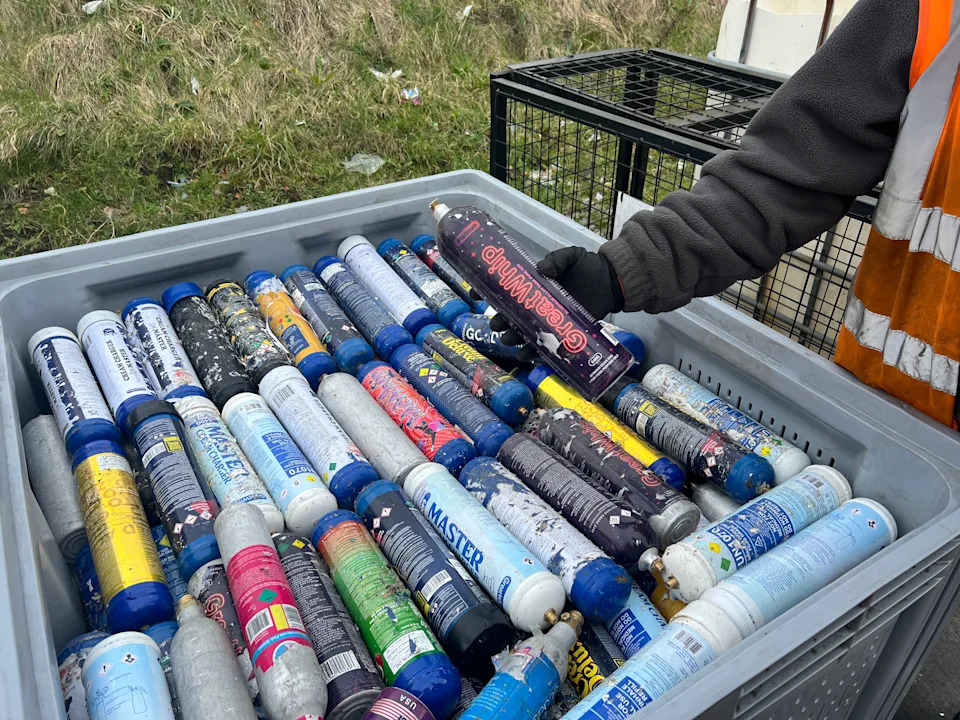
Nitrous oxide canisters pose a particular danger
(Veolia)
Nitrous oxide, known as laughing gas, is also a particular problem, Henshaw said.
“Laughing gas canisters are also dangerous if thrown away in household or on-street bins, because they can cause explosions. Even if they appear empty, canisters often still contain gas, which is highly flammable and can make fires burn hotter, faster, and more intensely.”
Why are vapes a problem?
Vapes have lithium-ion batteries, which catch fire or explode if crushed or damaged, with Veolia saying there is a fire every day in its lorries due to vapes.
Despite a ban on disposable vapes last year, large numbers are still being thrown away in the UK.
Manufacturers responded to the ban on disposables by introducing reusable devices at the same price as disposables, meaning that millions are still thrown away.
The Independent British Vape Trade Association (IBVTA) claims that the number disposed of has halved since the ban in June last year, but in practice, millions still end up in residual waste.
What about recycling?
Anything with a battery inside cannot be recycled in kerbside collection services.
Vapes and other items with Li-Ion batteries can cause explosions at Material Recovery Facilities (MRFs) where recycling is sorted.
This is due to the fact that materials are commonly compressed into bales, leading batteries to explode.
What should you do instead?
Anything with batteries CAN be recycled, often at council recycling centres or large supermarkets.
Recycle Now offers a recycling locator, which helps to find recycling points near you, broken down by different products.
Henshaw said: “Lots of items that can’t be put in the bin can still be recycled, but they have to be taken back to dedicated recycling points.
“Supermarkets and household recycling centres have separate bins for batteries and vapes to ensure they can be recycled at specialist facilities to recover critical raw materials. We always recommend checking your local council’s website to find out how you can recycle items near you.”