
What are the war aims? No, not Donald Trump’s. Over the past week they’ve included regime change, annihilation of the Iranian military, the election of a hand-picked replacement for the Ayatollah – a Magatollah – to unconditional surrender. In other words Trump is, again, making it up on the fly.
Instead, I mean what are Britain’s war aims? Last Saturday it seemed clear. It was to sit this one out.
British troops would not be involved in striking Iran, the Prime Minister announced. The US could not use British bases. Our policy was de-escalation and negotiation.
But since Saturday Sir Keir has begun to stumble, stutter and stammer his way into the middle of the burgeoning Middle East conflict. His initial lurch from clarity to prevarication began on Sunday afternoon, when he suddenly reversed his decision on the US use of UK bases.
Initially this vacillation was attributed to a Cabinet rebellion led by Environment Secretary Ed Miliband, who reportedly set himself against any form of UK involvement. But in truth, the Government’s confusion was entirely of Starmer’s making.
Last Friday, when ministers met to discuss the US basing request, there was unanimity it should be declined. The discussion then turned to another possible request from the US to use British bases for specific attacks against Iranian missile platforms, in the event of retaliatory strikes.
Here the Cabinet split, with Starmer and Defence Secretary John Healey speaking in favour, and others (Miliband included) arguing against. But because the Americans had not even put in a request at that point, no final decision was required, or made.
When the request did arrive, Starmer quickly agreed. But in doing so began to tie himself, his administration and his military planners in knots. British forces and civilians were at risk from Iranian counter-attacks, he claimed. What’s more, ‘the only way to stop the threat is to destroy the missiles at source – in their storage depots or the launchers which are used to fire the missiles’.
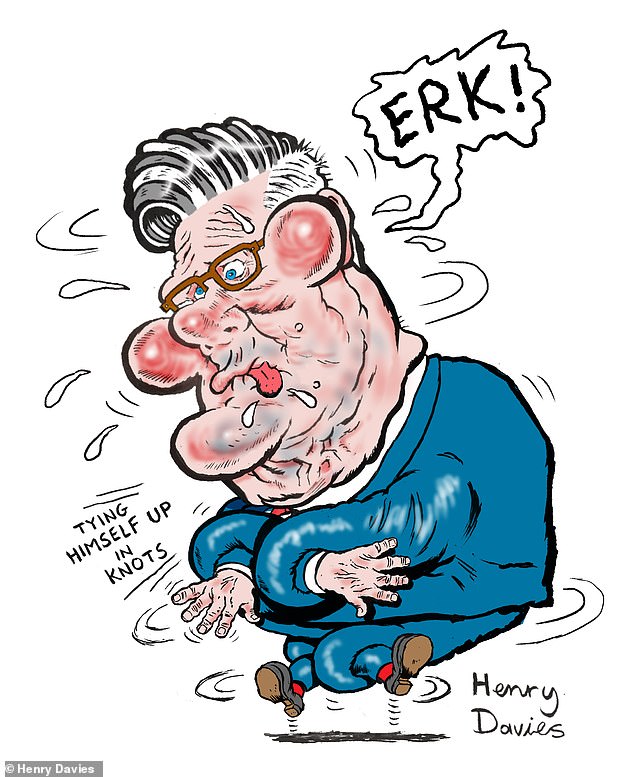
So US forces had been granted permission to use British bases to attack those weapons. Yet, bizarrely, British forces had not. This confusion then cascaded down the chain of command.
Where Britain had initially been stepping aside from the conflict, we now had one foot in. A legs akimbo stance that became even more tortuous when Iranian proxies successfully launched a drone attack on the RAF base at Akrotiri, Cyprus.
When the conflict began, Starmer sombrely announced: ‘We’ve stepped up protections for British bases and personnel to their highest level.’ But we hadn’t. As the Akrotiri attack proved, crucial counter-drone and missile defences had been left languishing in the UK, notably the Type 45 destroyer HMS Dragon.
Defence and government sources have provided multiple explanations for this staggering oversight. One claimed the Royal Navy believed the Dragon deployment was unnecessary because the US had their own sophisticated Arleigh Burke-class destroyers stationed in the Mediterranean. Which left Britain in the morally bankrupt position of relying on the US to defend British servicemen and women, while our Prime Minister refused to reciprocate.
Another source claimed ministers’ hands were tied because the Royal Navy did not formally request the deployment of HMS Dragon until 9.30am on Tuesday. And that when told she may not be ready to sail for at least 10 days they were taken aback.
‘We were a bit surprised we didn’t have anything at a higher state of readiness,’ one Whitehall official admitted. But another key issue was the way the Royal Navy had been thrown into confusion by a series of contradictory orders from Downing Street.
As a Navy source explained: ‘You’ve got to remember that just before this crisis broke, Starmer ordered the Navy to the High North with an entire Carrier Strike Group to protect Greenland. Then suddenly we were told, “No, forget that, get to Cyprus.”’
Which underlines another of Keir Starmer’s increasingly chaotic positions. The entire Greenland deployment was done to placate Trump. Now we’ve had the spectacle of Sir Keir and his ministers engaging in an increasingly ludicrous form of diplomatic hokey-cokey with the White House.
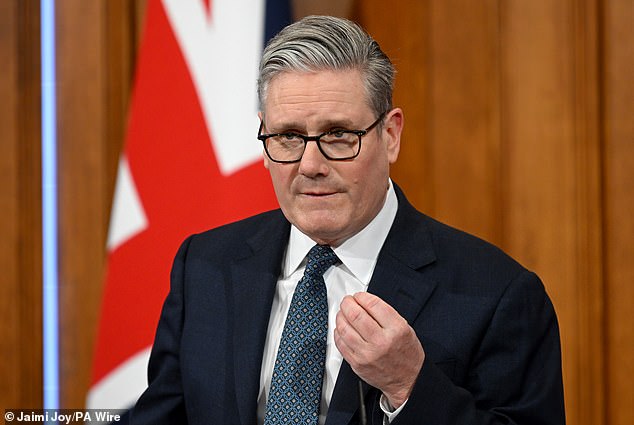
When the conflict began, Starmer sombrely announced: ‘We’ve stepped up protections for British bases and personnel to their highest level.’ But we hadn’t, writes Dan Hodges
On Sunday ministers were refusing to even say if they supported or opposed the US action for fear of upsetting Trump.
By Wednesday Starmer was chiding the US President for not having a legal and viable plan.
On Thursday he was vowing to stand firm in the face of Trump’s increasingly volatile and personal attacks.
But by Friday the tone shifted again, with ministers hinting they could join US strikes after all, and once again deflecting when asked if they supported the US action. Since becoming Labour leader, Starmer has made perceived strength on defence and foreign affairs central to his political strategy. It’s his way of saying: ‘Look, I’m not Jeremy Corbyn!!!’
But whatever you thought of him, at least Corbyn had a clear stance on global affairs. He believed, passionately but wrongly, that the US and Israel represented the greatest threats to world peace, and clung to his position regardless.
Likewise, Michael Foot had his principled, if politically unviable, unilateralism. Tony Blair believed unashamedly in paying the blood price to support the US.
Miliband, as we’ve seen, refuses to resile from his conviction foreign and military matters should be sub-contracted to the UN.
I haven’t the slightest idea what Starmer really thinks about defence or foreign affairs. And I suspect that by this time next week neither will the British people, the Cabinet or his own MPs.
Over the weekend a fleet of B-1 bombers has begun massing at British airbases. Soon they will take off to rain fire and destruction down on Iran. At which point Starmer will have tumbled headlong into the very heart of the conflict he pledged to avoid.
He could have levelled with the British people, our allies and adversaries from the outset of this crisis. He could have declared: ‘I believe these attacks are wrong and I have no intention of joining. But be clear. If the Iranians retaliate with an attack on our interests or our allies, I will order our armed forces to respond.’
But he didn’t. Sir Keir did what he always does. Tried to deflect and dodge and equivocate his way to pleasing everyone. And as ever, he will end up satisfying no one.
Starmer is about to go down in history as the Prime Minister who was too weak to fight a war. And the Prime Minister who was too weak to avoid one.