
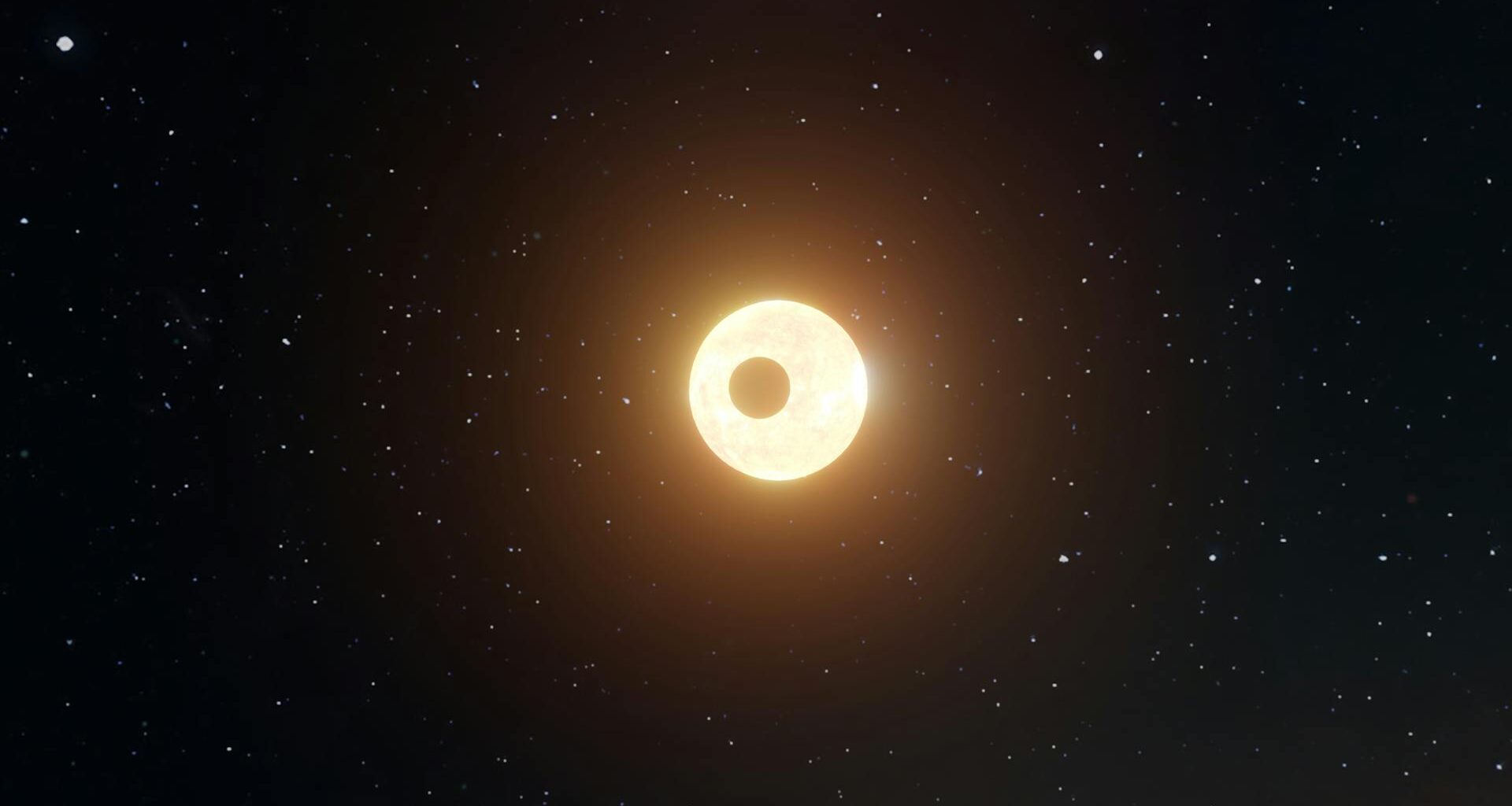
For nearly half a century, astronomers have believed that stars like our sun eventually change the way they rotate. The theory suggested that when such stars grow old and slow down, their rotation pattern flips—causing their poles to spin faster than their equators.
However, a new study from scientists at Nagoya University in Japan now suggests that this long-standing picture may be wrong. By running the most detailed simulations of stellar interiors ever performed, the researchers found that sun-like stars may keep the same rotation pattern for their entire lives.
“The simulation can reproduce the sun’s observed rotation pattern almost perfectly. When we apply it to slower-rotating stars, it also matches astronomical observations and shows no anti-solar rotation,” Yoshiki Hatta, study co-author and a professor at NU, said.
Instead of flipping to the predicted anti-solar rotation, the equator continues to rotate faster than the poles even when the star becomes very slow. These findings indicate that magnetic fields inside stars play a much larger role in shaping their behavior than earlier models suggested.
Why scientists expect stars to flip their rotation
Unlike Earth, which spins as a rigid body, stars are made of extremely hot, moving gas. This means different parts of a star can rotate at different speeds—a phenomenon called differential rotation.
In our sun, for example, the equator completes one rotation in roughly 25 days, while the polar regions take about 35 days. Scientists had long assumed that this pattern would eventually change as stars age. This is mainly because over billions of years, stars gradually lose rotational speed.
Earlier theoretical studies suggested that slower rotation would alter the movement of gas deep inside the star. Those internal flows were expected to reorganize in a way that would make the poles spin faster than the equator—a state known as anti-solar differential rotation.
However, there was a problem. Astronomers have never clearly observed such stars. The predicted rotation pattern appeared in computer models, but real observations failed to confirm it.
To investigate the discrepancy, researchers turned to powerful numerical simulations. The team built an extremely detailed model of the interior of solar-type stars using magnetohydrodynamic simulations, which simultaneously calculate the motion of hot plasma and the behavior of magnetic fields.
High-resolution simulations reveal the hidden role of magnetism
The calculations were carried out on Fugaku, one of the most powerful supercomputers in the world. The simulation was extraordinarily detailed. Each modeled star was divided into about 5.4 billion grid points, allowing scientists to track tiny turbulent motions and magnetic structures inside the stellar interior.
This level of detail turned out to be essential. Earlier simulations used far fewer grid points, which caused magnetic fields to weaken artificially during the calculations. Due to this limitation, earlier studies underestimated how important magnetism might be in shaping stellar rotation.
When the new high-resolution simulation was run, the magnetic fields remained strong and stable. The results revealed that magnetic forces together with turbulent gas motions keep the equator rotating faster than the poles, even when the star rotates very slowly.
“We found that these two processes, turbulence and magnetism, keep the equator spinning faster than the poles throughout the star’s life, not just when the star is young. So even though stars do slow down, the switch doesn’t happen because magnetic fields, which previous simulations missed, prevent it,” Hideyuki Hotta, one of the lead researchers and a professor at Nagoya, said.
The model also reproduced the sun’s observed rotation pattern with remarkable accuracy. When researchers applied the same simulation to stars rotating more slowly than the sun, the rotation pattern still did not flip. Instead, it remained solar-like.
This provides a possible explanation for why astronomers have struggled to find evidence of anti-solar rotation in real stars. The simulations also uncovered another trend. As a star ages, its magnetic field steadily weakens.
Earlier theories suggested the magnetic field might become strong again when the rotation pattern reversed, but the new results show no such revival. “Our results show that the magnetic field monotonically decreases over the stellar lifetime,” the study authors note.
Rethinking stellar evolution and magnetic activity
If confirmed, these findings could significantly change how astronomers understand the life cycles of stars. Stellar rotation influences many processes, including magnetic activity and the emission of energetic particles.
A better picture of these processes could also improve predictions about how stellar environments affect the planets orbiting them—especially whether those planets remain suitable for life over billions of years.
At the same time, the new results are based on simulations rather than direct measurements. Observing the internal rotation of distant stars remains extremely challenging. Future research will likely test these predictions using improved astronomical observations.
The study is published in the journal Nature Astronomy.