
Kolkata: There was no single defining moment, and that’s probably why this 2026 T20 World Cup will be remembered the most. This tournament quietly recalibrated its format on what was possibly the most even platform in its history even though it wrestled with the familiar noise and politics that accompany modern cricket these days.
 Fans throng the Narendra Modi Stadium in Ahmedabad. (REUTERS)
Tom-tommed as an extension of the IPL where power-hitting and predictable scorecards is the norm, this World Cup felt unexpectedly textured. Matches unfolded less like a pyrotechnics display and more like rapid chess. Bowlers wielded influence again, matchups weren’t always successful, and games lingered deep into the closing overs.
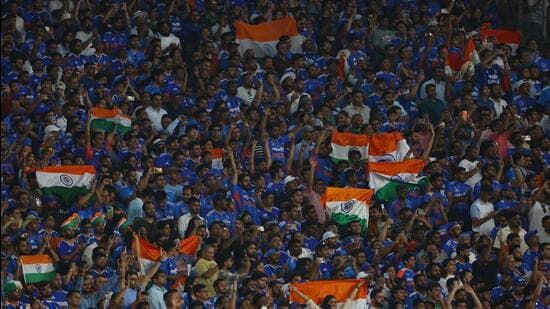
And perhaps most strikingly, audiences watched even when the sport’s most commercially irresistible rivalry wasn’t involved. Wankhede Stadium packed to the rafters with Nepal fans was a sight to behold. The England-Scotland game was similar, with 41,271 fans flocking to Eden Gardens on a day that coincided with the historic Calcutta Cup rugby match in Edinburgh.
This was a refreshing break from the confusion building up to the tournament, which witnessed Bangladesh’s pullout after Mustafizur Rahman was dropped from the KKR team. Pakistan threatened a pullout as well, but the ICC didn’t budge and replaced Bangladesh with Scotland. As a result, the tournament was probably robbed of a few close games.
For years, the India-Pakistan fixture has functioned as the emotional and financial axis of global cricket. Entire broadcast strategies orbit around it, sponsors plan around it, and administrators quietly depend on it. The game itself, however, wasn’t worth the hype. What emerged over several weeks instead was quietly encouraging: the tournament doesn’t need to revolve around a single match to matter.
Part of the reason was the cricket itself. Sri Lanka’s pitches challenged England and New Zealand to evolve and adapt but overall the TRACKS throughout the tournament resisted the excesses that occasionally define T20 competitions. They weren’t so slow that batting became a grind, but neither were they too flat so that matches would turn into mathematical chases.
Instead, they occupied a middle ground—a space where 170 could feel like a formidable total but 200-plus too could at times, leave room for anxiety. India, for example, has lived in both those realms, against West Indies and England.
In short, there was hardly any predictable cricket. Captains were forced to change strategy according to scenarios, bowlers could shape outcomes despite not opening or closing the overs, and batters had to balance aggression with calculation. This was exactly the dose of uncertainty the format needed for the world to rediscover its charm.
The difference was also visible almost immediately. Group-stage matches that would have otherwise drifted into routine contests produced close finishes instead. Teams could not rely solely on batting depth or reputational advantage. Even a tournament favourite like India found themselves navigating moments of vulnerability after a resounding defeat at the hands of South Africa.
For the tournament’s emerging teams, that vulnerability created opportunity. Though not a new face, Zimbabwe’s rise—at the cost of Sri Lanka and Australia—was heartening. The performances of Associate nations, notably debutants Italy, Nepal, Scotland and the United States, formed one of the competition’s quiet subplots. These teams have long existed on the margins, often appearing in World Cups more as symbols of expansion than genuine contenders. But this time, the gap felt genuinely narrowed.
They fielded sharply, bowled with defined plans and batted without the tentativeness that once marked encounters with established sides. Victories over major teams remained rare, but there were scares indeed.
England were nearly bested by Nepal, the US tested India and Pakistan again, and overall, matches frequently extended deeper than expected. For stretches of the tournament, the established order looked less impenetrable than it once did. That shift matters for a sport still grappling with doubts over its global reach.
If the tournament revealed a closing gap at one end of the spectrum, it also exposed a curious absence at the other. Few teams possess the institutional confidence of Australia in World Cups. It was probably taken for granted that the latter stages are simply where they belong. This time though, Australia’s campaign unfolded with surprising quietness before falling over the cliff with defeats to Sri Lanka and Zimbabwe.
The questionable selection—Steve Smith was named standby and finally included in the squad when all was over for them—aside, Australia never quite seemed to settle into the tournament’s rhythm. Their performances lacked the clarity that has historically defined Australia’s campaigns. There were flashes of brilliance, but little sustained momentum. Matches slipped away at junctures where previous Australian teams would have tightened their grip, revealing a problem that seems more psychological than technical.
By the time Australia’s tournament ended earlier than expected, the prevailing impression was not collapse but drift. It was as if the competition had passed them by before they fully arrived. Pakistan was even more ordinary—-almost losing to Netherlands, barely putting up a fight against India before letting their fate be decided by numbers. Sri Lanka too flattered with a sensational victory against Australia, only to deceive in the latter stages.
West Indies entertained, England flirted with the impossible, but South Africa’s downfall was probably the most shocking—crashing to a nine-wicket defeat to New Zealand in the semi-finals after an unbeaten run in the league stages and the Super Eights. Only New Zealand continued to tread a familiar pattern of understated efficiency. Rarely the most flamboyant side but definitely the most astute, New Zealand navigated the turns and corners with methodical, disciplined and effective cricket.
By the time only four teams were standing, New Zealand’s presence felt both predictable and strangely underappreciated. The nine-wicket dismantling of South Africa reinforced New Zealand’s reputation for tournament composure. In the other semi-final, India and England took us back to the basics of T20 cricket in a staggeringly nerve-wracking contest sustained by explosive batting but punctuated by bowling brilliance. India eked out victory in a match that refused to settle until the final overs, serving a timely reminder that the shortest format is still capable of generating extended suspense.
India’s journey had an oddly satisfying touch even before the final was played out on Sunday. It has not been the most consistent team in the past two years because of an individual but a meritocracy based process that keeps giving second chances. Which is why the cricket frequently rose to the occasion even when the tournament couldn’t stay controversy free. The India-Pakistan game turned into an opportunity for geopolitical sparring, with administrative uncertainty generating speculation that harmed the ICC’s goodwill and kept the broadcasters as well as travelling fans on edge.
For a rivalry steeped in emotional baggage, the additional political tension felt both familiar and faintly exhausting. Ironically, the rest of the tournament demonstrated that cricket’s appeal can do without such drama. Several of the competition’s most absorbing matches—South Africa-Afghanistan’s double Super Over finish being the crescendo—involved teams with no historical rivalry at all. What sustained interest was not political symbolism but competitive uncertainty. When the result was in doubt, audiences watched. That could ultimately be the tournament’s biggest takeaway..