
The first phase of Regjeringskvartalet comes 15 years after the July 2011 terrorist attack, in which the district was targeted by a bomb that heavily damaged several buildings.
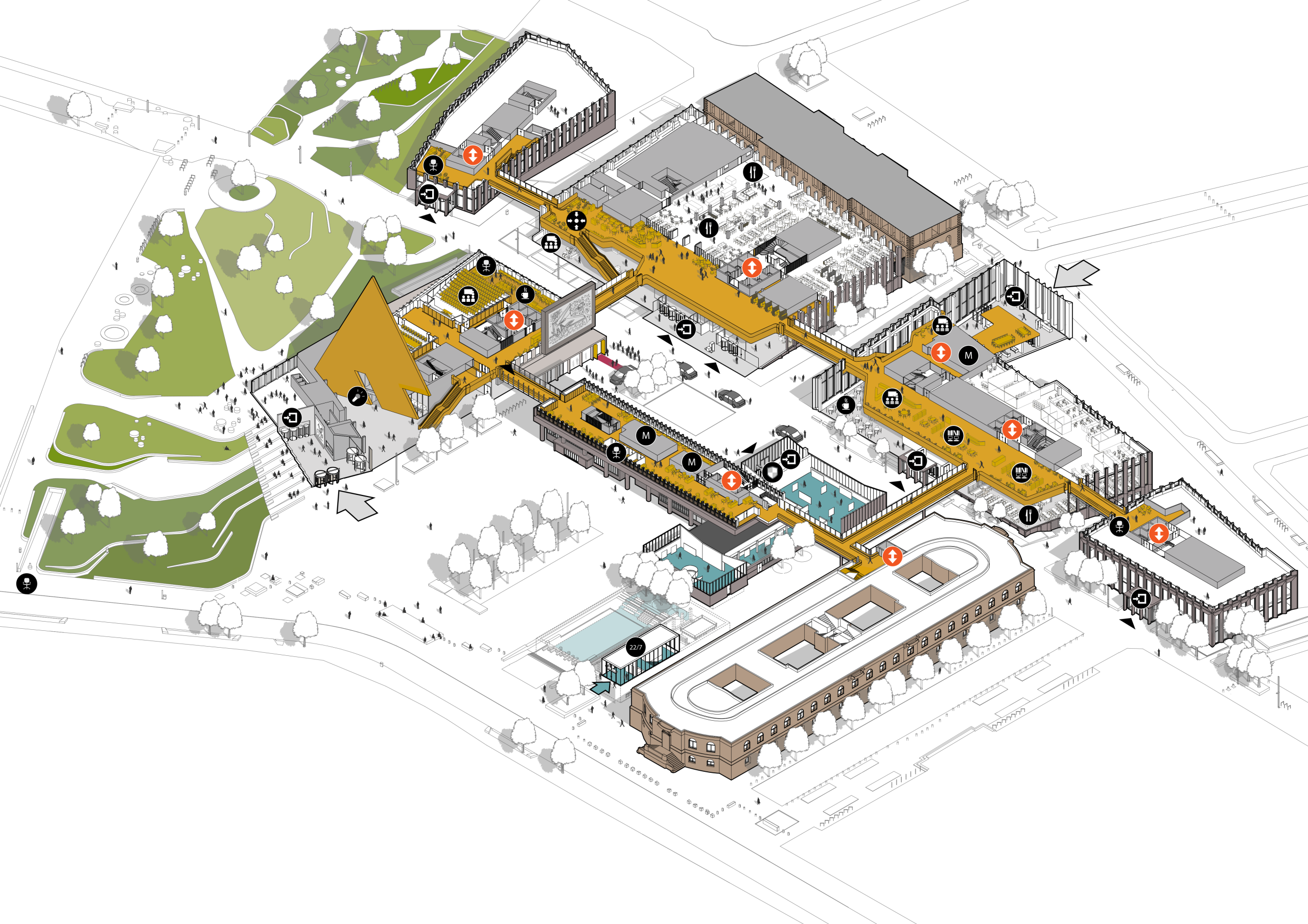
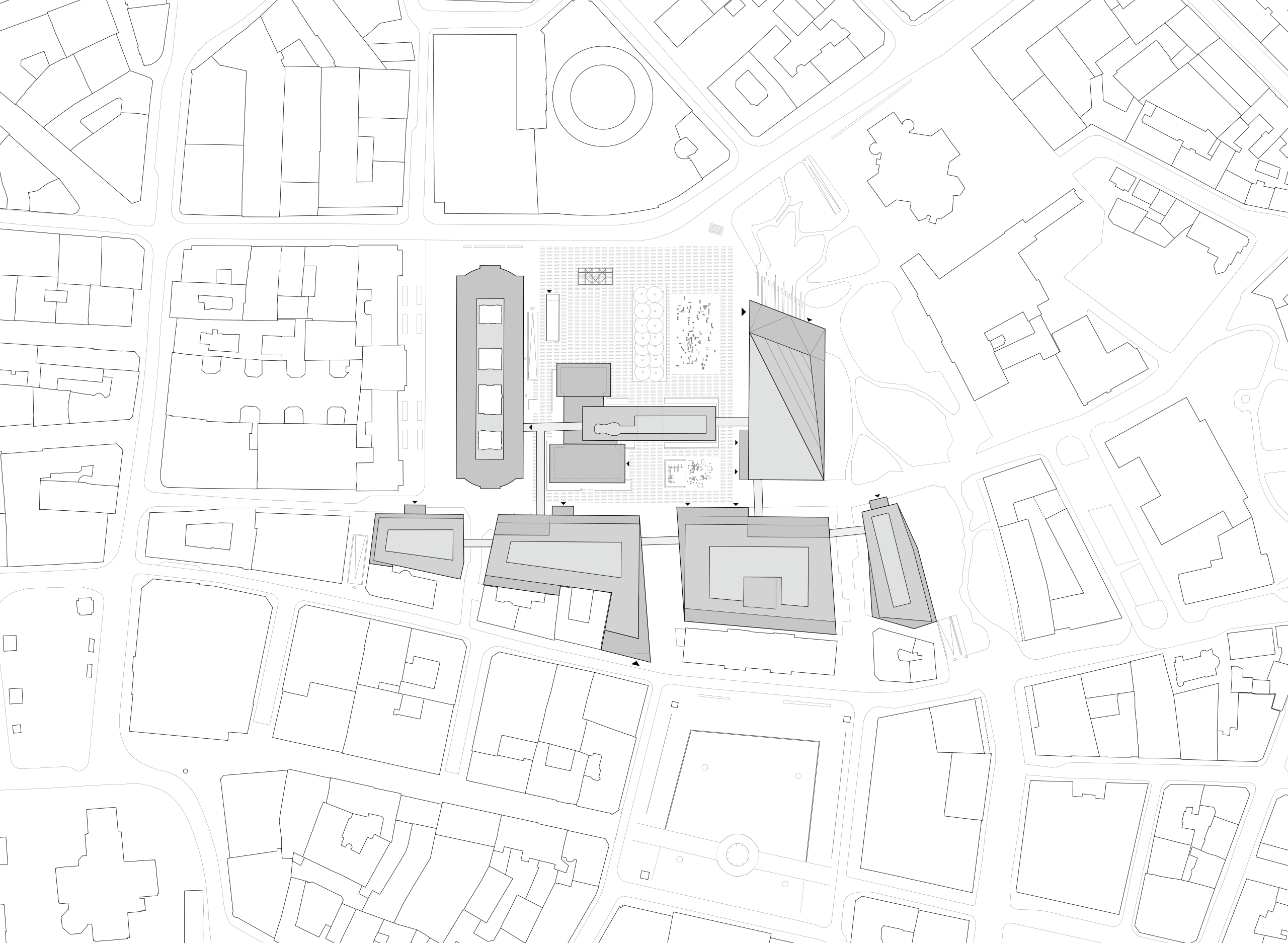
The masterplan includes five new buildings and two restored buildings in a ring framing a series of interconnected public spaces, stitching the quarter into Oslo’s historic centre.
The district’s design has been carried out by the Team Urbis consortium, led by Norwegian big hitter Nordic Office of Architecture. The group also includes London, Oslo and Bilbao-based Haptic Architects, Oslo-based Scenario and interior designer I-d Interiørarkitektur & Design.
The scheme was commissioned by the Ministry of Digitalisation and Public Administration with government developer Statsbygg following an international competition launched in 2016.
The ‘design for democracy’ scheme aims to create a new model for bringing government ministries together in an open yet secure civic development.
The prime minister of Norway, government officials and staff will move into the quarters, consolidating almost all Norwegian ministries into a single campus for around 4,100 employees.
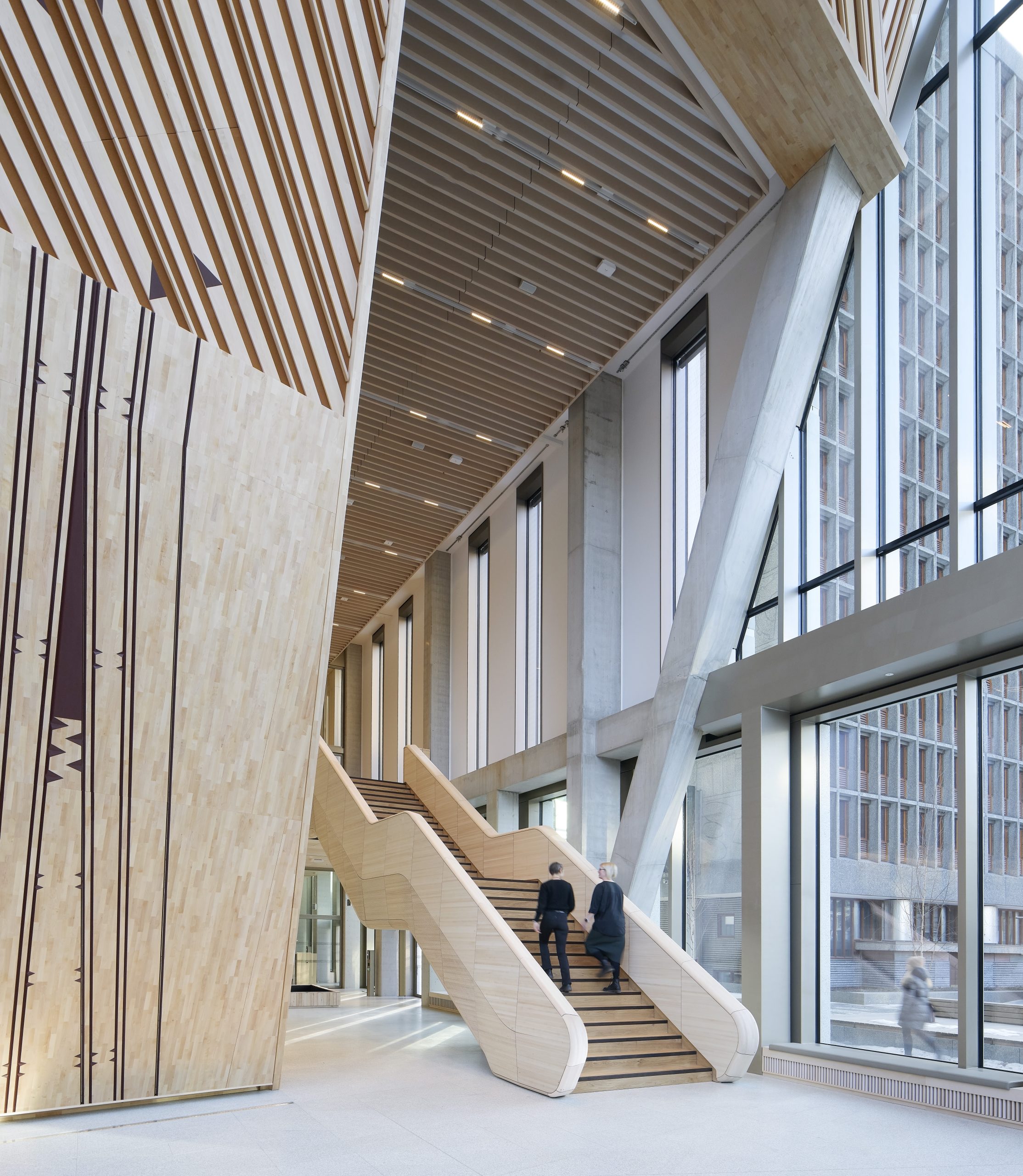
A Block feature staircase leading from the pyramid hall
Phase 1 comprises three buildings: the restored Høyblokken and the new A and D Blocks. Phase 2 is due to complete in 2030, while a final, third phase will complete much later.
A Block features a Pyramid Hall while the retained historic G Block faces the city and forms the ‘public front line’ of the quarter, while expressing different eras of Norwegian democracy through its architecture. D Block and future phases aim to create a quieter backdrop to complete the walkable campus.
Also included in the first phase is a 22 July Centre, public museum and learning space dedicated to the 2011 events, as well as new parks, plazas and public-facing cafés. Two existing plazas – Johan Nygaardsvolds plass and Einar Gerhardsens plass – have been upgraded, reconnecting previously closed streets and re-establishing pedestrian and cycle routes between Hammersborg, the city centre and the fjord.
A collaboration district is also formed of linking bridges, atriums and shared social zones, connecting ministries on the first floor, allowing people to move easily between departments. The office layouts are modular for flexibility and include additional shared meeting zones.
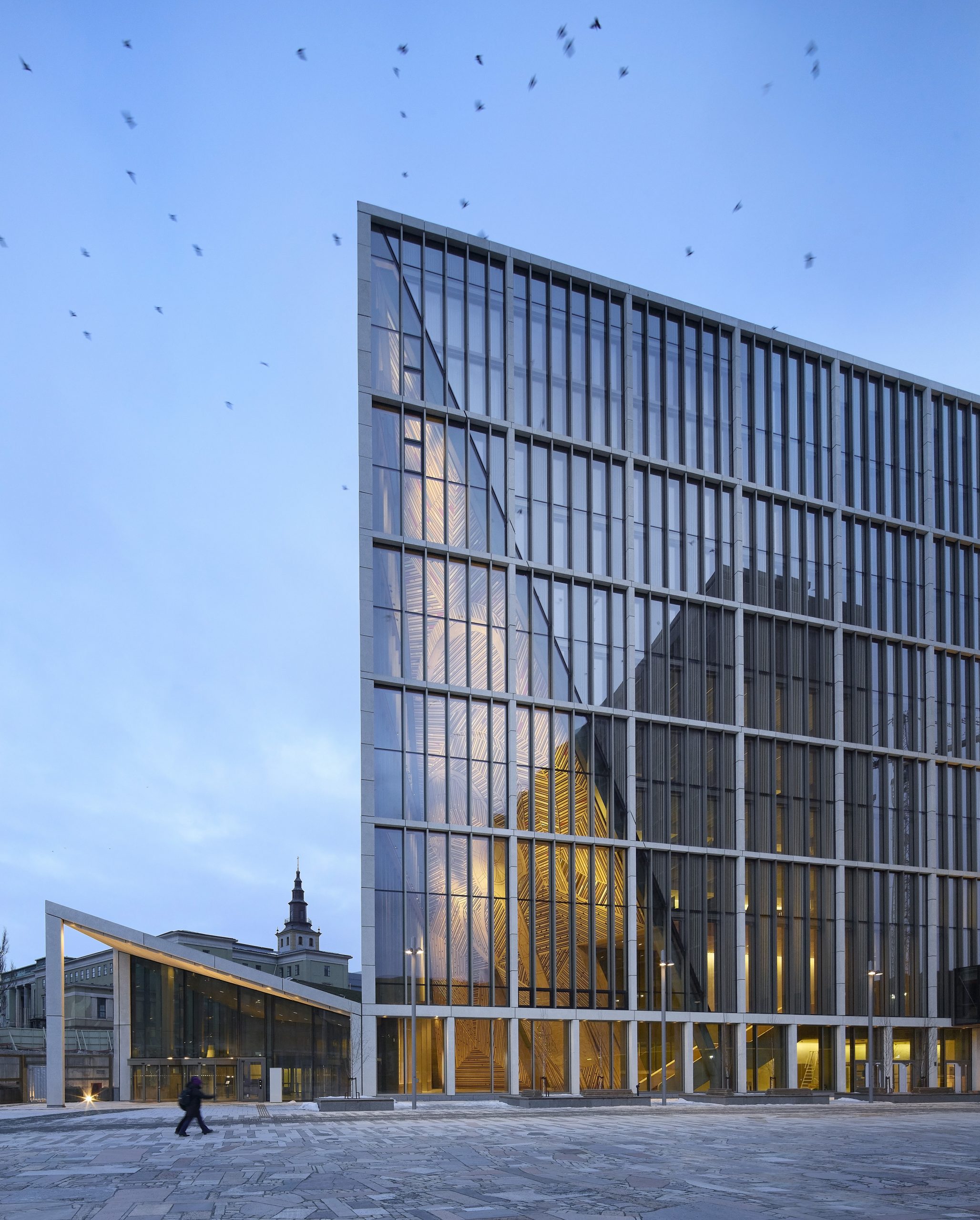
A Block Pyramid Hall onto Johan Nygaardsvolds plass
At the centre of the quarter is a newly created park: Regjeringsparken. Designed in collaboration with landscape architects SLA and Bjørbekk & Lindheim, it will form a ‘green heart’ and features open lawns, native planting and clear sightlines.
Larvikite, a silver-grey Norwegian stone, is used across the façades and public surfaces, taking inspiration from Norway’s iconic landscapes, local craft and sustainability. Timber from Nordmarka, a large, forested region in northern Oslo, has been used for workspaces and public interiors.
Key interiors feature double-curved wooden surfaces, such as the sculpted timber stair and balustrade elements. These were created by boatbuilder Risør Båtbyggeri in collaboration with Biko.
Norwegian designers from different eras are represented by the furniture choices, which include pieces by Torbjørn Afdal, Rastad & Relling, Sverre Fehn and Fredrik A Kayser, as well as more contemporary designers, such as Andreas Engesvik, Anderssen & Voll, Jonas Stokke Tron Meyer and Daniel Rybakken.
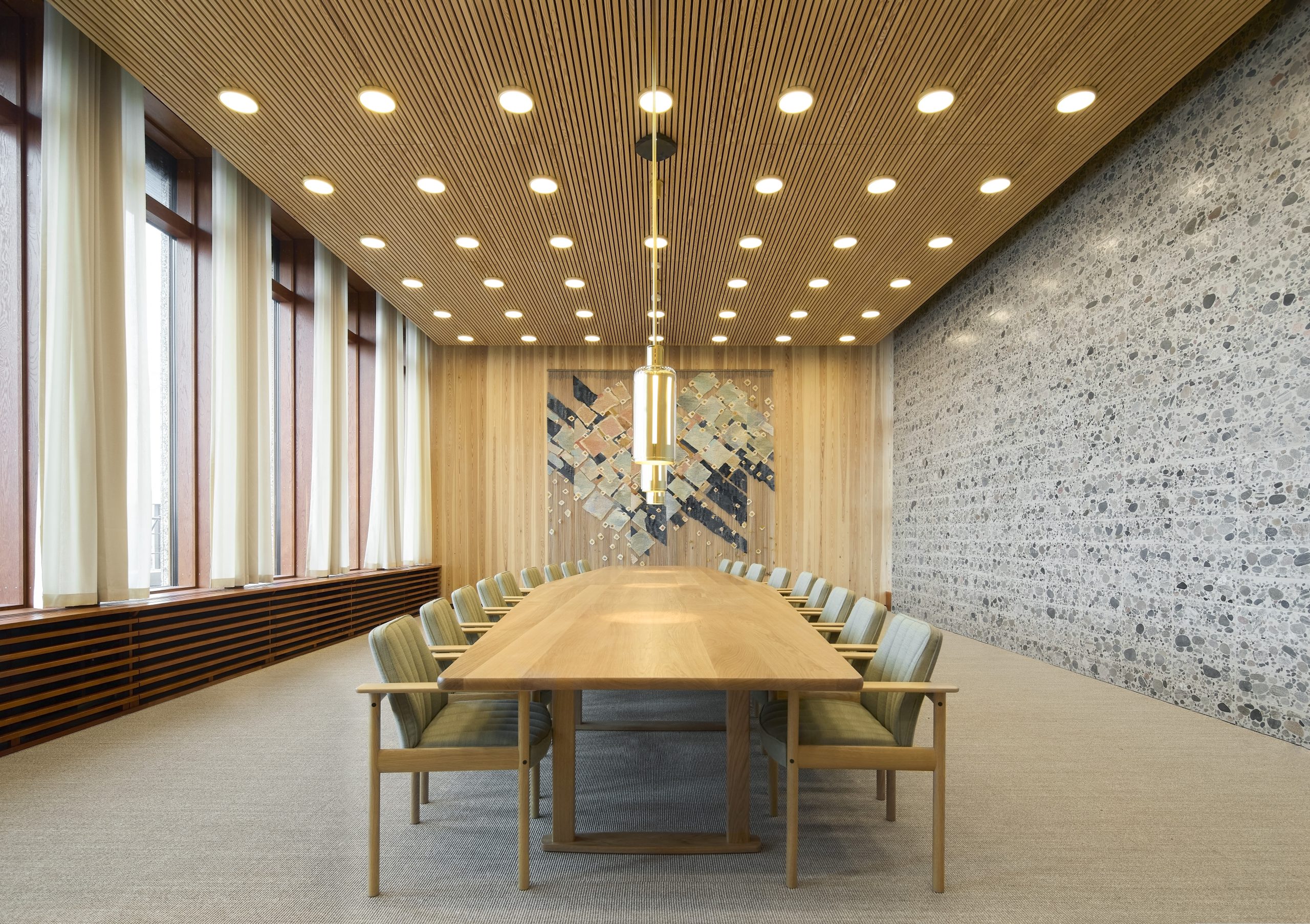
Hoyblokken meeting room for government officials
The scheme is designed to meet the BREEAM-NOR Excellent standard. It uses seawater for heating and cooling, while around 20 per cent of the 15,800 furniture items in phase 1 have been reused from previous government buildings.
The new quarter is also now Norway’s largest public art programme, curated and produced by KORO (Public Art Norway) and featuring up to 300 new and re-sited works across the buildings and accompanying open spaces. These include Picasso’s sandblasted concrete mural The Fisherman relocated from Y Block.
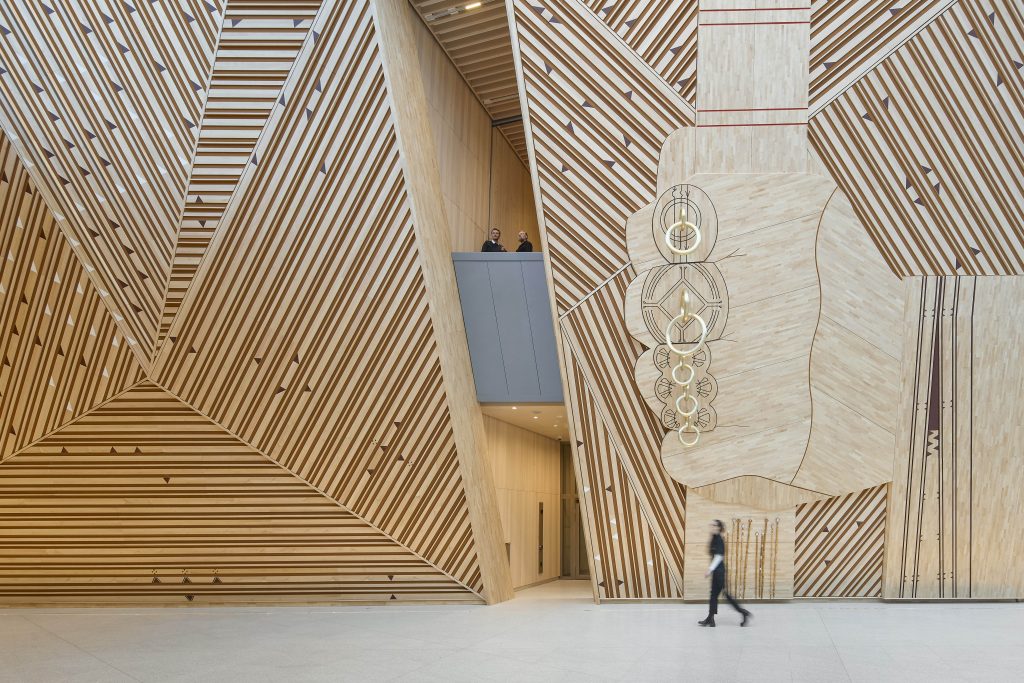
In A Block’s atrium (The Pyramid Hall) is a 51m-high Birch-lined piece by Outi Pieski, called AAhkA – meaning ‘Mother Earth’. Its timber patterns and large-scale address Sámi history, indigenous futurism and ecological awareness.
Phase 1 was delivered on time and more than NOK 2 billion (£160,000) below the parliamentary budget of NOK 24.7 billion (£1.9 billion).
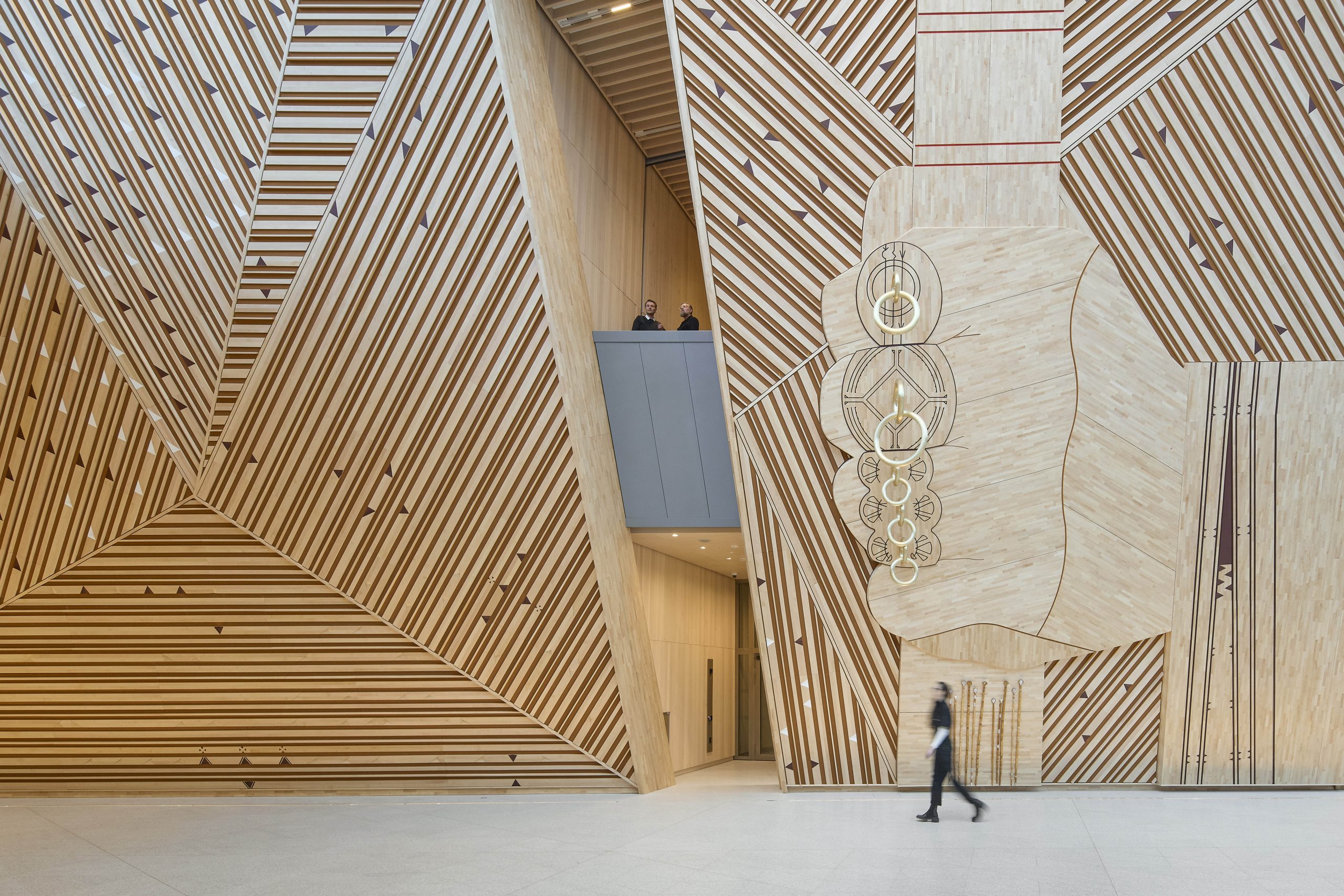
Outi Pieski’s artwork AAhkA in the Pyramid Hall
Lead architects’ views
From day one, the question was how to create a place that symbolises Norwegian democracy and identity. We were asked to design a secure government district, but also a place where people feel welcome to walk, sit, protest and remember – a government quarter that belongs to the whole of Norway.
Gudmund Stokke, founding partner and head of design, Nordic Office of Architecture
When designing the new government quarter, it was evident to us that restitching the city fabric would be just as important as the individual buildings. By reopening and creating new routes through the area, reducing underground traffic and bringing life back to the ground plane, people can once again use this area as part of their daily lives. The quarter is now part of Oslo’s everyday life rather than an isolated enclave.
Knut Hovland, partner and head of design, Nordic Office of Architecture
The quarter is a once‑in‑a‑generation commission that demonstrates how architecture, landscape, engineering and art can come together on one of the most sensitive sites in Norway. It transforms a closed government district into an open civic heart for Oslo and the country, where everyday government and everyday life converge. For Nordic, it is a defining project that brings out the very best of our practice – from long‑term collaboration with our partners to our commitment to designing environments that strengthen democracy and public trust.
Eskild Andersen, chief executive and partner, Nordic Office of Architecture
Nordic has always believed that sustainability is social as well as environmental. Here, long-life materials, local sourcing and low-carbon technologies sit alongside spaces that support wellbeing for staff and visitors, collaboration between ministries and everyday civic life.
Liv Aimée Halvorsen, senior architect, Nordic Office of Architecture
Architect’s view
Designing the New Government Quarter meant working with a site that carries deep national significance. The project is both a response to a defining moment in Norway’s recent history and a long-term investment in the future of its democracy. The challenge has been to create buildings that are secure and resilient while remaining open, generous, and connected to the everyday life of Oslo.
What makes the quarter remarkable is the scale of collaboration behind it. Over many years, architects, engineers, landscape designers and artists have worked closely with the client to shape a place where security, civic openness and urban life can coexist. It’s been a great joy to work with Nordic Office of Architecture on realising this important project.
Ultimately, the ambition has been to create a framework for government that will endure for generations – a quarter where the work of the state and the life of the city meet in a way that reflects the values of Norwegian society.
Tomas Stokke, co-founding director, Haptic Architects
Project data
Location Oslo, Norway
Completion date Phase 1 (Høyblokka, A Block, D Block, key public spaces): February 2026, Phase 2 (C Block, G Block): 2030, Phase 3 (B Block, E Block): TBC
Project budget NOK 24.7 billion (£1.9 billion)
Client Statsbygg
Owner Ministry of Digitalisation and Public Administration (DFD), Norway
Architects Nordic Office of Architecture, Haptic Architects, Scenario, I-d. Interiørarkitektur & Design
Lead architect Nordic Office of Architecture
Interior architect I-d Interiørarkitektur & Design
Landscape consultants Bjørbekk & Lindheim, SLA
Design consortium Team Urbis (Nordic Office of Architecture, COWI, Rambøll, Aas‑Jakobsen, Asplan Viak, Bjørbekk & Lindheim, SLA)
Planning and urban design Nordic Office of Architecture, Aas‑Jakobsen, Asplan Viak
Structural, services and security engineers COWI, Rambøll, Aas-Jakobsen, Asplan Viak
Heritage and specialist design NIKU, Scenario, Per Rasmussen
Public art KORO (Public Art Norway)