
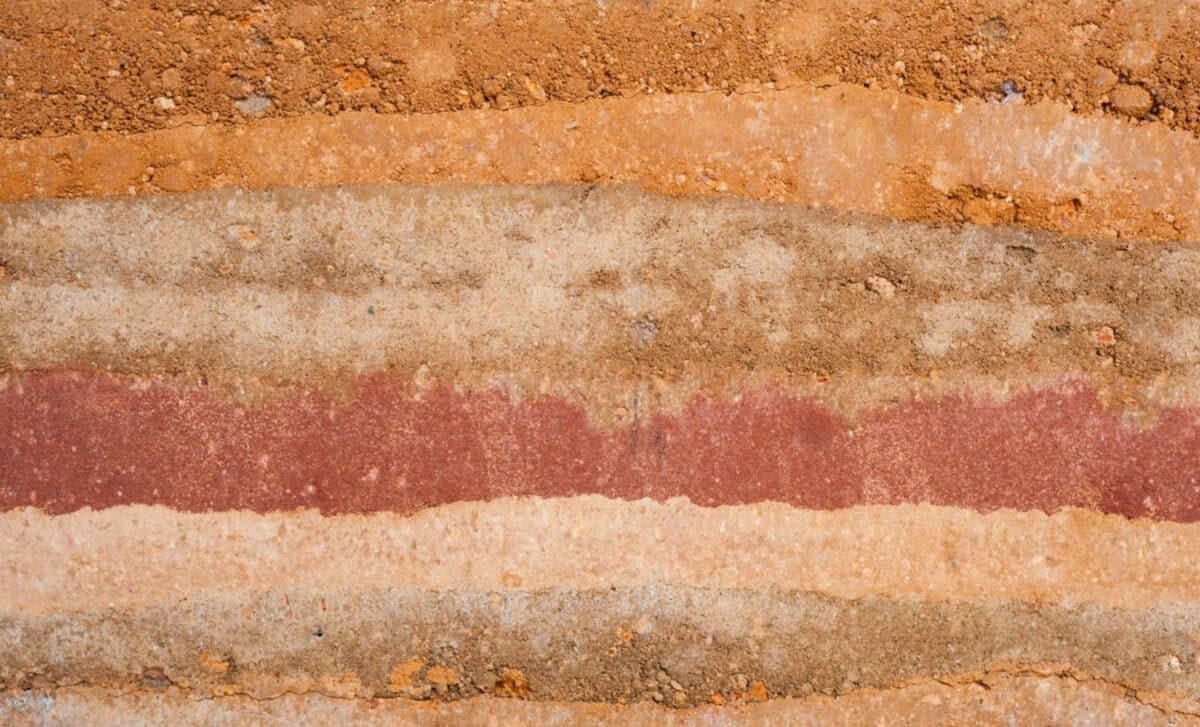
The Great Unconformity refers to a striking break in Earth’s rock record, where Cambrian rocks rest directly on much older Precambrian basement. In places such as the Grand Canyon, that missing interval spans more than 1 billion years, which is why the feature has remained a major puzzle for geologists for well over a century.
That puzzle matters because the unconformity has often been linked to other turning points in Earth history, including large-scale continental erosion, shifts in ocean chemistry, and the early diversification of animal life. The new paper, published in Proceedings of the National Academy of Sciences, does not erase those debates, but it does move the timing of the main erosional phase much deeper into the past.
Ancient Rocks in China Reshape the Timeline
According to the PNAS study, researchers examined Precambrian basement rocks from five sites in North China where the Great Unconformity is exposed. They combined field observations with several dating methods, including zircon and monazite U-Pb, biotite and muscovite Rb-Sr, and zircon (U-Th)/He thermochronology, to reconstruct the rocks’ cooling and exhumation history.
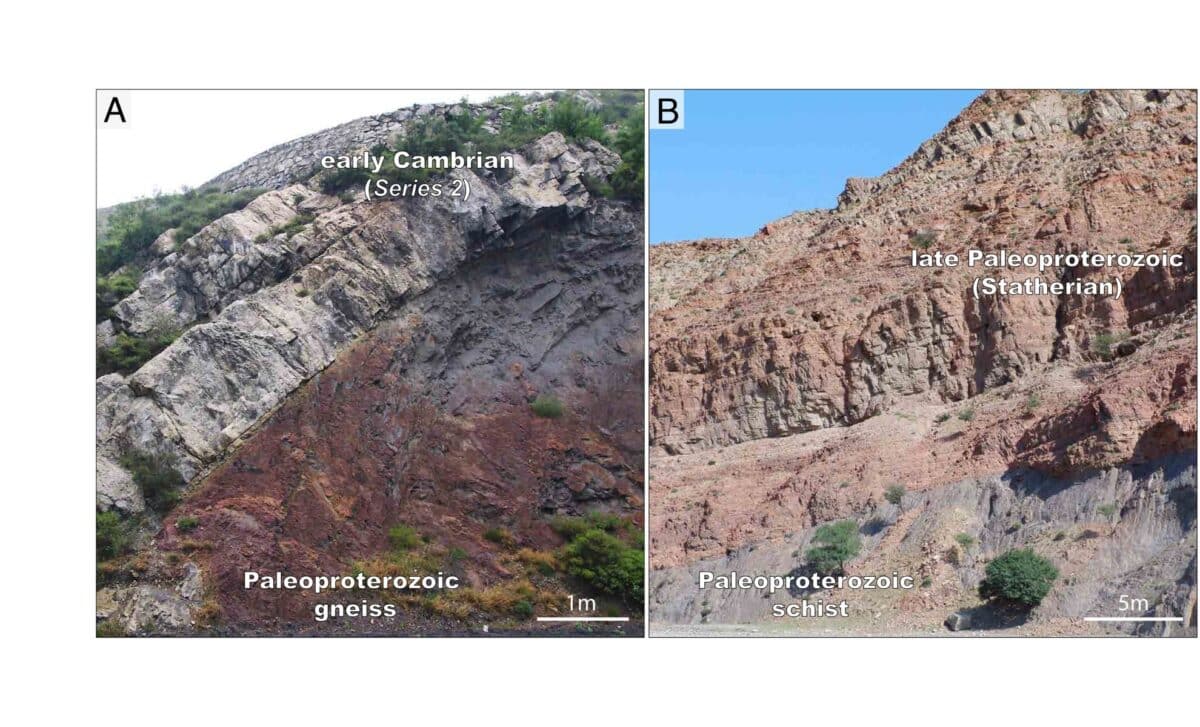 Great Unconformity in North China: 520-million-year-old sandstone resting atop ~2.18-billion-year-old basement rocks in Xiweikou and Inner Mongolia sections ©PNAS
The core result is a timing shift. The paper states that “the most substantial cooling of continental basement took place from ~2,100 to 1,600 Ma,” which places the strongest erosional pulse hundreds of millions of years before both Rodinia’s assembly and the Cryogenian glaciations usually grouped under the label “snowball Earth.”
At one North China site, early Cambrian sandstone about 520 million years old lies directly above granitic basement dated to about 2.182 billion years. According to Science, the thermal history inferred from the samples suggests the rocks rose from depths of roughly 12 kilometers, which the authors interpret as evidence of mountain building and erosion long before the later Neoproterozoic events often cited in earlier models.
The Case against a Glacial Main Cause
For years, one influential explanation held that glaciers during a global deep freeze around 700 million years ago carved away vast volumes of rock, helping to produce the Great Unconformity. Another model pointed to uplift and erosion linked to Rodinia. The new study does not say those processes played no role, but it argues they were secondary.
The authors write in PNAS that “protracted plate tectonics broadly modulated by supercontinent cycles, and not “snowball Earth” glaciation, is responsible for crustal exhumation below the unconformity.” That is the central claim of the paper, and it is a sharp one.
Not everyone is persuaded. According to Science, Dartmouth geologist Kalin McDannell said the team “don’t have enough data to actually resolve the Great Unconformity,” while also acknowledging that earlier erosion is plausible. The same report notes that the disagreement turns on how confidently the cooling history can be translated into uplift, exposure, and surface erosion. That distinction may sound technical, but it sits right at the heart of the debate.
A Result That Complicates an Old Story
The revised timing matters because the Great Unconformity has often been discussed alongside the Cambrian explosion, the rapid diversification of marine life beginning around 540 million years ago. If the strongest erosional phase happened between about 2.1 billion and 1.6 billion years ago, the neat sequence proposed in some earlier hypotheses becomes harder to maintain.
Science quotes Shanan Peters of the University of Wisconsin–Madison saying that, if the new work is correct, the Cambrian explosion may not have followed one major sediment pulse but instead smaller-scale coastal erosion “picking at the scab” of older rock. The image is vivid, maybe a little rough around the edges, yet it captures the shift well: not one dramatic scrape, but a longer and more uneven process.
The study also raises an awkward point for the so-called Boring Billion, the long interval from roughly 1.8 billion to 0.8 billion years ago that is often described as geologically subdued. Geophysicist Stephan Sobolev said, “If we believe these data, I didn’t expect there was so significant erosion during this Boring Billion.” That reaction, brief as it is, shows why the paper is drawing attention. It does not solve every part of the mystery, but it changes where many researchers may now look first.