
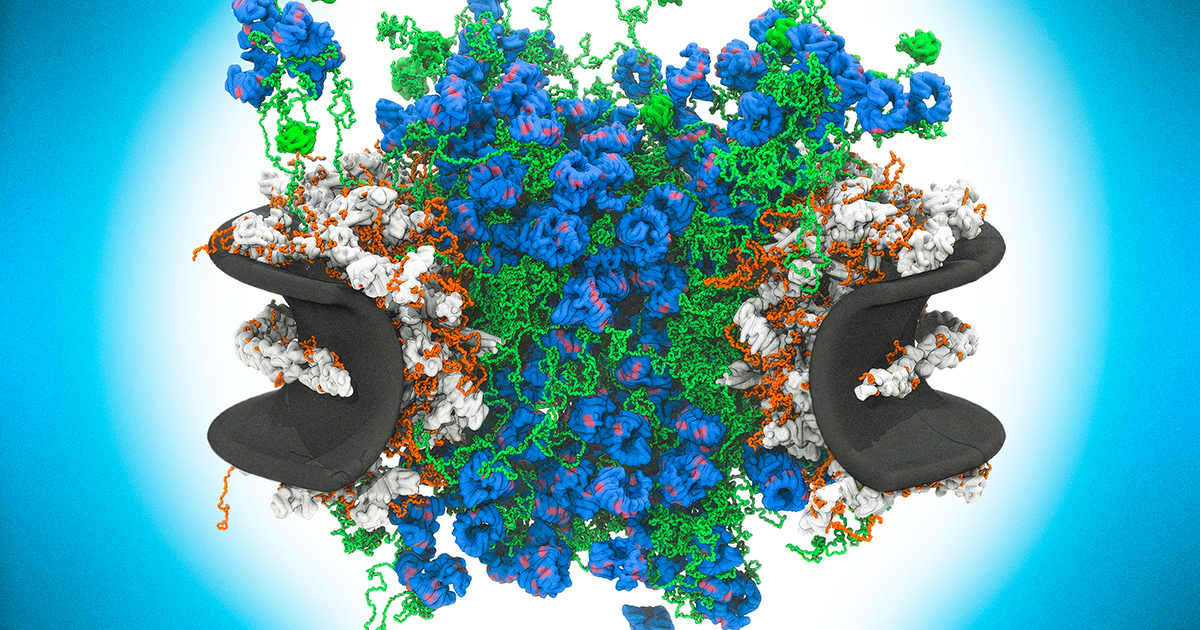
“If you know how to dance, you can simply enter the dance and swing from partner to partner, holding hands, just quickly exchanging going across,” he said. “If you don’t know how to dance, all you see is this turbulent melee, and you try to get in. No one’s taking hold of you to help you enter the dance, so you just get pushed away.”
To further test their observations, Rout and Lim created synthetic pores the same size as natural nuclear pore complexes. When they tethered nucleoporins inside and added transport factors, the synthetic pores behaved like the wild yeast nuclear pore complexes. They saw the central plug appear.
“What I find actually very striking is that they reproduce the result with a very simple model,” Musser said. “It’s a pretty stunning result.”
Door Not Closed
Hoelz is not totally convinced that this is a nail in the coffin for the gel model. The “answer is [probably] somewhere in the middle, which is very often the case in science,” he said. Researchers likely catch the central channel in different configurations because it’s changing all the time, he suggested, or perhaps the inner channels of some nuclear pores are more like a gel and others are more like a brush.
One recent modeling study led by Onck and published in Nature Communications suggested that the central transport channel could have some parts that are brushlike and others that are similar to condensates — membraneless, liquidlike compartments that have characteristics of gels and brushes. It could even be the case that the channel’s denser center has qualities more like a gel or condensate, Musser said, while the periphery is more brush-like.
Hoelz said that only new technologies that can fully see inside the pore will resolve the debate — and they could come any day now.
“People are constantly trying to develop new tools or new strategies to try to figure out what’s going on,” Musser agreed. In 2025, he and his team published results in Nature that used a powerful 3D imaging tool called Minflux to trace molecules in high resolution as they move through nuclear pore complexes in intact nuclei of human cells. Learning of this method was “a complete game changer for me,” said Hoelz, who was not involved.
Musser’s team observed molecules moving only near the edge of the transport channel. This also complements Rout and Lim’s study, given that the central plug might be blocking the center. “But it doesn’t make sense for the middle not to be used,” Musser said. “I think we just haven’t found the right substrate or developed the right tools to see stuff go through the middle.”
No matter what the inside looks like, it’s clear that the nuclear pore complex is incredibly malleable and robust — which also makes it the cell’s “Achilles’ heel,” Rout said. It is critical to a cell’s health, and central to its most important processes: protein production and gene regulation. But because it is resilient and can endure damage, it can be altered by disease without shutting down.
Some proteins that make up the nuclear pore “show up again and again and again as weak spots for disease,” Rout said, including neurodevelopmental disorders, viral diseases, and cancers. Both cancer cells and viruses likely interfere with proteins in the complex to swing the protein-making machinery in their favor or shut down an immune response.
In that sense, the nuclear pore complex is far more than a molecular gate. “It’s a nexus for integration of information,” Rout said. “And I think if the cell had thoughts, that would be how it thinks of its nuclear pores.”