
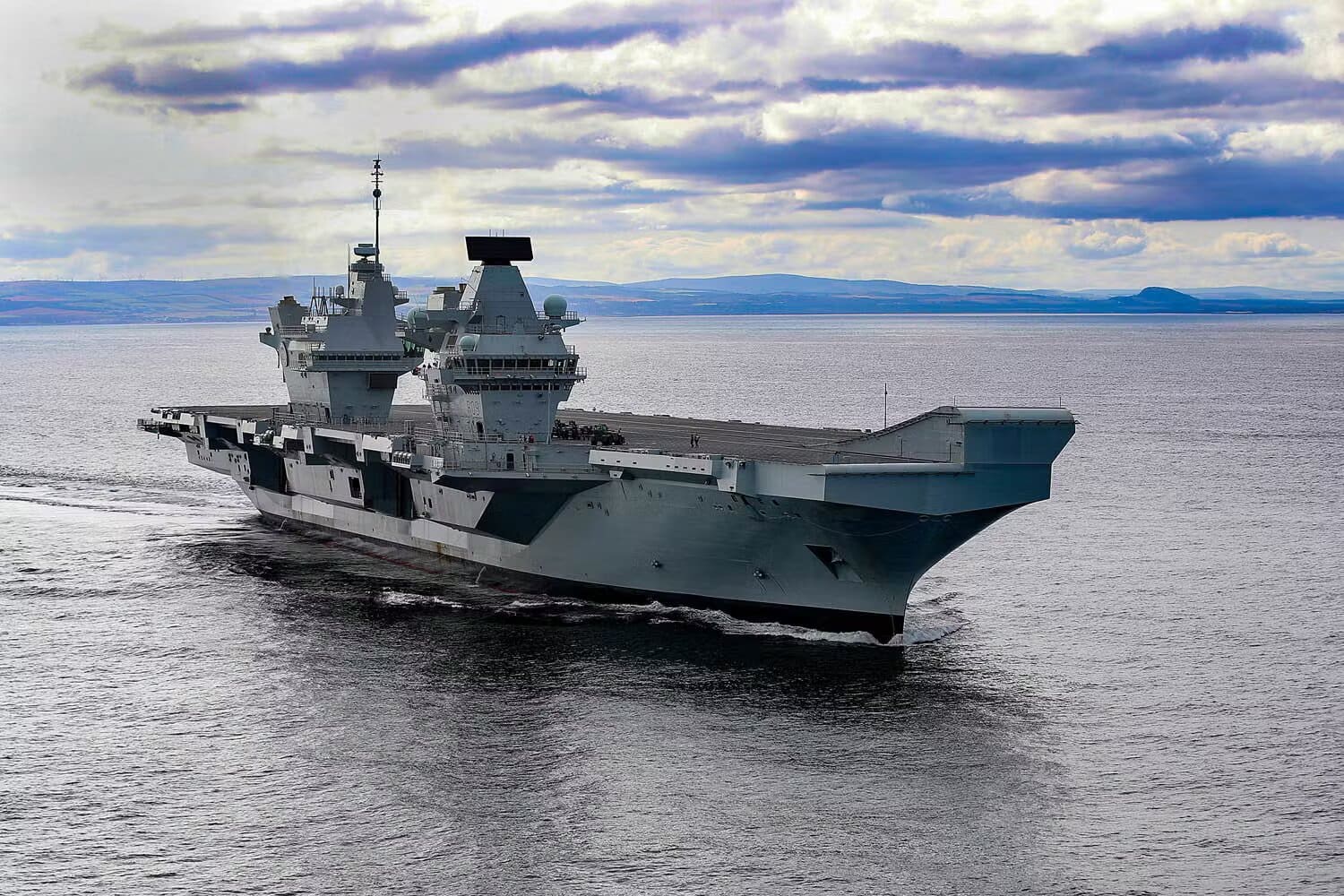
The UK Government has, for now, ruled out deploying the aircraft carrier HMS Prince of Wales to the Middle East, despite criticism coming from the United States in the context of the conflict involving Washington, Israel, and Iran. Although the ship has been placed at a higher level of readiness, British authorities indicated there is no formal decision to send it to the region.
In recent days, reports emerged suggesting that the 65,000-ton aircraft carrier—considered one of the Royal Navy’s flagship vessels—could be sent to the Eastern Mediterranean. The UK Ministry of Defence (MOD) confirmed that the notice-to-move timeline was reduced from 14 to 5 days, a measure that increases the ship’s readiness for a potential sail order, though it does not necessarily imply immediate employment in the conflict.
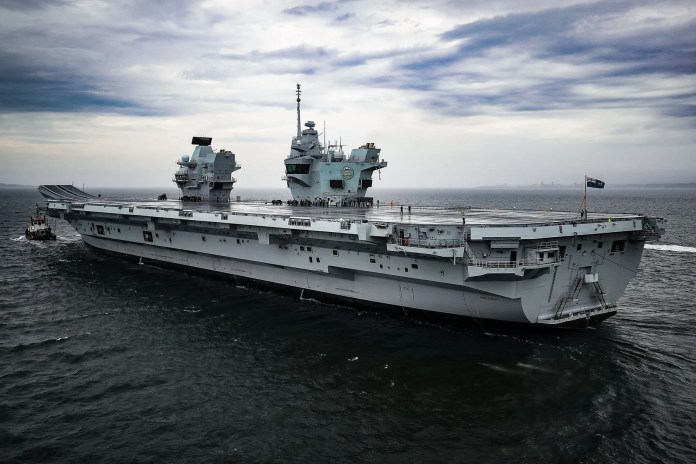 HMS Prince of Wales – Royal Navy
Downing Street played down claims of an imminent deployment. The Prime Minister’s official spokesperson explained that “HMS Prince of Wales has always been at a very high state of readiness” and added that “the Ministry of Defence is increasing the carrier’s readiness by reducing the time it would take to sail for any deployment, but there is no decision to send it.”
The ship was originally expected to lead a Carrier Strike Group in an operation known as Firecrest, focused on activities in the High North. However, the deterioration of the security situation in the Middle East has fueled speculation about a potential mission shift toward the Eastern Mediterranean or areas closer to the Persian Gulf.
Military experts note that deploying an aircraft carrier is not a decision that can be executed in isolation. Retired Vice Admiral Duncan Potts, a former Royal Navy officer, explained that these platforms must operate within a combat group made up of naval escorts, air assets, and logistical capabilities. According to him, the composition of the group depends on the threat environment in which it is expected to operate.
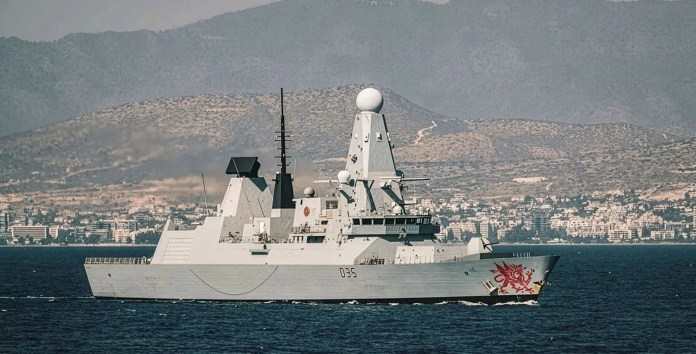 HMS Dragon – Royal Navy
Potts stated that, in a scenario like the Middle East—where the primary threat comes from the air—the carrier would need to operate under the air-defence cover of a Type 45 destroyer. “If we’re thinking about that part of the world, you’d want to operate under the air-defence umbrella of a Type 45 destroyer, like HMS Dragon,” the former officer said while outlining the conditions required for an operational deployment.
In that context, the Royal Navy ultimately confirmed the dispatch of the destroyer HMS Dragon to the Eastern Mediterranean, after several days of reports about delays in preparations. The Portsmouth-based ship will use its Sea Viper air-defence system to help protect British assets and interests in the region, supported by Wildcat helicopters from 815 Naval Air Squadron equipped with Martlet missiles designed to counter threats such as drones.
At the same time, the United Kingdom has reinforced its air presence in the region in recent months. In early February, the Royal Air Force (RAF) deployed stealth F-35B fighters to RAF Akrotiri in Cyprus, a key installation for British operations in the Eastern Mediterranean. These fifth-generation aircraft are intended to ensure rapid-response capabilities in a regional environment marked by rising tensions.
The military reinforcement also included sending more Eurofighter Typhoon fighters to Qatar. The UK Ministry of Defence confirmed the deployment of four additional aircraft to support British defensive operations in the Persian Gulf, adding to the joint Typhoon squadron maintained with Qatar to strengthen regional security and protect British citizens and interests.
These British decisions come amid criticism from U.S. President Donald Trump, who questioned London’s reluctance to take a more direct role in the conflict. Trump stated that “we don’t need them anymore” and added that “we don’t need people joining wars after we’ve already won,” remarks reflecting the political tensions generated by the level of British military involvement.
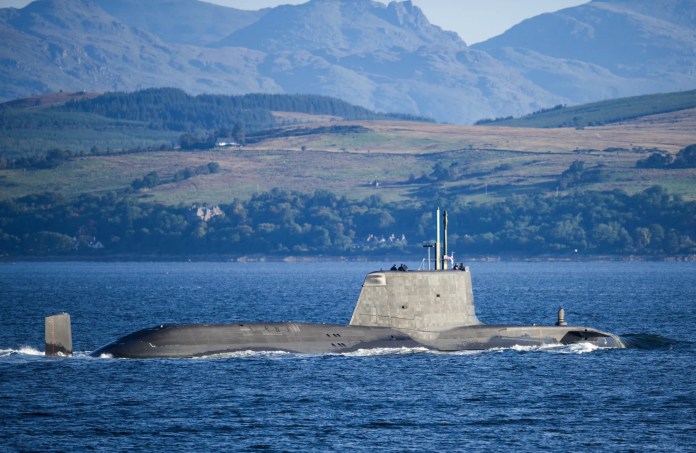 Astute-class submarine – RN – UK
It should be taken into account that sending an aircraft carrier is not simply a matter of deploying an isolated ship—it entails deploying an entire Carrier Strike Group, as mentioned above. And within that strike group, surface ships such as Type 45 destroyers must be considered, but also submarine forces. Under that premise, the United Kingdom is not currently able to assemble a strike group at short notice.
This situation is due to the severe limitations affecting its nuclear submarine fleet. The Astute-class submarines are in various states of maintenance or low availability. HMS Astute is waiting for HMS Audacious to complete its maintenance period so it can enter a mid-life refit, while HMS Ambush is at a very low readiness level. Meanwhile, HMS Agamemnon, commissioned in September, is not yet operational. Finally, HMS Anson has been deployed to Australia to strengthen the UK’s commitment to the AUKUS program. As a result, they have no submarine ready to deploy.
This is the UK’s major problem. Despite having two aircraft carriers—HMS Prince of Wales and HMS Queen Elizabeth, which was modernized in mid-last year—it lacks the operational capacity to send them to the Middle East. And refusing to do so could cool relations with the United States.
Images used for illustrative purposes.
You may also like: After delays and difficulties, the British destroyer HMS Dragon sailed from Portsmouth toward the Eastern Mediterranean